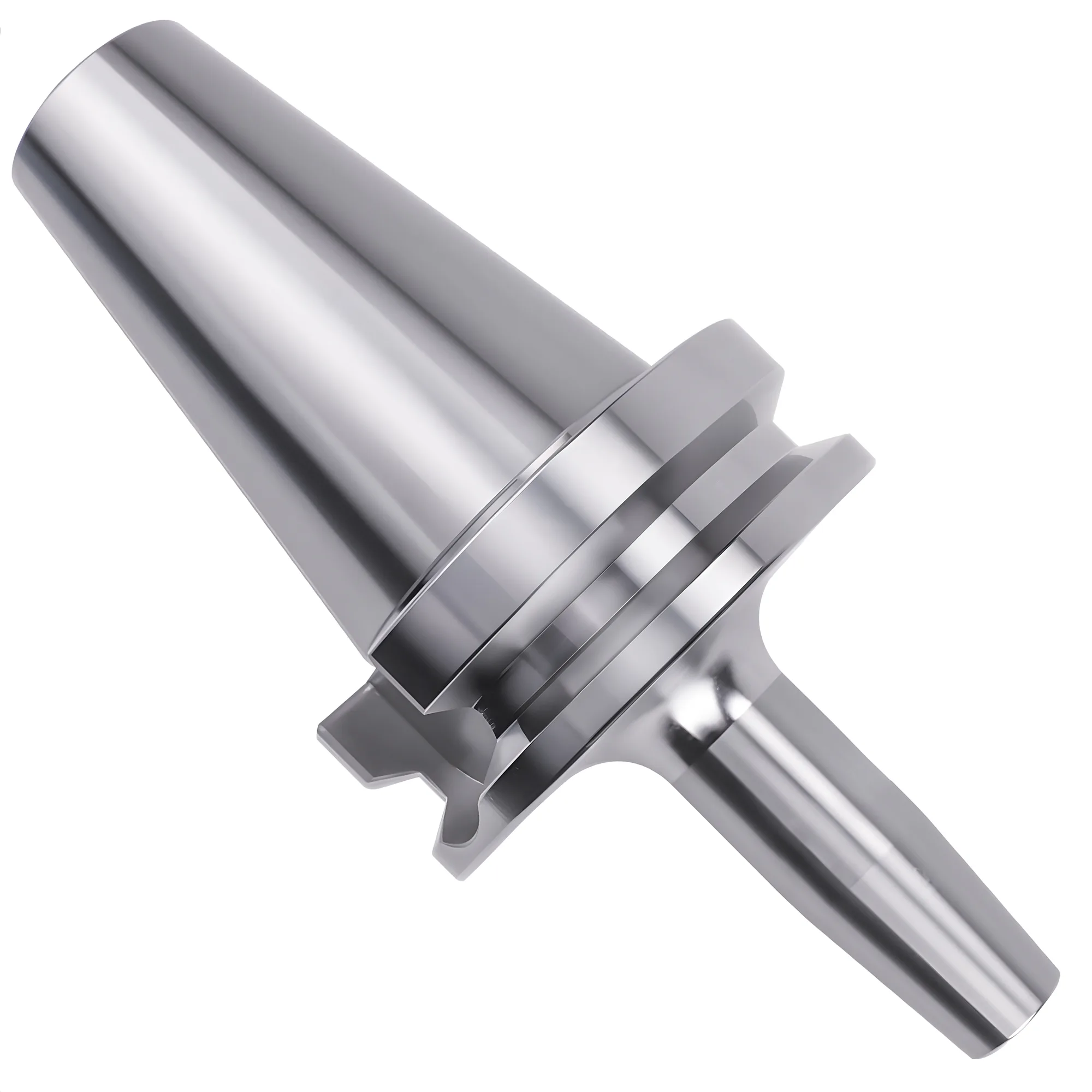
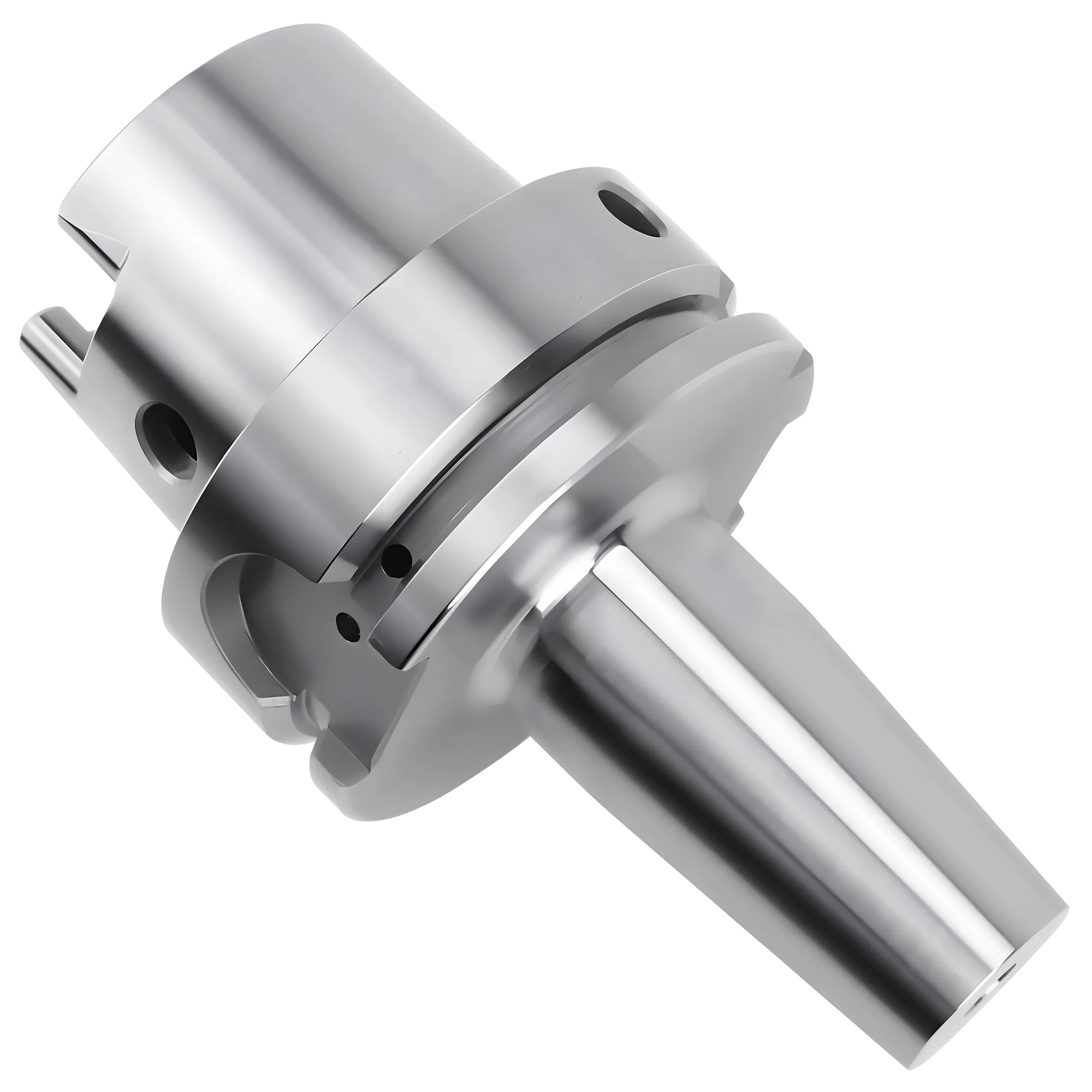
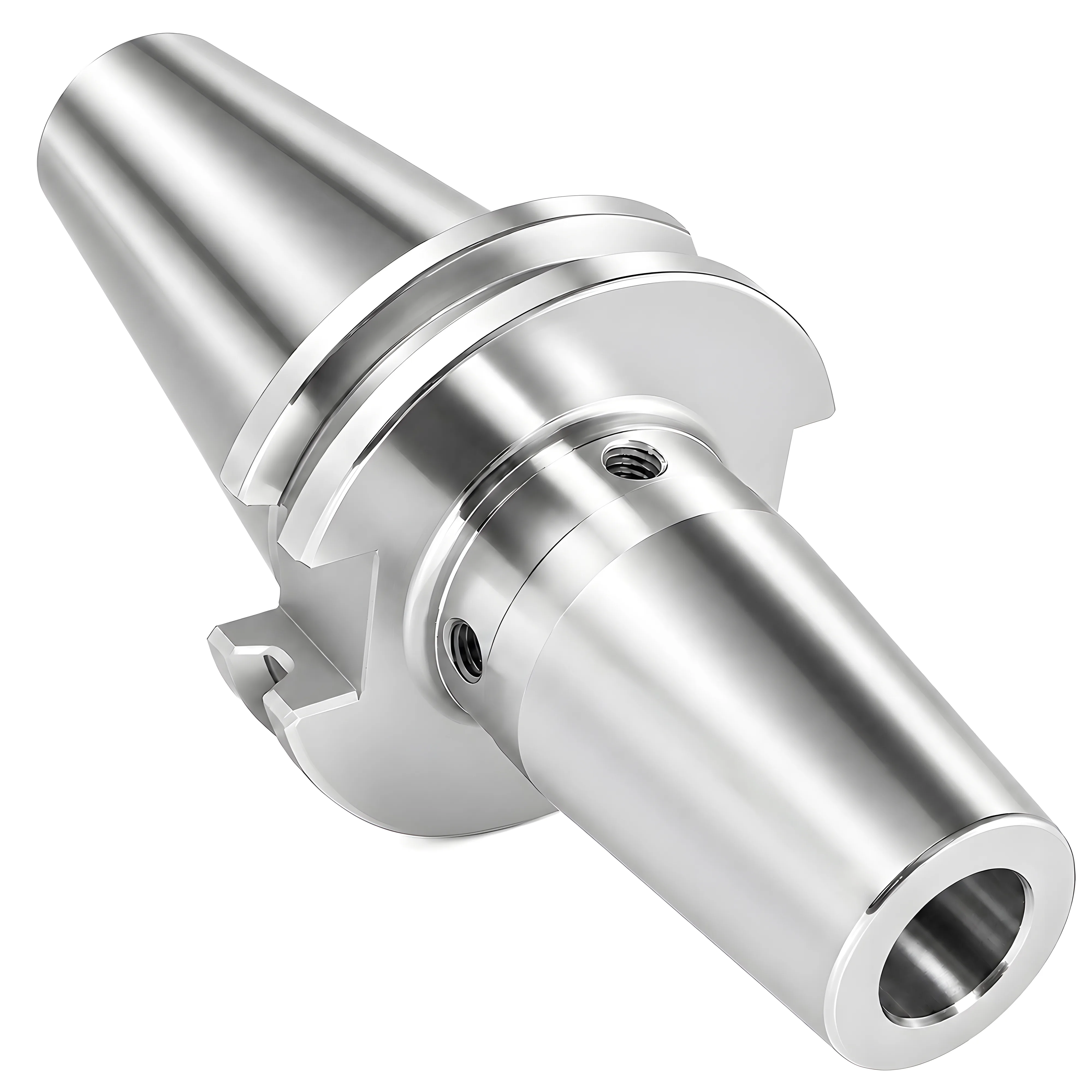
Choose shrink fit when you need the slimmest nose, the most grip (typically 25,000–40,000 N) and long, unattended runs; choose a hydraulic chuck (typically 10,000–20,000 N) when you need oil-chamber damping, sub-30-second tool changes with one hex key, and no $5,000–15,000 induction heater. Both start at ≤0.003 mm TIR at 3×D, so runout new is a tie: the decision comes down to reach, grip, change time and capital.
This is a head-to-head between the two precision holders only. For how either one compares with an ER collet chuck, see Collet Chuck vs Hydraulic Chuck; for which holder survives crashes and rough handling, see Tool Holder Durability vs Runout.
How Do Shrink-Fit and Hydraulic Chucks Grip?
A shrink-fit holder grips by interference: a mid-size bore (around 20 mm) is typically machined about 8–15 µm smaller than the shank, so it has to be heated to roughly 200–300°C before a carbide shank will slide in, and it clamps as it cools. A hydraulic chuck grips by pressure: turning one actuation screw drives a piston into a sealed oil chamber, and the thin-wall expansion sleeve closes roughly 0.02–0.05 mm around the shank. Both bores accept plain cylindrical shanks ground to h6.
The mechanism difference drives every trade-off below. Shrink fit is one piece of steel with no moving parts, so its stiffness, grip and balance are set when the holder is machined. A hydraulic chuck carries an oil chamber, seals and a sleeve, which costs some grip and nose slimness but buys vibration damping and a tool change that needs nothing more than a hex key.
Runout New and After Thousands of Tool Changes
Shrink-fit and hydraulic chucks both typically start at ≤0.003 mm TIR at 3×D, so the real runout difference shows up after thousands of tool changes, not on day one. The two holders age in different ways.
A shrink-fit bore returns to the same machined center on every cycle because nothing moves except steel expanding and contracting. Its weak point is heat: used correctly, a bore typically lasts several thousand heat cycles (Kennametal rates bores of 6 mm and up for as many as 5,000 heat/shrink cycles), but one overheat above about 350°C can temper the bore and open it permanently. Runout then creeps, and a common retirement trigger is TIR above 0.010 mm.
A hydraulic chuck's runout also stays stable in clean use, but it depends on a sealed circuit. A worn seal bleeds pressure, a chip trapped under the shank lifts it off center, and pressurizing an empty chuck can overstress the sleeve. On a hydraulic chuck, runout above roughly 0.010 mm usually signals a fault — a contaminated bore, a bled seal or a damaged sleeve — rather than gradual wear. The fault isolation sequence is covered in the hydraulic chuck troubleshooting guide listed under related articles.
| Runout factor | Shrink fit | Hydraulic chuck |
|---|---|---|
| New runout at 3×D | ≤0.003 mm | ≤0.003 mm |
| What ages it | Bore tempering and growth from heat cycles | Seal wear, sleeve damage, bore scoring |
| Typical life before service | Several thousand heat cycles (Kennametal: up to ~5,000) | Seal service every ~10,000 cycles |
| Single event that ends it | One overheat above ~350°C | Crash that dents the sleeve; empty-bore pressurizing |
| Retire or service trigger | TIR above ~0.010 mm or bore grown 5–10 µm | TIR above ~0.010 mm or pressure loss |
Slim Nose and Interference Contour
Shrink fit typically wins on reach because its 4.5°-per-side nose taper lets the holder follow the tool into a pocket, while a standard hydraulic chuck needs a thicker body to wrap the oil chamber around the bore. That geometry decides whether a 5-axis tool path clears a fixture wall or forces a longer tool.
The nose diameter of a tapered holder grows with distance from its tip:
D(x) ≈ D₀ + 2 × x × tan(4.5°) ≈ D₀ + 0.157 × x
Where D₀ is the nose diameter at the tip and x is the distance back from it in mm. Distance from the tip dominates: every 10 mm the holder reaches deeper adds only about 1.6 mm of diameter, so a shrink-fit nose can sit 30 mm inside a pocket while growing under 5 mm in diameter. Several hydraulic makers now sell slim hydraulic chucks that copy the 4.5° contour, but the oil chamber has to fit inside that envelope, so grip and damping on slim versions are typically lower than on the standard body (manufacturer-dependent).
A shorter tool stickout reduces deflection by the cube of the length ratio, so reach is a stiffness lever, not just a clearance issue. For a cantilevered tool, deflection follows δ = F × L³ / (3 × E × I). If a slim shrink-fit nose lets you cut the stickout from 4×D to 3×D, deflection falls to (3/4)³ ≈ 0.42 of its previous value, roughly 58% less, at the same cutting force. For a given tool diameter, overhang length dominates this formula because it is cubed; tool diameter enters through I, which scales with diameter to the fourth power, and the holder type only changes how short L can be. The vibration side of the same problem is covered in Chatter Diagnosis and Fix.
Damping vs Stiffness
Hydraulic chucks damp vibration through their oil chamber, which can improve surface finish by roughly 0.2–0.4 µm Ra in long-reach finishing (4×D or more) where chatter is present. The gain shrinks toward zero on short, rigid cuts where there is no chatter to absorb.
Shrink fit takes the opposite route: a monolithic steel body with 360° metal-to-metal contact gives the stiffer connection but adds little damping of its own. In practice the two strategies meet in the middle. A slim shrink-fit holder that shortens stickout often removes the chatter that a hydraulic chuck would otherwise have to absorb, while a hydraulic chuck rescues a setup where reach cannot be shortened.
- Thin-wall or long-reach finishing with chatter already present: hydraulic damping is the typical first choice.
- Deep pockets where the holder can follow the tool: shrink fit, because a 25% shorter stickout cuts deflection by about 58%.
- Interrupted or entry-heavy cuts on rigid parts: either holder; stiffness and grip matter more than damping.
Small Shanks and Micro Tools: Grip and Push-In
Small shanks are where shrink fit gets touchy: a 3 mm bore heated by 250°C grows only about 9 µm, roughly 6.7× less than a 20 mm bore at the same temperature. Using ΔD ≈ α × D × ΔT with α ≈ 12 × 10⁻⁶ /°C for hardened tool steel, a 3 mm bore gives 12 × 10⁻⁶ × 3 × 250 ≈ 0.009 mm, while a 20 mm bore gives about 0.060 mm. Bore diameter dominates the absolute clearance, so on micro tools the insertion window is narrow and the small holder typically sheds heat within seconds; set the depth stop before heating and push the tool home in one motion. Makers scale the interference down on small bores to keep it inside that clearance, so the working margin on a 3 mm holder is typically only a few microns.
Shank tolerance matters more at this size. ISO 286-2 sets the h6 band at 6 µm for shanks over 1 up to 3 mm and 8 µm for shanks over 3 up to 6 mm, versus 13 µm for shanks over 18 up to 30 mm. ISO 286-2 is the reference for h6 shanks because both holder types size their bores around that tolerance, and on a 3 mm shrink-fit bore the h6 band is a large share of the roughly 9 µm thermal clearance. Carbide shanks, with thermal expansion of roughly 5–6 × 10⁻⁶ /°C, barely grow while the steel bore expands, which is why carbide is the standard shrink-fit shank material. HSS shanks are a different case: HSS is tempered far above shrink temperatures, so hardness is not the limit, but it expands almost as much as the holder steel, so any heat that soaks into the shank keeps it gripped at release. That is why several machine makers list HSS shanks only from Ø6 mm and rely on fast, localized heating.
Hydraulic chucks handle small shanks differently. Many standard ranges start at a 6 mm direct bore and reach 3 mm or below through slotted reduction sleeves, which adds a second interface and typically some runout and grip loss. The shank also has to cover the full clamping zone before the screw is turned; a micro tool with a short shank may not reach it. Length setting is easier, though: a hydraulic chuck can be preset cold on a presetter and adjusted with its rear stop screw, while shrink fit fixes length at the moment of insertion.
Clamping Force, Torque and Pull-Out
Shrink-fit holders typically clamp at 25,000–40,000 N against 10,000–20,000 N for hydraulic chucks, so shrink fit carries roughly 1.3–4× more friction torque before slip at the same friction coefficient. Transmitted torque is proportional to clamping force × friction coefficient × shank radius, so with the same shank and surface condition, the force ratio sets the torque ratio: 25,000/20,000 ≈ 1.3 at the overlap of the two ranges and 40,000/10,000 = 4 at the extremes.
Hydraulic chucks give up more than clamping force under heavy load. Their smooth sleeve bore and the oil behind it can allow micro-slip under extreme lateral loads, which is why hydraulic chucks are generally rated for finishing and semi-finishing rather than full-width slotting. High-helix end mills in heavy roughing pull axially on the shank, and a friction-only grip on either holder can let the tool creep out of the bore, scrapping the part. Several makers offer positive anti-pull-out systems for both holder types, using a profiled shank that engages drive elements in the bore; consider them for roughing high-helix tools in titanium or stainless steel.
For the heaviest roughing beyond either holder's comfort zone, shops typically move to a power milling chuck or a Weldon side-lock rather than pushing a precision holder to its grip limit.
Tool-Change Time and the Cost of a Shrink-Fit Machine
A hydraulic tool change typically takes under 30 seconds with one hex key, while a shrink-fit change takes roughly 2–5 minutes including heat, insertion and forced-air cooling, or about 1 minute with water-cooled contact cooling. Heating itself is short, typically 3–8 seconds with a matched coil; cooling is the slow stage, at roughly 1.5–5 minutes with forced air versus roughly 20–30 seconds with a water-cooled contact cooler.
The bigger difference is capital. Shrink-fit holders typically cost $200–500 each against $300–600 for a hydraulic chuck, but the shrink-fit fleet needs an induction machine, typically $5,000–15,000. The break-even holder count is:
N ≈ C_machine / (P_hydraulic − P_shrink)
Where C_machine is the induction machine cost and P is the price per holder. The price gap per holder dominates: with a $10,000 machine and a $100 gap, N ≈ 100 holders; with a $5,000 machine and a $200 gap, N ≈ 25 holders. A shop running fewer than roughly 25 precision holders usually spends less with hydraulic chucks, and above roughly 100 holders the shrink-fit machine typically pays for itself on holder price alone — before counting the heater as a single point of failure for every shrink-fit change in the shop.
Small shops often ask whether a torch or a general-purpose handheld induction heater can replace a shrink-fit machine. A torch can release a tool, but it heats from the outside in, cannot hold the 200–300°C window, and can push the nose past the ~350°C point where holder steel begins to lose hardness. Flame heating creates uneven expansion that can distort the bore and shift runout. A handheld induction heater sold for automotive work avoids the flame, but without a holder-matched coil, a depth stop and temperature control it shares the overheating and repeatability risk. For an occasional change on one or two holders it may work; for a fleet, a holder-rated machine with power cut-off is what protects the ≤0.003 mm runout you paid for.
Common Mistake
Buying a shrink-fit fleet for a high-mix shop that changes tools dozens of times per shift. At roughly 2–5 minutes per change with forced-air cooling, or about 1 minute even with water-cooled contact cooling, and one shared heater, tool changes queue at the machine. In that shop a hydraulic chuck's sub-30-second change and zero auxiliary equipment usually matter more than shrink fit's extra grip.
Head-to-Head: Shrink Fit vs Hydraulic Chuck
Shrink fit typically wins on grip, reach and balance at speed, while hydraulic typically wins on damping, tool-change time and entry cost; runout new is a tie at ≤0.003 mm.
| Factor | Shrink fit | Hydraulic chuck |
|---|---|---|
| Runout new (3×D) | ≤0.003 mm | ≤0.003 mm |
| Clamping force | 25,000–40,000 N | 10,000–20,000 N |
| Nose contour | 4.5° per side typical | Larger body; slim 4.5° variants exist |
| Damping | No oil chamber; relies on shorter stickout (~58% less deflection at 3×D vs 4×D) | Roughly 0.2–0.4 µm Ra gain in chatter-prone long reach |
| Tool change | ~2–5 min with forced-air cooling; ~1 min with water contact cooling | Under ~30 s with a hex key |
| Holder price | ~$200–500 | ~$300–600 |
| Extra equipment | Induction machine ~$5,000–15,000 | None |
| Smallest direct bore | Commonly 3 mm | Commonly 6 mm; smaller via reduction sleeves |
Spindle interface does not change this comparison. Both holder types are sold on BT and CAT steep tapers and on HSK. JIS B6339 defines the BT taper geometry, so a BT40 shrink-fit holder and a BT40 hydraulic chuck seat in the same spindle and the choice between them is independent of the machine's taper. HSK-A shanks, whose geometry DIN 69893 defines, are commonly preferred for either holder above roughly 20,000 rpm because face-and-taper contact holds the holder axially as the spindle bore expands — a practice drawn from manufacturer data, since the standard sets no speed limit. Taper selection itself is covered in BT vs CAT vs HSK.
Balance is close to a tie as well. ISO 1940-1 provides the G-grade framework both families are balanced to, and manufacturers commonly rate both shrink-fit and hydraulic chucks at G2.5 at 25,000 rpm — a manufacturer rating, not a requirement of the standard. Balance the assembled tool and holder, not the holder alone, for work above roughly 15,000 rpm.
✦ Shrink Fit Best For
- Deep pockets, mold cavities and 5-axis paths where the 4.5° nose clears fixtures
- High-speed finishing in aluminum and graphite above 20,000 rpm
- Semi-roughing with solid carbide where 25,000–40,000 N grip resists slip
- Long production runs where tools change once per shift
✦ Hydraulic Chuck Best For
- Long-reach finishing with chatter, where oil damping adds roughly 0.2–0.4 µm Ra
- High-mix cells that change tools in under 30 seconds with a hex key
- Reamers and small finishing tools preset cold on a presetter
- Shops with fewer than roughly 25 precision holders and no induction machine
Quick Selection Table
For most jobs, the deciding question is whether the holder can follow the tool into the part (shrink fit) or whether chatter and change frequency dominate (hydraulic).
| Scenario | Recommended Holder | Key Spec | Change Time | Why |
|---|---|---|---|---|
| 6 mm ball mill, 40 mm deep mold cavity | Shrink fit | 4.5° nose, ≤0.003 mm TIR | ~1–5 min | Slim nose follows the tool, so stickout and deflection drop |
| 12 mm finisher, 5×D reach, thin wall | Hydraulic chuck | Oil-chamber damping | <30 s | Damping absorbs chatter where the stickout cannot be shortened |
| 10 mm high-helix semi-roughing in 4140 | Shrink fit | 25,000–40,000 N grip | ~1–5 min | 1.3–4× the friction torque of a hydraulic chuck before slip |
| Aluminum HSM at 20,000–25,000 rpm on HSK-A63 | Shrink fit | G2.5 at 25,000 rpm | ~1–5 min | Monolithic, symmetric body holds balance and grip at speed |
| Reaming 8 mm H7 bores, batch of 20 parts | Hydraulic chuck | ≤0.003 mm TIR, cold presetting | <30 s | Runout control plus quick length setting on the presetter |
| High-mix job shop, under 25 precision holders | Hydraulic chuck | No auxiliary equipment | <30 s | Avoids a $5,000–15,000 machine that fewer than 25 holders typically cannot pay back |
| 3 mm micro end mill, tight reach | Shrink fit (3 mm bore) | 3 mm direct bore | ~1–5 min | No reduction sleeve between tool and holder, so one interface sets runout |
Buy shrink fit for reach, grip and speed; buy hydraulic for damping, quick changes and a low entry cost.
Shrink-fit and hydraulic chucks both start at ≤0.003 mm TIR at 3×D, so the choice is about everything else. Shrink fit clamps at typically 25,000–40,000 N, reaches deeper with a 4.5° nose and holds balance at high speed, but it needs a $5,000–15,000 induction machine and roughly 1–5 minutes per change, depending on how the holder is cooled. Hydraulic chucks clamp at 10,000–20,000 N, damp chatter in long-reach finishing, and change in under 30 seconds with a hex key. Below roughly 25 precision holders, hydraulic usually costs less; above roughly 100, shrink fit usually pays back its machine.
Is shrink fit better than a hydraulic chuck?
Shrink fit is better for grip and reach, with typically 25,000–40,000 N clamping force versus 10,000–20,000 N and a slim 4.5° nose. Hydraulic chucks are better for damping chatter and fast changes under 30 seconds without a heater. Both start at ≤0.003 mm TIR at 3×D, so runout alone does not decide it.
Can I use a torch instead of a shrink-fit machine?
A torch can release a tool, but it heats unevenly from the outside and cannot hold the typical 200–300°C window. Above roughly 350°C the holder steel begins to lose hardness and the bore can open permanently, raising runout. For more than one or two holders, a temperature-controlled induction machine typically costs less than scrapped holders.
How many holders justify buying a shrink-fit machine?
Divide the machine cost by the price gap per holder between hydraulic and shrink-fit chucks. With a $10,000 machine and a $100 gap the break-even is about 100 holders; with a $5,000 machine and a $200 gap it is about 25. Below roughly 25 precision holders, hydraulic chucks usually cost less overall.
Do hydraulic chucks lose runout over time?
Not gradually in clean use; a hydraulic chuck typically holds ≤0.003 mm TIR until something goes wrong. Runout above roughly 0.010 mm usually points to a fault such as a trapped chip, a bled seal or a dented sleeve. Seal service is typically needed around a 10,000-cycle interval, with no collets or consumables in between.
Which holder is better for 3 mm micro tools?
Shrink fit is usually better, because many shrink-fit ranges offer a direct 3 mm bore while hydraulic chucks often start at 6 mm and need reduction sleeves. The catch is heat: a 3 mm bore grows only about 9 µm at a 250°C rise, so set the depth stop first and insert the tool in one quick motion.
Sources
- ISO 1940-1:2003 — Mechanical vibration: Balance quality requirements for rotors in a constant (rigid) state
- ISO 286-2 — Tables of standard tolerance classes and limit deviations for holes and shafts
- BIG DAISHOWA — Shrink-fit chucks
- SCHUNK — TENDO hydraulic expansion toolholders
- Kennametal — Technical Information: Shrink Fit (heat-cycle life, HSS and carbide shanks)
- Machinery's Handbook, 31st Edition — Beam deflection and thermal expansion formulas