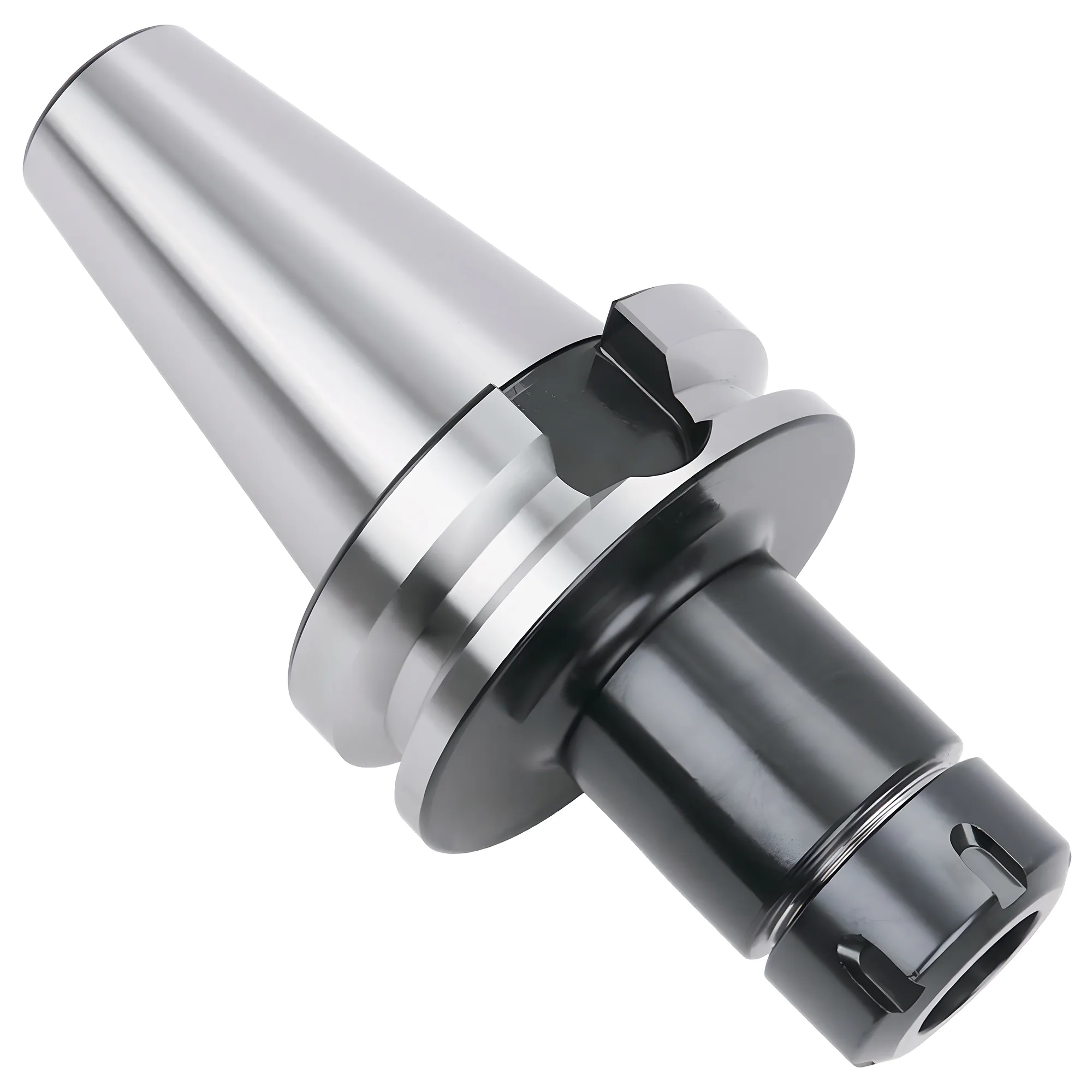
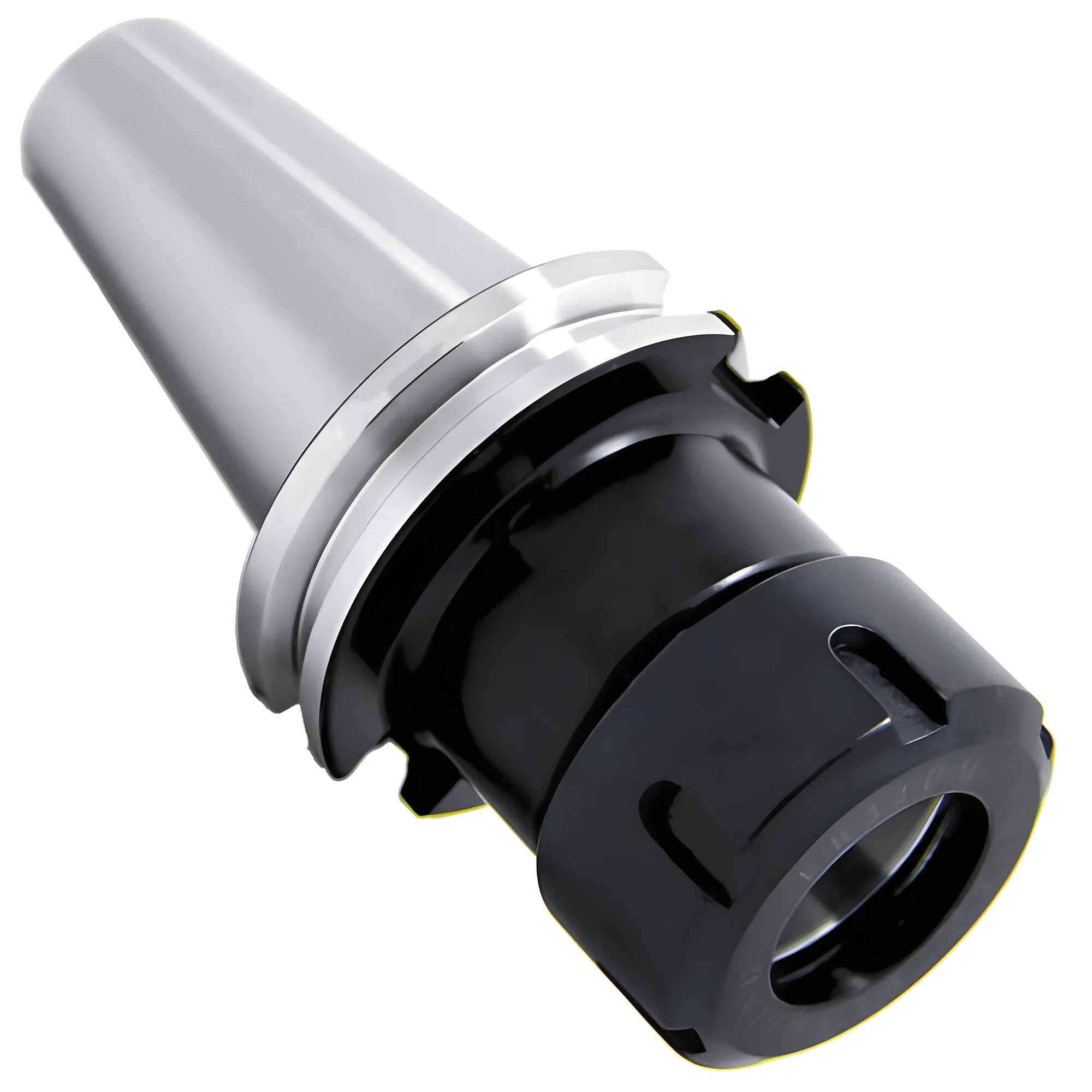
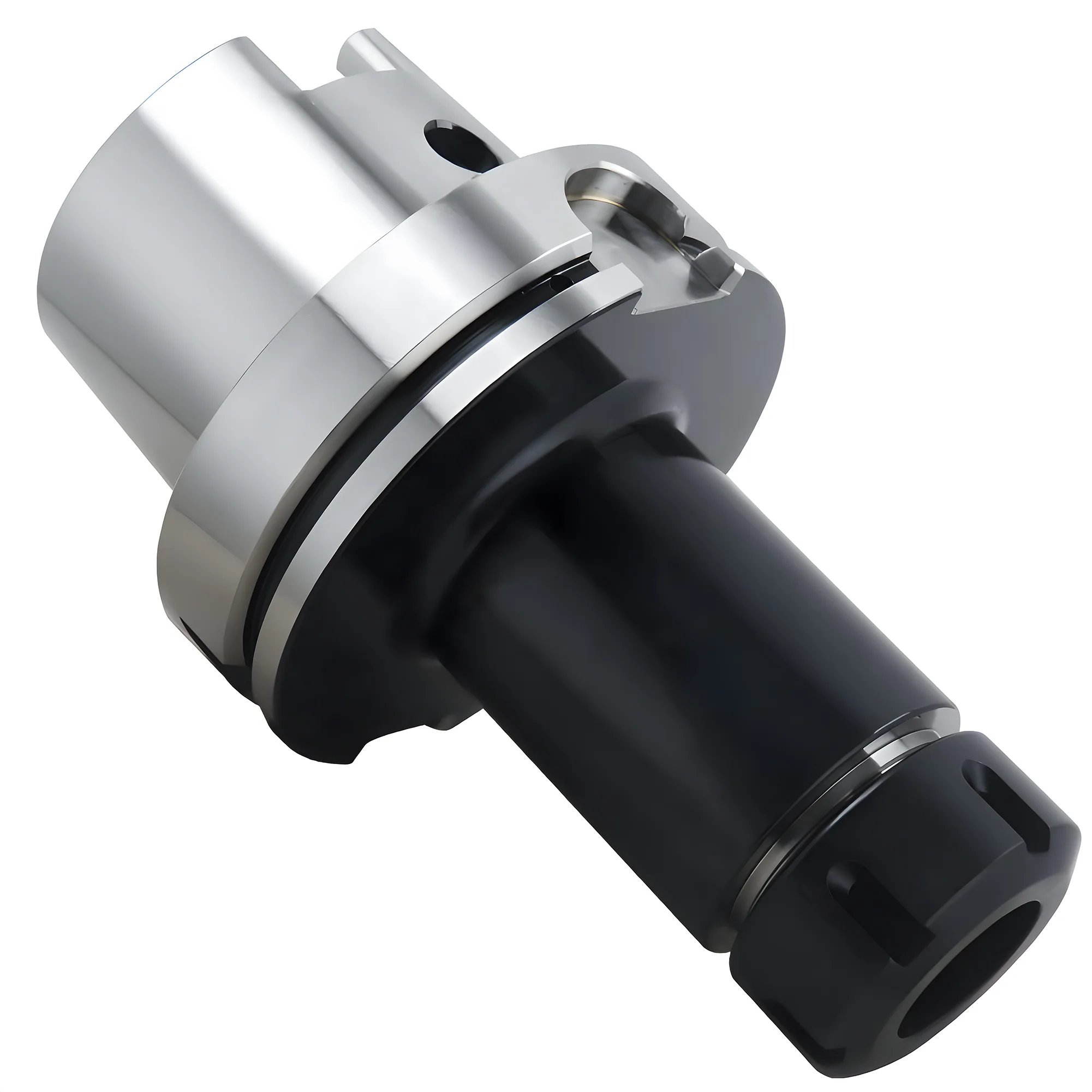
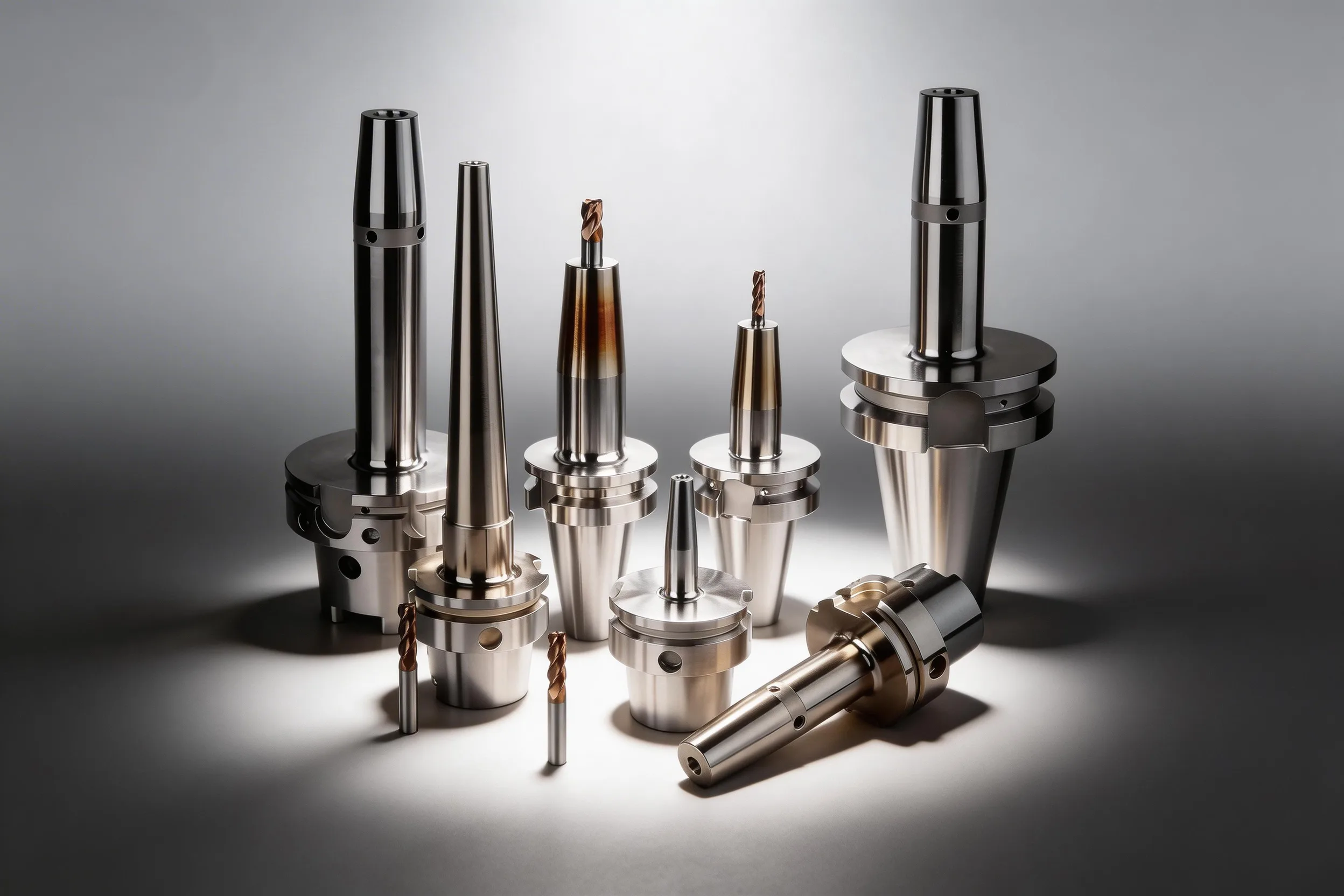
A collet chuck grips through a slotted collet squeezed by a nut and covers a band of shank sizes per collet; a hydraulic chuck grips through oil pressure on a thin-wall sleeve and holds one bore. ER collet chucks hold ≤0.015–0.020 mm TIR at ISO 15488 Class 2 (normal grade), or about 0.005 mm with UP/AA-grade collets, with clamping force typically estimated at 3,000-25,000 N by size (about 10,000-15,000 N for ER32) at $80-200 per chuck ($230-600 with an 18-piece ER32 collet set). Hydraulic chucks achieve 0.003 mm TIR with superior vibration damping at $300-600, but transmit less torque under heavy milling loads. For finishing where runout drives tool life and surface quality, hydraulic chucks can extend tool life by 25–50% (based on the one-tenth rule; actual results vary with material and tool diameter) when replacing standard-grade ER collets with hydraulic (0.003 mm TIR) in steel finishing. For roughing and general work, ER collets provide better value and flexibility.
For a complete overview of tool holding systems including tapers, collets, and workholding, see the tool holding complete guide.
Collet vs Chuck: What's the Difference?
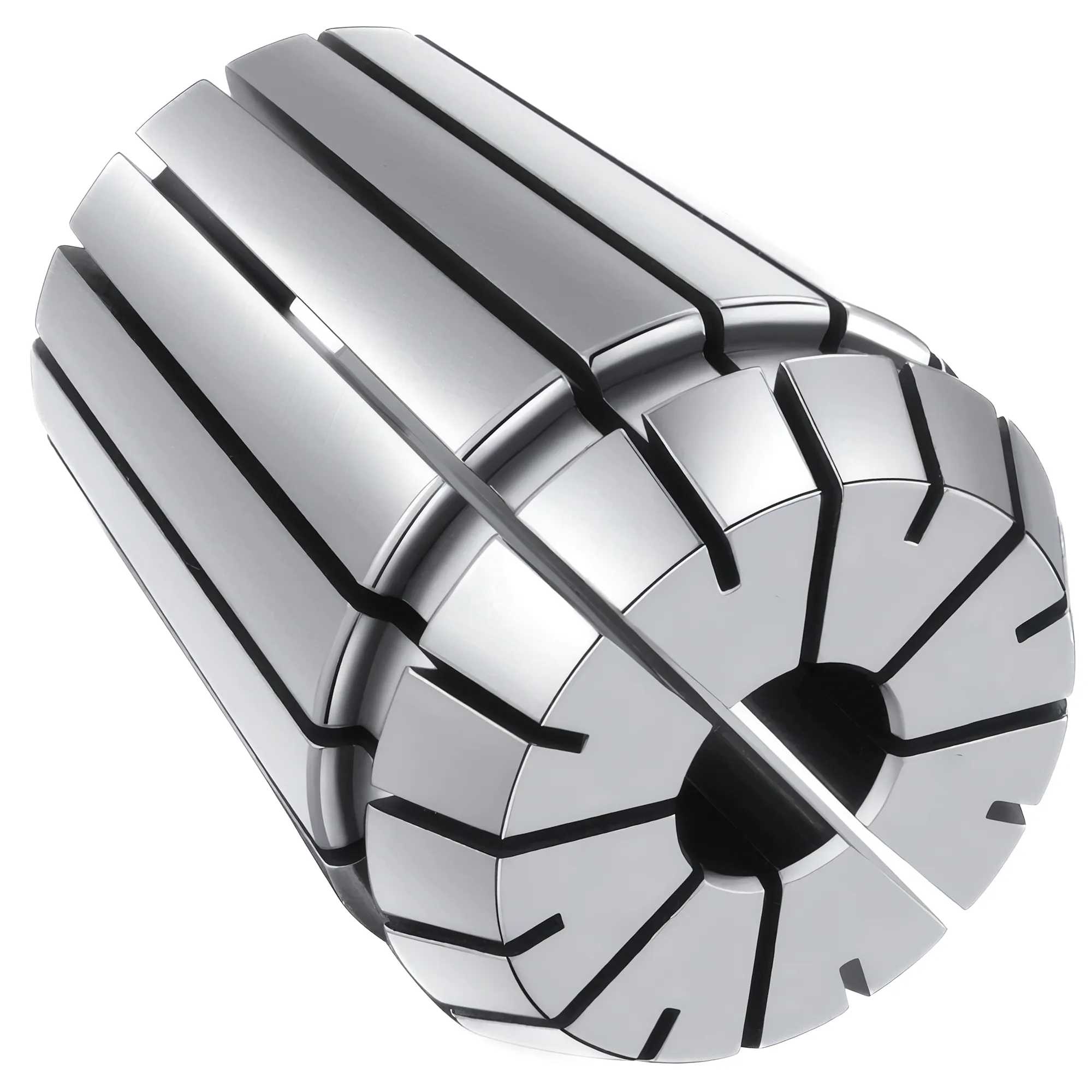
A collet is a slotted, tapered sleeve that closes around a narrow band of shank sizes when a nut draws it into a tapered bore; a chuck is the holder that does the gripping — with jaws (drill chuck), oil pressure (hydraulic chuck), heat (shrink-fit holder) or a collet and nut (collet chuck). In a CNC collet chuck the collet sets the shank size and the chuck body sets the spindle interface, so one holder takes many collet sizes. A hydraulic chuck has no collet at all: the bore itself is the gripping surface, which is why each hydraulic chuck holds one shank diameter.
How Each System Works
ER collet chucks per ISO 15488 / DIN 6499 are the default tool holding choice for general-purpose milling because one chuck plus an 18-collet set covers a 2-20 mm shank range (ER32) at moderate cost, and the ISO 15488 sizes ER11-ER40 together span 1-26 mm.
Collet chucks use a tapered split sleeve (collet) compressed by a nut to grip the tool shank. The collet deforms elastically, distributing clamping force around the full circumference. ER collets per ISO 15488 (with collet geometry detailed in DIN 6499) are the most common type, with a clamping range of 1 mm per collet for ER16-ER40 and 0.5 mm for ER11. ISO 15488 covers ER11 through ER40; ER8 and ER50 are manufacturer extensions. Choosing the right series and runout grade is covered in the ER collet selection guide.
Hydraulic chucks use an internal oil chamber sealed by a thin-wall sleeve. Tightening a set screw pressurizes the oil, which expands the sleeve uniformly around the tool shank. No collet is needed -- the tool inserts directly into the bore. Hydraulic chuck bodies are typically built on standard tool-holder shanks such as HSK (DIN 69893) or HSK-T (ISO 12164) for turning so the chuck integrates with existing spindle systems.
Hydraulic Collet Chuck Design: How It Works
In CNC tool holding, a "hydraulic collet chuck" usually means a hydraulic expansion chuck: turning a pressure screw drives a piston that pressurizes oil in a sealed chamber behind a thin-wall expansion sleeve, which flexes inward evenly around an h6 tool shank. Releasing the screw lets the sleeve spring back elastically to its free bore.
- Pressure screw and piston -- convert screw travel into oil pressure; no collet or nut is involved
- Oil chamber and channels -- spread the pressure along the clamping length, which is what gives near-uniform grip and the damping effect
- Thin-wall expansion sleeve -- the only part that touches the tool; its bore tolerance sets runout
- Reduction sleeves -- slotted intermediate sleeves let one chuck take smaller shank diameters, at some cost in runout and grip
- Tool insertion -- the shank should cover the full clamping zone before pressurizing; tightening an empty chuck can overstress the sleeve
On lathes, "hydraulic collet chuck" can also mean a workholding chuck whose collet is closed by a hydraulic cylinder through a draw tube. That is a different device: it grips the workpiece, not the cutting tool.
Collet Chuck Types
Collet chucks differ mainly in how the collet is drawn into the taper and how much shank length it grips; ER is the general-purpose default, and the other types trade range for grip, accuracy or length stability.
- ER collet chucks -- ISO 15488 collets with an 8° setting angle, closed by a front nut; the widest range per collet and the largest interchangeable ecosystem
- High-precision / power ER chucks -- take ordinary ER collets but use a reinforced, often full-round nut for higher grip and tighter runout than a standard ER chuck
- DA collet chucks -- an older double-angle collet system used mostly for drilling
- TG collet chucks -- a slow-taper (8° included) collet system that trades clamping range (about 0.4 mm collapse) for higher grip than ER in milling
- Pull-back collet chucks (SDC type) -- draw the collet back toward the spindle as it clamps, so the tool is not pushed outward and the set length stays stable
- SK-type collet chucks -- manufacturer-specific collet seats that each hold a continuous clamping range (about 1–25 mm across sizes)
- Milling (power milling) chucks -- grip on a long parallel bore with straight collets or none, built for high-torque roughing rather than range
Hydraulic chucks and shrink-fit holders are not collet chucks: both grip the shank directly with the holder bore.
Runout and Precision Comparison
Runout is the single largest differentiator between these systems. Hydraulic chucks typically achieve 0.003 mm TIR at 3xD projection, roughly 5-7x tighter than the ISO 15488 Class 2 limits for ER collets in steel finishing setups.
| Measurement Point | Collet Chuck (ISO 15488 Class 2) | Collet Chuck (UP/AA grade) | Hydraulic Chuck |
|---|---|---|---|
| At test projection (per ISO 15488) | ≤0.015 mm (d₁ ≤ 10 mm); ≤0.020 mm (d₁ 10–26 mm) | ~0.005 mm | ≤0.003 mm (at 3xD, manufacturer spec) |
ISO 15488 Class 2 is the production standard for normal ER collets. The "UP" or "AA" grades sold by manufacturers like Rego-Fix, Schunk, and BIG DAISHOWA exceed the ISO standard's Class 1 — they require the entire system (spindle, holder, collet, h6 shank) to maintain that accuracy.
Why Runout Matters Quantitatively
BIG DAISHOWA's "one-tenth rule" estimates approximately 10% tool life reduction per 0.0001 inch (2.5 µm) of runout — based on finishing tests in steel with carbide end mills. Actual impact varies with material, radial engagement, and flute count. At 0.01 mm (4 tenths), the impact is roughly 40%. A hydraulic chuck at 0.003 mm versus a standard collet at 0.015 mm therefore extends tool life by 25–50% (based on the one-tenth rule; actual results vary with material and tool diameter). For shops running expensive carbide end mills, the math favors hydraulic chucks on finishing operations.
Hydraulic chucks achieve superior runout because the pressurized oil distributes force with near-uniform pressure around the shank. Collet chucks rely on mechanical compliance of the collet, which introduces small asymmetries.
Clamping Force and Rigidity
Collet chucks transmit more torque before slipping, even though hydraulic chucks clamp with comparable or higher radial force (10,000-20,000 N), because the oil film behind a smooth bore can allow micro-slip under extreme loads. ER32 collet nuts are tightened to 136 Nm (about 100 ft-lb, the REGO-FIX recommended tightening torque for a standard nut), and the collet's segmented grip resists pull-out better than a hydraulic chuck's smooth bore, so collet chucks are typically preferred for roughing and slotting where pull-out risk is highest.
✦ Collet Chuck Strengths
- Higher torque transmission before slip when the nut is tightened to its rated torque (136 Nm for an ER32 standard nut)
- Better for heavy roughing and slotting
- Wider tool diameter range per collet set
- Accepts Weldon-flat and h7-h10 cylindrical shanks (hydraulic needs h6)
✦ Hydraulic Chuck Strengths
- Superior vibration damping from oil chamber
- Better surface finish in finishing operations
- Faster tool changes (insert and tighten one screw)
- Lower maintenance (no collet wear or replacement)
For aggressive roughing at high chip loads, collet chucks provide the grip strength needed to prevent tool pullout. For finishing operations where vibration control and surface quality matter most, hydraulic chucks excel.
Milling Chuck and Shrink Fit vs Collet Chuck
A milling (power) chuck grips over a long parallel bore with a thick body, so it resists pull-out in heavy roughing better than an ER collet chuck of similar size, while an ER collet chuck covers many shank diameters per holder and costs less for mixed light-to-medium work. Milling chucks are usually limited to the larger shank sizes and add weight at the spindle nose.
Shrink-fit (sometimes searched as "press fit") holders typically reach ≤0.003 mm TIR and 25,000-40,000 N clamping force, versus the ≤0.015-0.020 mm ISO 15488 Class 2 limit for ER collets. The trade-offs are a heating unit, one bore size per holder, and h6 shanks only.
| System | Typical Runout | Clamping Force | Shank Range per Holder | Best Fit |
|---|---|---|---|---|
| ER collet chuck (Class 2) | ≤0.015-0.020 mm (ISO 15488) | 3,000-25,000 N by size (typical estimate) | Full collet set (e.g. 2-20 mm for ER32) | General milling, drilling, mixed tools |
| ER collet chuck (UP/AA collets) | ~0.005 mm | 3,000-25,000 N by size (typical estimate) | Full collet set | Finishing on existing ER holders |
| Hydraulic chuck | ≤0.003 mm at 3xD | 10,000-20,000 N | One bore (smaller with reduction sleeves) | Finishing, long reach, damping |
| Shrink-fit holder | ≤0.003 mm at 3xD | 25,000-40,000 N | One bore | High speed, slim reach, high grip |
| Milling chuck | Manufacturer-specified | Manufacturer-specified | One bore per straight collet | Heavy roughing, high torque |
Vibration Damping
The oil chamber inside a hydraulic chuck acts as a passive vibration damper, absorbing chatter frequencies that would otherwise transfer between the tool and spindle. Hydraulic chucks can typically improve surface finish by 0.2-0.4 µm Ra in long-reach finishing setups (4xD or greater) where chatter is present, but the benefit shrinks toward zero on rigid short-stickout cuts. In setups where chatter is present or borderline (long stickout, thin walls, hard materials), this damping effect can improve surface finish by 0.2-0.4 µm Ra. On rigid setups with short tool projection, the improvement may be negligible because there is no chatter to damp.
This advantage becomes more pronounced in:
- Long-reach finishing operations (4xD or greater stickout)
- Thin-wall machining where chatter marks are unacceptable
- Hard material finishing where tool vibration accelerates wear
Cost and Practical Considerations
An ER32 collet chuck plus an 18-piece collet set typically costs $230-$600 total and covers shanks from 2 mm to 20 mm, while a single hydraulic chuck covers only one shank diameter at $300-$600 — making collet systems far cheaper for shops running varied tool diameters.
Collet chucks have a lower entry cost and cover a wide range of tool diameters with one chuck and a set of collets. Hydraulic chucks require one chuck per shank diameter, increasing initial investment. However, hydraulic chucks have virtually no consumable costs -- no collets to wear out or replace.
Selection Decision Framework
Most productive shops run both systems in parallel because collet chucks win on roughing economics while hydraulic chucks win on finishing surface quality and tool life.
- Roughing operations, high chip loads -- Collet chuck (higher torque transmission)
- Finishing operations, tight surface specs -- Hydraulic chuck (better runout and damping)
- Job shop with varied tool sizes -- Collet chuck (one chuck covers many diameters)
- Production line with fixed tooling -- Hydraulic chuck (faster changes, consistent runout)
- High-speed machining (20,000+ RPM) -- Hydraulic chuck (better balance, lower runout)
For matching the right cutter geometry to these holder choices, see the end mill selection guide.
Quick Tool Holding Selection by Application
| Scenario | Recommended System | Speed Range | Specification | Why |
|---|---|---|---|---|
| 10 mm end mill roughing 1045 steel at 0.15 mm/tooth | ER collet chuck (ISO 15488 Class 2) | 6,000-10,000 RPM | G6.3 balance, 136 Nm nut torque (ER32 standard nut) | Collet's segmented grip carries the higher torque demand of roughing without micro-slip that an oil-film chuck can develop |
| 6 mm finishing tool in P20 mold steel | Hydraulic chuck | 12,000-18,000 RPM | 0.003 mm TIR, G2.5 | Sub-0.005 mm runout typically extends finishing tool life by 25-50% via the one-tenth rule, paying back the chuck cost on carbide wear alone |
| 12 mm tool, 6xD reach into thin-wall pocket | Hydraulic chuck | 8,000-14,000 RPM | 0.003 mm TIR, oil-chamber damping | Oil chamber absorbs chatter at the tool's natural frequency, typically improving Ra by 0.2-0.4 µm at long stickout |
| Job-shop varied work, 3-20 mm shank range | ER32 collet chuck + 18-collet set | up to 15,000 RPM | G6.3, 1 mm clamping range per collet | One chuck plus collet set covers the entire diameter range at $230-$600 versus 18 separate hydraulic chucks |
| Production cell, fixed 8 mm shank, lights-out | Hydraulic chuck | 12,000-20,000 RPM | 0.003 mm TIR, h6 shank, no consumables | No collet wear between seal services, reducing unattended-shift failure modes |
| 20,000+ RPM aluminum HSM | Hydraulic chuck or shrink-fit on HSK-A (DIN 69893) shank | 20,000-25,000 RPM | G2.5 balance, 0.003 mm TIR | Hydraulic on an HSK-A shank combines high-RPM balance with low runout because both face and taper contact stay engaged at speed |
Use both systems strategically for maximum shop performance.
Collet chucks remain the best general-purpose tool holding system for their versatility, resistance to slip in roughing, and cost-effectiveness. Hydraulic chucks justify their higher price on finishing stations, high-speed machines, and any operation where runout below 0.005mm directly improves part quality or tool life. Most productive shops use collet chucks for roughing and hydraulic chucks for finishing.
What is the difference between a collet and a chuck?
A collet is a slotted, tapered sleeve that closes around a narrow band of shank sizes when a nut draws it into a tapered bore. A chuck is the holder that does the gripping — with jaws (drill chuck), oil pressure (hydraulic chuck) or a collet and nut (collet chuck). In a collet chuck, the collet sets the size and the holder sets the spindle interface.
What is a hydraulic collet chuck?
In CNC tool holding it usually means a hydraulic expansion chuck: turning a pressure screw drives a piston that pressurizes oil behind a thin-wall sleeve, which closes evenly around an h6 shank. It holds one bore size, with reduction sleeves for smaller shanks. On lathes, the same phrase can mean a hydraulically actuated workholding collet chuck.
Milling chuck vs collet chuck — which holds better in roughing?
A milling (power) chuck grips over a long parallel bore with a thick body, so it typically resists pull-out in heavy roughing better than an ER collet chuck of similar size. An ER collet chuck covers many shank diameters per holder and costs less, which makes it the better general-purpose choice for mixed light-to-medium cuts.
Is shrink fit better than a collet chuck?
For runout and grip, generally yes: shrink-fit holders typically reach ≤0.003 mm TIR and 25,000-40,000 N clamping force, versus ≤0.015-0.020 mm for ISO 15488 Class 2 ER collets. The trade-offs are a heating unit, one bore size per holder, and h6 shanks, so ER chucks stay cheaper and more flexible for varied tools.
What is the typical runout difference between collet chucks and hydraulic chucks?
ER collet chucks with Class 2 (normal grade) collets are limited to ≤0.015-0.020 mm TIR at the ISO 15488 test projection, while hydraulic chucks achieve 0.003 mm or better -- roughly 5-7x tighter. Precision UP/AA-grade collets narrow the gap to about 0.005 mm, but hydraulic chucks still lead for finishing operations where runout drives surface quality.
Can hydraulic chucks handle heavy roughing operations?
Hydraulic chucks transmit less torque than ER collet chucks because the oil film can slip under heavy lateral loads. For heavy roughing with high chip loads, ER collet chucks provide more secure tool grip, provided the nut is tightened to its rated torque (136 Nm for an ER32 standard nut).
How long do hydraulic chucks last before requiring service?
Hydraulic chucks typically run long intervals between seal services, and unlike collet systems they have no consumable parts -- no collets to replace and no nuts to re-torque. Because periodic seal service costs less than replacing worn collets over the same number of tool changes, long-run total cost is often comparable.
When should I use both systems in the same shop?
Most productive shops run collet chucks on roughing stations -- a correctly torqued ER32 collet (136 Nm nut torque) resists pullout under heavy chip loads -- and hydraulic chucks on finishing stations where 0.003 mm TIR and oil-chamber vibration damping improve surface quality and extend carbide end mill life by up to 25-50%.