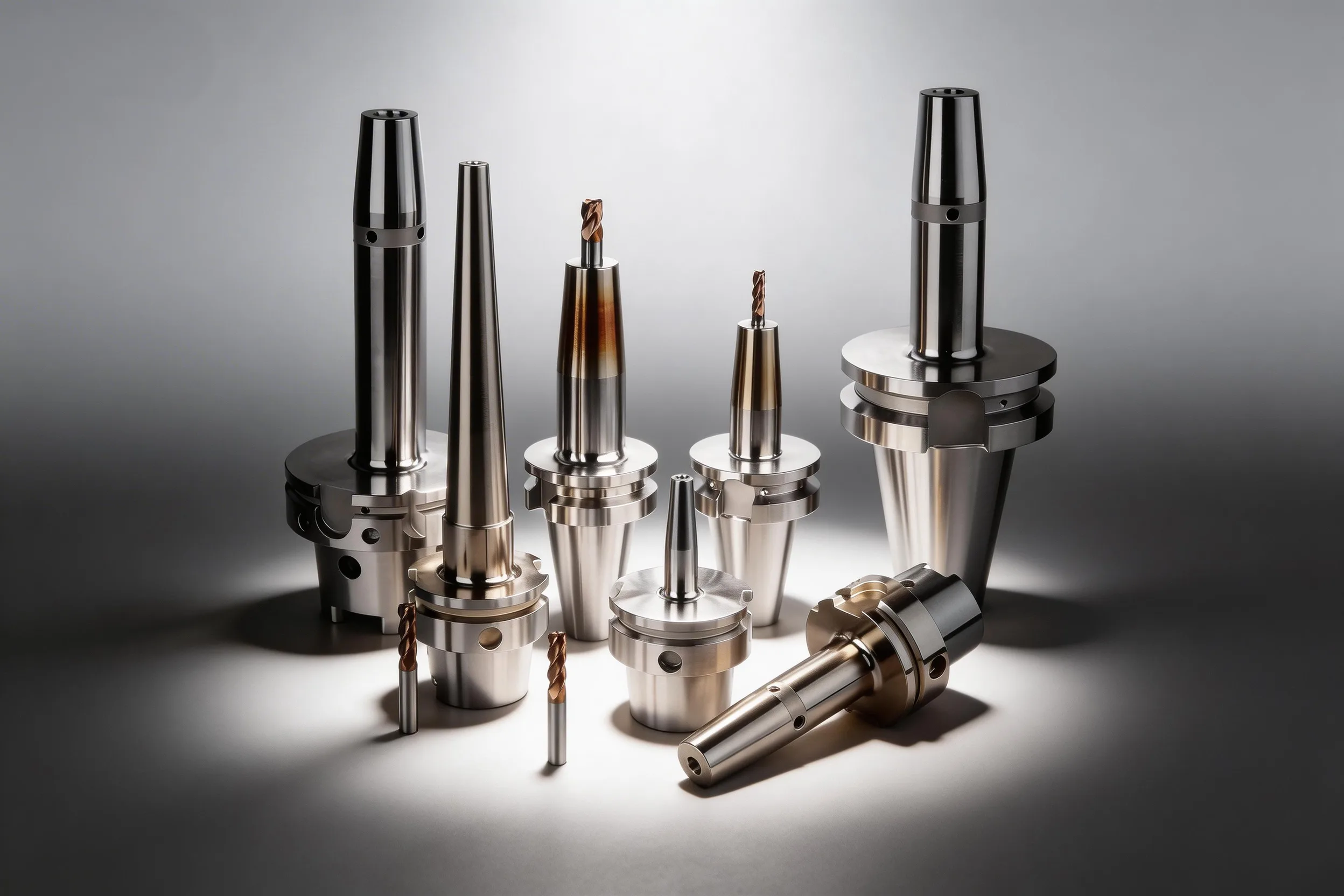
BT (JIS B6339) and CAT (ANSI/ASME B5.50) 7:24 V-flange tapers are typically rated up to 12,000-15,000 RPM in standard form (~20 N/µm radial stiffness), with Big Plus dual-contact variants extending to ~20,000 RPM. HSK (DIN 69893) hollow tapers deliver 2-3x higher radial stiffness (~50 N/µm) and runout below 0.003 mm at 4xD — HSK-A is the production standard at 15,000-25,000 RPM, while HSK-E/F variants without flange drive slots reach 30,000-40,000+ RPM. Stiffness values measured under specific gauge length and test conditions; vary by setup. This guide compares all three systems by speed, rigidity, cost, and regional availability.
For a complete overview of tool holding systems including collets, chucks, and workholding, see the tool holding complete guide.
BT Taper (JIS Standard)
The BT taper, standardized under JIS B6339, is the most common system in Asia. It features a 7:24 taper ratio with a flange for automatic tool changing.
Key advantages:
- Lower cost than HSK
- Wide availability of tooling
- Good rigidity for general machining
Speed Considerations
Standard BT holders are optimized for speeds up to 12,000-15,000 RPM. Big Plus (dual face-and-taper contact) variants extend this to 20,000 RPM.
Big Plus (BT-DC)
Big Plus is a dual-contact version of the BT taper that adds simultaneous face contact, significantly improving rigidity and speed capability. If your machine supports Big Plus, BT holders can compete with HSK in the 15,000-20,000 RPM range.
Best for: General milling, drilling, and machining centers running under 15,000 RPM (standard) or up to 20,000 RPM (Big Plus).
CAT Taper (ANSI Standard)
The CAT (Caterpillar) system follows ANSI/ASME B5.50 standards, primarily used in North America. It shares the same 7:24 taper ratio as BT but with a different pull stud configuration.
Key advantages:
- Standard in US manufacturing
- Interchangeable with many American-made machines
- Established tooling supply chain
Important Note
CAT and BT holders are NOT interchangeable despite similar appearance. The V-flange dimensions and pull stud threads differ between standards. Always verify compatibility before purchasing.
HSK Taper (DIN Standard)
The HSK (Hohl Schaft Kegel) system, standardized under DIN 69893, represents the modern approach to tool holding. It uses a hollow 1:10 taper with dual-contact clamping for superior performance at high speeds.
Form A vs E/F — the high-speed distinction: DIN 69893 defines six HSK forms (A, B, C, D, E, F), differing primarily in the flange geometry:
- HSK-A and HSK-B have rear drive slots in the flange. The slots create rotational asymmetry that limits achievable balance grade and practical operating speed (typically 15,000-25,000 RPM in production).
- HSK-E and HSK-F eliminate the drive slots entirely for a fully symmetric design. This enables balance grades of G1.0 or finer, allowing safe operation at 30,000-40,000+ RPM. HSK-F additionally has an enlarged flange diameter for extra rigidity.
The "40,000+ RPM" figure commonly cited for HSK applies specifically to HSK-E/F variants in high-speed aluminum and finishing applications, not to the more common HSK-A used in general production machining.
Key advantages:
- Dual face and taper contact for maximum rigidity
- Better performance at high speeds
- Lighter weight than BT/CAT
- Superior runout characteristics
- Centrifugal force at high RPM increases (rather than decreases) clamping force, because the internal expansion mechanism is driven outward by the rotating mass
Considerations:
- Higher initial investment
- Requires HSK-compatible spindle
- Form A vs E/F selection determines achievable speed
Best for: High-speed machining (HSK-A above 15,000 RPM, HSK-E/F above 25,000 RPM), aerospace, and precision applications.
Quick Selection Guide
| Factor | BT | CAT | HSK-A | HSK-E/F |
|---|---|---|---|---|
| Standard | JIS B6339 | ANSI/ASME B5.50 | DIN 69893 | DIN 69893 |
| Typical Max Speed | 12,000-20,000 RPM | 12,000-20,000 RPM | 15,000-25,000 RPM | 30,000-40,000+ RPM |
| Rigidity | Good | Good | Excellent | Excellent |
| Tool Change | Standard | Standard | Fast | Fast |
| Cost | Low | Low | Higher | Highest |
| Region | Asia | North America | Global (growing) | Global (specialty) |
✦ BT/CAT Best For
- General milling and drilling
- Budget-conscious shops
- Standard machining centers
- Wide tooling availability
✦ HSK Best For
- High-speed machining (20,000+ RPM)
- Aerospace applications
- Precision requirements
- Maximum rigidity at speed
Practical Recommendations
The best tool holder system is the one that matches your specific machining requirements - not necessarily the most expensive option.
Recommendations by application:
- Job shops with varied work: BT40 or CAT40 systems offer the best value with broad tooling availability
- High-speed aluminum machining: HSK-A63 for optimal performance at elevated RPM
- Heavy cutting in steel: BT50 or CAT50 for maximum rigidity and stability
Match your taper to your speed requirements.
For general machining under 15,000 RPM, BT (Asia) or CAT (North America) provides excellent value, with Big Plus variants extending capability to 20,000 RPM. When precision and high-speed performance matter, HSK's dual-contact design justifies the investment with superior rigidity and runout characteristics.
Are BT and CAT tool holders interchangeable?
No. Despite sharing the same 7:24 taper ratio, BT and CAT holders have different V-flange dimensions and pull stud threads. Always verify compatibility before purchasing.
What is the maximum RPM for each taper system?
Standard BT and CAT holders are limited to 12,000-15,000 RPM (up to 20,000 RPM with Big Plus dual contact). HSK holders support 40,000+ RPM thanks to their dual face-and-taper contact design.
What is Big Plus (BT-DC) and is it worth upgrading to?
Big Plus adds simultaneous face contact to the standard BT taper, significantly improving rigidity and extending speed capability to 20,000 RPM. If your machine supports it, Big Plus lets BT holders compete with HSK in the 15,000-20,000 RPM range.
Which taper system should a job shop choose?
For general machining under 15,000 RPM, BT40 (Asia) or CAT40 (North America) offers the best value with broad tooling availability. Choose HSK only when you need high-speed performance above 20,000 RPM or runout below 0.003mm.