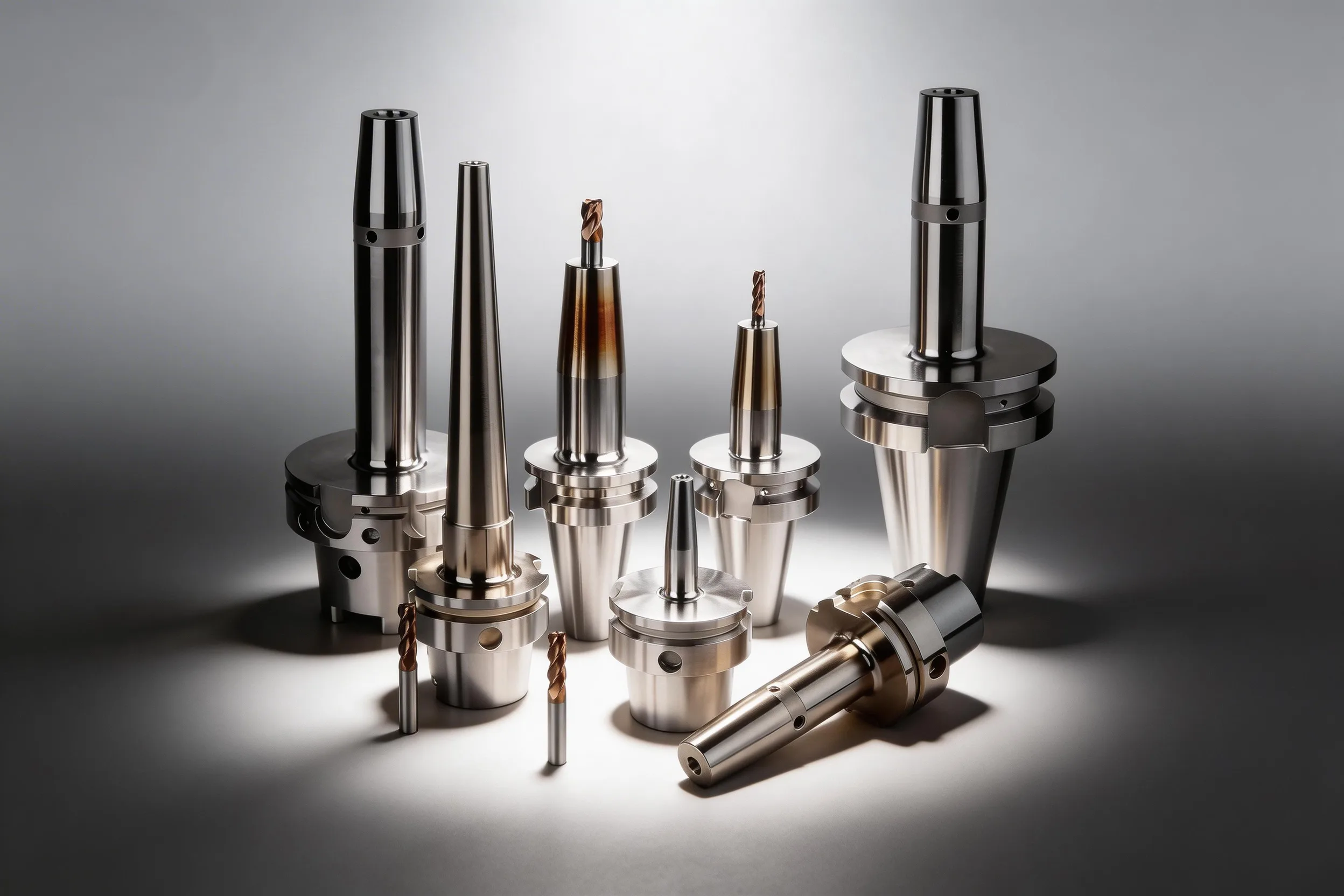
ER collet chucks achieve 0.008-0.015 mm TIR with 8,000-15,000 N clamping force at $15-150 per setup. Hydraulic chucks achieve 0.003 mm TIR with superior vibration damping at $300-600, but transmit less torque under heavy milling loads. For finishing where runout drives tool life and surface quality, hydraulic chucks can extend tool life by 25-40% when replacing standard-grade ER collets (0.015 mm TIR) with hydraulic (0.003 mm TIR) in steel finishing. For roughing and general work, ER collets provide better value and flexibility.
For a complete overview of tool holding systems including tapers, collets, and workholding, see the tool holding complete guide.
How Each System Works
Collet chucks use a tapered split sleeve (collet) compressed by a nut to grip the tool shank. The collet deforms elastically, distributing clamping force around the full circumference. ER collets per ISO 15488 are the most common type, with clamping ranges of 1mm per collet size.
Hydraulic chucks use an internal oil chamber sealed by a thin-wall sleeve. Tightening a set screw pressurizes the oil, which expands the sleeve uniformly around the tool shank. No collet is needed -- the tool inserts directly into the bore.
Runout and Precision Comparison
Runout is the single largest differentiator between these systems.
| Measurement Point | Collet Chuck (ISO 15488 Class 2) | Collet Chuck (UP/AA grade) | Hydraulic Chuck |
|---|---|---|---|
| At tool nose | 0.015-0.025 mm | 0.008-0.012 mm | 0.003-0.005 mm |
| At test projection (per ISO 15488) | ≤0.015 mm | ~0.005 mm | ≤0.003 mm |
| Repeatability | ±0.005 mm | ±0.003 mm | ±0.001 mm |
ISO 15488 Class 2 is the production standard for normal ER collets. The "UP" or "AA" grades sold by manufacturers like Rego-Fix, Schunk, and BIG DAISHOWA exceed the ISO standard's Class 1 — they require the entire system (spindle, holder, collet, h6 shank) to maintain that accuracy.
Why Runout Matters Quantitatively
BIG DAISHOWA's "one-tenth rule" estimates approximately 10% tool life reduction per 0.0001 inch (2.5 µm) of runout — based on finishing tests in steel with carbide end mills. Actual impact varies with material, radial engagement, and flute count. At 0.01 mm (4 tenths), the impact is roughly 40%. A hydraulic chuck at 0.003 mm versus a standard collet at 0.015 mm therefore extends tool life by 30-50%. For shops running expensive carbide end mills, the math favors hydraulic chucks on finishing operations.
Hydraulic chucks achieve superior runout because the pressurized oil distributes force with perfect uniformity. Collet chucks rely on mechanical compliance of the collet, which introduces small asymmetries.
Clamping Force and Rigidity
Collet chucks generate higher absolute clamping force, making them better suited for heavy material removal operations.
✦ Collet Chuck Strengths
- Higher clamping torque (100-120 Nm for ER32)
- Better for heavy roughing and slotting
- Wider tool diameter range per collet set
- Can grip flats, squares, and irregular shanks
✦ Hydraulic Chuck Strengths
- Superior vibration damping from oil chamber
- Better surface finish in finishing operations
- Faster tool changes (insert and tighten one screw)
- Lower maintenance (no collet wear or replacement)
For aggressive roughing at high chip loads, collet chucks provide the grip strength needed to prevent tool pullout. For finishing operations where vibration control and surface quality matter most, hydraulic chucks excel.
Vibration Damping
The oil chamber inside a hydraulic chuck acts as a passive vibration damper, absorbing chatter frequencies that would otherwise transfer between the tool and spindle. In setups where chatter is present or borderline (long stickout, thin walls, hard materials), this damping effect can improve surface finish by 0.2-0.4 Ra. On rigid setups with short tool projection, the improvement may be negligible because there is no chatter to damp.
This advantage becomes more pronounced in:
- Long-reach finishing operations (4xD or greater stickout)
- Thin-wall machining where chatter marks are unacceptable
- Hard material finishing where tool vibration accelerates wear
Cost and Practical Considerations
Collet chucks have a lower entry cost and cover a wide range of tool diameters with one chuck and a set of collets. Hydraulic chucks require one chuck per shank diameter, increasing initial investment. However, hydraulic chucks have virtually no consumable costs -- no collets to wear out or replace.
Selection Decision Framework
- Roughing operations, high chip loads -- Collet chuck (higher clamping force)
- Finishing operations, tight surface specs -- Hydraulic chuck (better runout and damping)
- Job shop with varied tool sizes -- Collet chuck (one chuck covers many diameters)
- Production line with fixed tooling -- Hydraulic chuck (faster changes, consistent runout)
- High-speed machining (20,000+ RPM) -- Hydraulic chuck (better balance, lower runout)
Use both systems strategically for maximum shop performance.
Collet chucks remain the best general-purpose tool holding system for their versatility, clamping force, and cost-effectiveness. Hydraulic chucks justify their higher price on finishing stations, high-speed machines, and any operation where runout below 0.005mm directly improves part quality or tool life. Most productive shops use collet chucks for roughing and hydraulic chucks for finishing.
What is the typical runout difference between collet chucks and hydraulic chucks?
Standard collet chucks produce 0.010-0.015mm runout at 3xD, while hydraulic chucks achieve 0.003mm or better -- roughly 3-5x more precise.
Can hydraulic chucks handle heavy roughing operations?
Hydraulic chucks transmit less torque than ER collet chucks because the oil film can slip under heavy lateral loads. For heavy roughing with high chip loads, ER collet chucks (100-120 Nm torque for ER32) provide more secure tool grip.
How long do hydraulic chucks last before requiring service?
Hydraulic chucks typically last 10,000+ tool changes before needing seal service, and they have virtually no consumable costs since there are no collets to replace.
When should I use both systems in the same shop?
Most productive shops use collet chucks for roughing (higher clamping force) and hydraulic chucks for finishing stations (0.003mm runout and superior vibration damping for better surface finish).