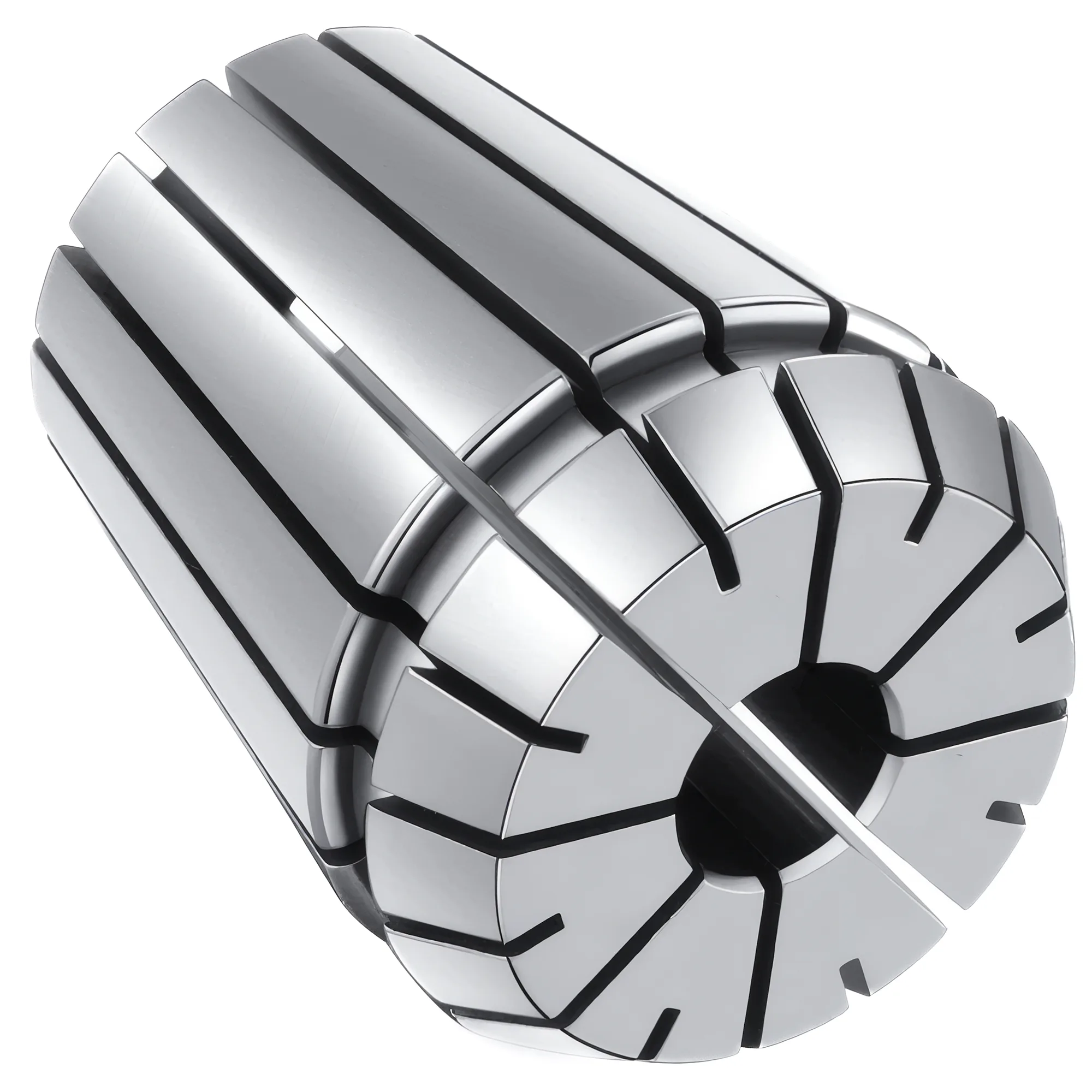
ER, DA and TG are the three common nut-clamped collet types for rotating tools, and they split on one trade-off: collapse range versus grip. ER collets collapse about 1 mm per collet from ER16 to ER40 (0.5 mm on ER11, per ISO 15488), so one set covers the most shank sizes. DA (double-angle) collets collapse 0.3–0.8 mm depending on size and are built mainly for drilling. TG collets collapse only about 0.4 mm (1/64 in) but use an 8° included taper that grips harder than ER (manufacturer catalogs). Choose ER for range and interchangeability, TG for grip in milling, and DA to keep existing drilling tooling running.
This article compares collet types. For sizing within the ER family, see the ER collet selection guide; for nut torque and runout procedure, see the ER collet runout and torque guide. For a broader holder comparison, see side-lock vs ER vs shrink-fit end mill holders.
What Are the Main Collet Types?
ER, DA and TG collets are all closed by a threaded nut on the collet chuck — none of them is drawn in by a drawbar. What separates them is taper geometry, collapse range and the standard behind them.
- ER collets have an 8° setting angle (16° included) and are standardized internationally in ISO 15488, which covers ER11 to ER40; the original German standard is DIN 6499. ER8 and ER50 are manufacturer extensions outside ISO 15488.
- TG ("Tremendous Grip") collets are a single-angle design with a slow 8° included taper, about half the ER angle. They date from the original Erickson system and are not covered by ISO 15488, though standard TG collets are made to DIN 6499 Class 2 accuracy and high-precision TGHP collets to Class 1 (WIDIA catalog).
- DA (double-angle) collets are tapered at both ends and also come from the Erickson system. Manufacturers do not publish a standardized taper angle for them, and they are positioned mainly for drilling.
Drawbar collets are a different category. Knee-mill and lathe collets such as R8 and 5C are pulled into the spindle or collet closer by a drawbar, so the tool or part is clamped from behind rather than by a nut at the nose. They solve a machine-interface problem, not a tool-holder one, and are outside this comparison.
Collapse Range: Why ER Covers the Most Sizes per Collet
ER has the widest collapse of the three types for sizes ER16 and up — 1 mm per collet under ISO 15488 — against 0.3–0.8 mm for DA and about 0.4 mm for standard TG. One exception keeps the comparison honest: ER11 collapses only 0.5 mm, which is less than a large DA collet's 0.8 mm.
Collapse range sets how many collets a shop needs. With ER, each collet covers a 1 mm band, so a set in 1 mm steps reaches every shank size in its span. A standard TG collet clamps only from its nominal size down about 0.4 mm, so it effectively serves one shank size; covering the same span continuously takes well over twice as many TG collets. DA falls between the two, with larger DA sizes approaching 0.8 mm.
| Factor | ER | DA | TG |
|---|---|---|---|
| Collapse per standard collet | 1 mm (ER16–ER40); 0.5 mm (ER11) | 0.3–0.8 mm by size (max 1/32 in) | ~0.4 mm (1/64 in) |
| Taper | 8° setting angle (16° included) | Double-angle (angle not published as a standard) | 8° included, single-angle |
| Series and capacity | ER11 1–7, ER16 1–10, ER20 1–13, ER25 1–16, ER32 2–20, ER40 3–26 mm (ISO 15488) | 300DA to 1/4 in, 200DA to 3/8 in, 100DA to 9/16 in, 180DA to 3/4 in | TG50 1.5–13.5, TG75 3–20, TG100 3–25.5, TG150 12–40 mm |
| Standard | ISO 15488 / DIN 6499 | Manufacturer (Erickson system) | Manufacturer; accuracy to DIN 6499 classes |
| Clamping | Nut | Nut | Nut |
DA sizing trips people up: the series numbers do not rise with capacity. The 180DA is the largest common DA size, reaching 3/4 in, while the 300DA is the smallest, at 1/4 in. On the other side, TG150 reaches 40 mm, well beyond ER40's 26 mm limit in ISO 15488.
Selection Tip
Count the collets you will actually need. If your tool list spans many shank sizes, ER's 1 mm collapse keeps the set small. If you run a few fixed shank sizes and need maximum grip, TG's narrow range costs little, because each shank only needs its own collet.
Runout and Grip by Collet System
Standard ER and standard TG collets sit in the same accuracy class — ISO 15488 / DIN 6499 Class 2 — so the runout difference between them is smaller than their reputations suggest. ISO 15488 Class 2 allows ≤0.015 mm TIR for d₁ ≤ 10 mm and ≤0.020 mm for d₁ 10–26 mm; manufacturer UP/AA ER grades reach ≤0.005 mm TIR, and TGHP collets are made to Class 1. Kennametal rates DA collets at 0.001 in (0.025 mm) TIR at the collet nose, looser than either.
TG's grip advantage comes from its taper: an 8° included angle gives roughly a 3:1 mechanical advantage (WIDIA), and Lyndex-Nikken describes it as delivering greater clamping torque than a 16° ER collet chuck. The price of that slow taper is the narrow 0.4 mm collapse. ER trades some grip for range; DA is not a milling collet at all — Lyndex-Nikken states DA chucks are not designed for milling and can crack at the nose under radial load or overtightening, and Kennametal lists drilling as the main DA application.
| Factor | ER (standard) | DA (standard) | TG (standard) |
|---|---|---|---|
| Accuracy | ISO 15488 Class 2: ≤0.015–0.020 mm TIR | ~0.025 mm TIR at collet nose (Kennametal) | DIN 6499 Class 2 |
| Precision option | UP/AA grades ≤0.005 mm TIR (manufacturer) | Not covered here | TGHP to DIN 6499 Class 1 |
| Grip | Baseline; 16° included taper | Drilling-oriented; not rated for milling | Higher than ER; 8° included taper (~3:1) |
| Main use | Milling, drilling, mixed tools | Drilling, small tools | Milling where grip matters |
Runout still matters when choosing between types, because it shortens tool life. Each 0.0001 inch (2.5 µm) of runout reduces tool life by approximately 10% (BIG DAISHOWA one-tenth rule), so a 0.025 mm DA setup costs a finishing cutter far more life than a Class 2 ER or TG collet. The effect varies with tool diameter, material and feed.
Common Mistake
Running an end mill in a DA collet chuck because the shop already owns one is a common error. DA chucks are rated for drilling; side load from milling can crack the chuck nose. Move milling tools to ER or TG holders.
When Should You Choose Each Collet Type?
✦ ER Best For
- Mixed tool inventories where 1 mm collapse keeps the collet count low
- Finishing and general milling (Class 2 standard; UP/AA grades to ≤0.005 mm)
- Brand-interchangeable collets under ISO 15488 / DIN 6499
✦ DA Best For
- Drilling with existing DA chucks and collets
- Small shanks, up to 3/4 in in the largest (180DA) size
- Keeping legacy drilling tooling in service rather than replacing it
Choose ER when shank range and interchangeability drive the decision, TG when grip on a fixed set of shank sizes matters more, and DA only for drilling on chucks you already own. For most machining-center shops buying new holders, ER is the default because ISO 15488 makes its collets interchangeable across brands and its 1 mm collapse covers the broadest tool mix. For ER against fundamentally different holding methods, see collet chuck vs hydraulic chuck, and for the full holder landscape, the complete guide to tool holding.
Practical Recommendations
Quick Selection Table
| Scenario | Recommended Collet Type | Accuracy | Why |
|---|---|---|---|
| Mixed milling and drilling, many shank sizes | ER (standard) | Class 2, ≤0.015–0.020 mm | 1 mm collapse (ER16–ER40) covers the most sizes per collet |
| Finishing, tight tolerance | ER (UP/AA grade) | ≤0.005 mm (manufacturer) | Precision grades exceed ISO 15488 Class 1 |
| Heavy milling on a few fixed shank sizes | TG | DIN 6499 Class 2 (TGHP Class 1) | 8° included taper grips harder than ER |
| Shanks above 26 mm | TG150 or ER50 extension | Manufacturer rating | Beyond ISO 15488's ER40 limit |
| Drilling on existing DA chucks | DA | ~0.025 mm at nose | Drilling is the intended application |
| Milling on a DA chuck | Move to ER or TG | — | DA chucks are not designed for milling |
Default to ER for range, TG for grip, and keep DA for drilling.
ER collets collapse 1 mm per collet from ER16 to ER40 (0.5 mm on ER11) and are interchangeable under ISO 15488, which makes them the default for mixed CNC work. TG collets collapse only about 0.4 mm but grip harder than ER through an 8° included taper and reach 40 mm in TG150. DA collets collapse 0.3–0.8 mm, run about 0.025 mm TIR at the nose and are intended for drilling, not milling. All three are nut-clamped; drawbar collets such as R8 and 5C are a separate machine-interface category.
ISO 15488 and DIN 6499 define the ER taper geometry, collapse range and runout classes that make ER collets interchangeable across brands — the main reason ER dominates new machining-center tooling, while TG and DA remain manufacturer systems from the original Erickson line.
What is the difference between ER, DA and TG collets?
All three are nut-clamped. ER collets collapse 1 mm per collet from ER16 to ER40 and follow ISO 15488. TG collets collapse about 0.4 mm but grip harder than ER through an 8° included taper. DA collets collapse 0.3–0.8 mm, run about 0.025 mm TIR at the nose and are meant mainly for drilling.
Which collet type has the widest clamping range?
ER, for sizes ER16 and up: ISO 15488 gives 1 mm of collapse per collet, against 0.3–0.8 mm for DA and about 0.4 mm for standard TG. ER11 is the exception at 0.5 mm, less than a large DA collet's 0.8 mm. Wider collapse means fewer collets to cover a range of shank sizes.
Can you use DA collets for milling?
It is not recommended. Lyndex-Nikken states DA collet chucks are not designed for milling and can crack at the nose under radial load or overtightening, and Kennametal lists drilling as the main DA application. Use ER or TG collet chucks for light or medium milling and keep DA for drilling.
What is a TG collet?
A TG ("Tremendous Grip") collet is a single-angle, nut-clamped collet with an 8° included taper, giving roughly a 3:1 mechanical advantage. Standard TG collets collapse about 0.4 mm and are made to DIN 6499 Class 2 accuracy. Series TG50 to TG150 cover about 1.5 to 40 mm shanks.
What is an ER collet system?
An ER collet system is a nut-clamped collet chuck plus ER collets to ISO 15488, which covers ER11 to ER40. Collets collapse about 1 mm per collet from ER16 to ER40, 0.5 mm on ER11, and hold 0.015 to 0.020 mm TIR under Class 2. ER8 and ER50 are manufacturer extensions beyond the standard.
Sources
- ISO 15488:2003 — Collets with 8° setting angle for tool shanks — Collets, nuts and fitting dimensions
- DIN 6499 — Clamping sleeves for collet chucks
- WIDIA (Kennametal) — Erickson TG Single-Angle Collets catalogue
- Kennametal — Double Angle (DA) Collet Systems, Toolholding Systems catalogue pp. S282–S283
- Kennametal — DA Double-Angle Standard Collets
- Lyndex-Nikken — BIG BLUE Tooling System Catalog (TG and DA collet chucks)
- Techniks — Certified Collets & Nuts catalogue
- BIG DAISHOWA — The One Tenth = 10% Rule and Effects of Runout