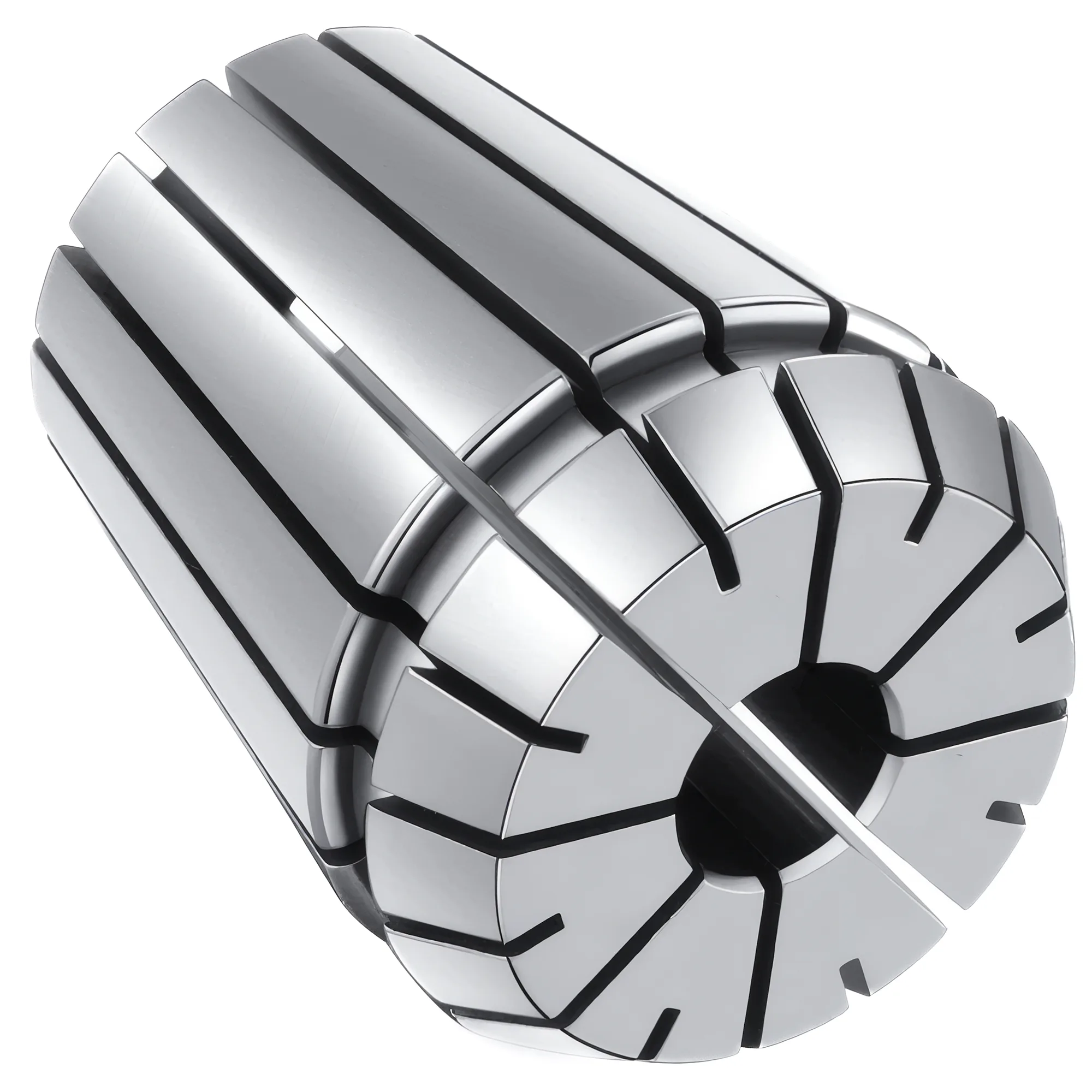
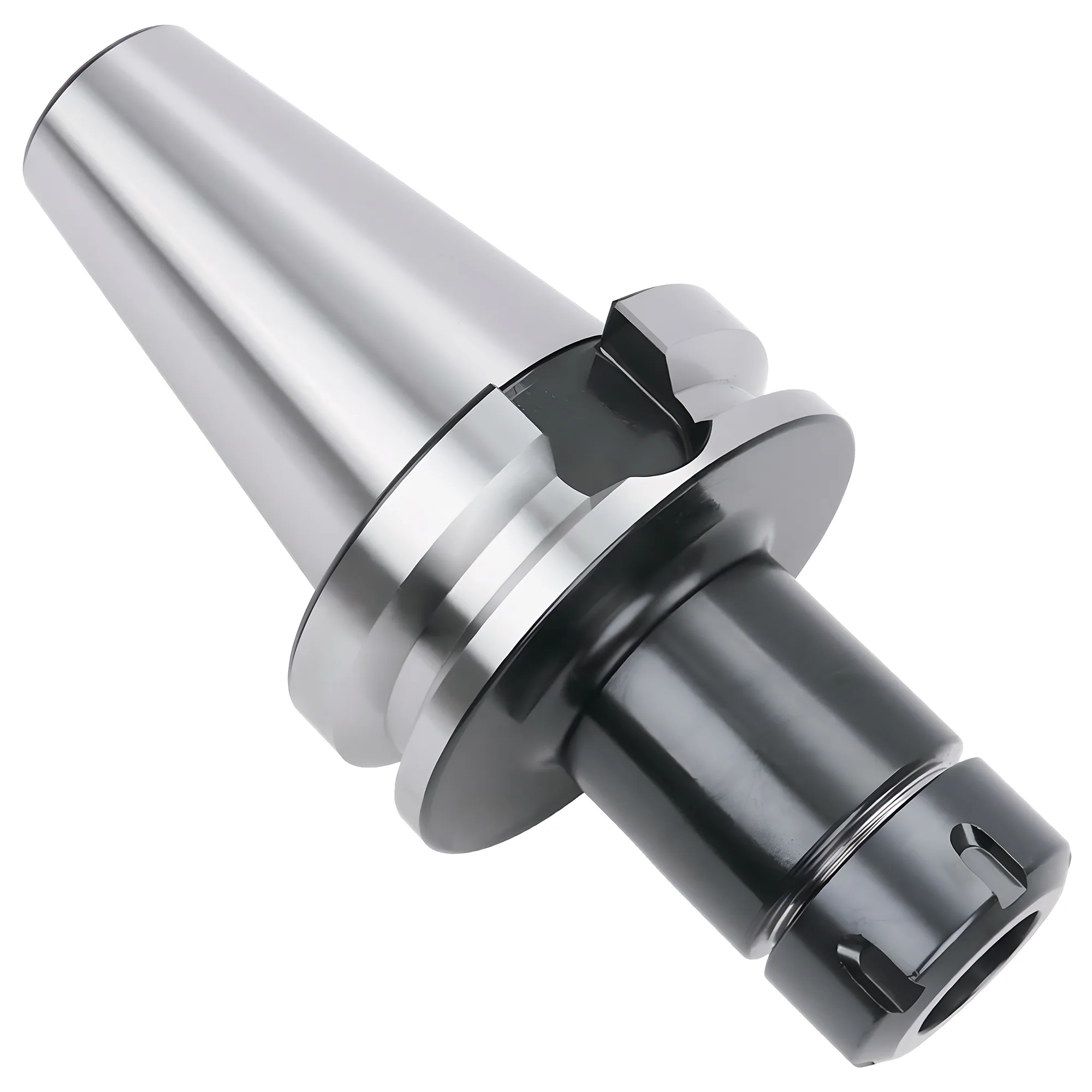
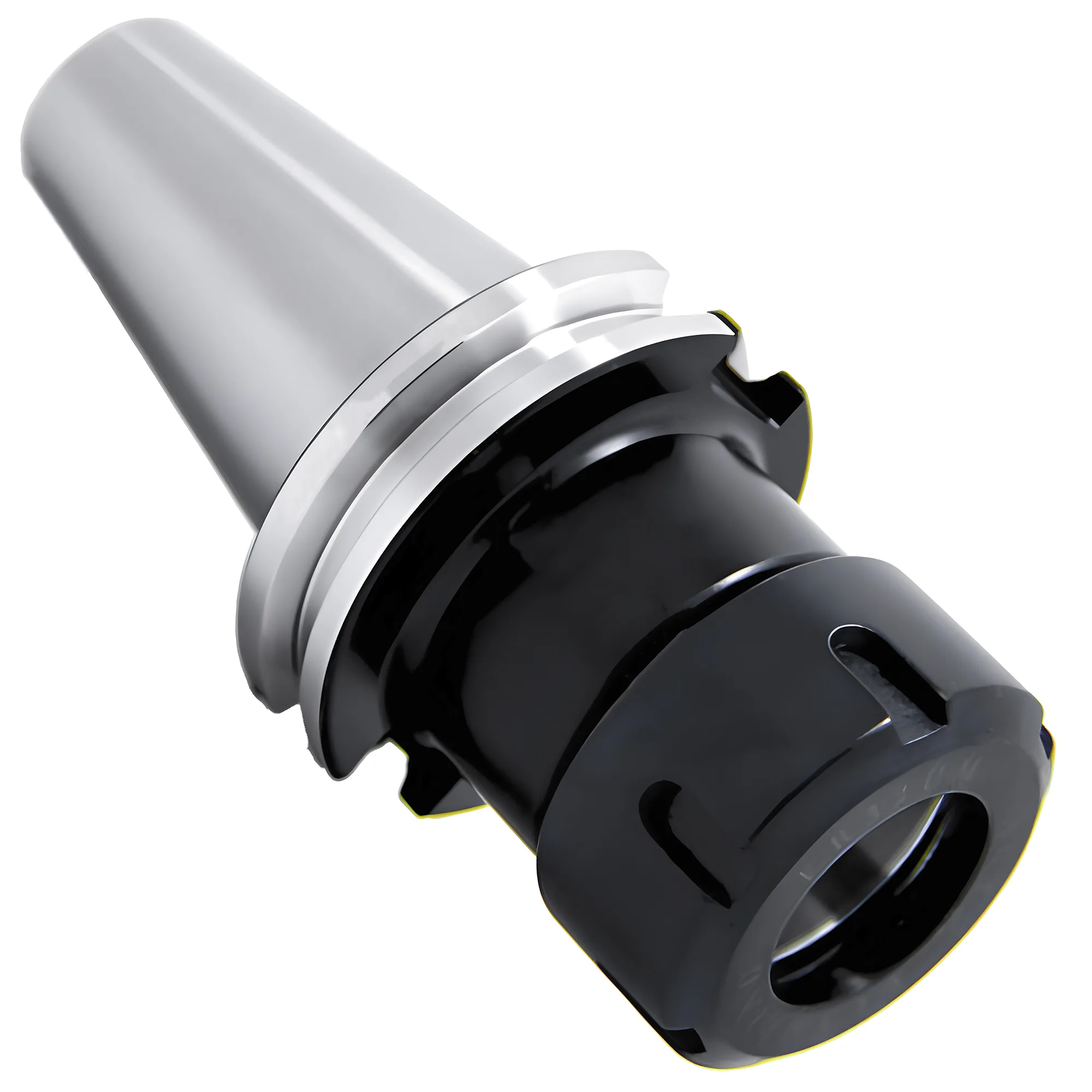
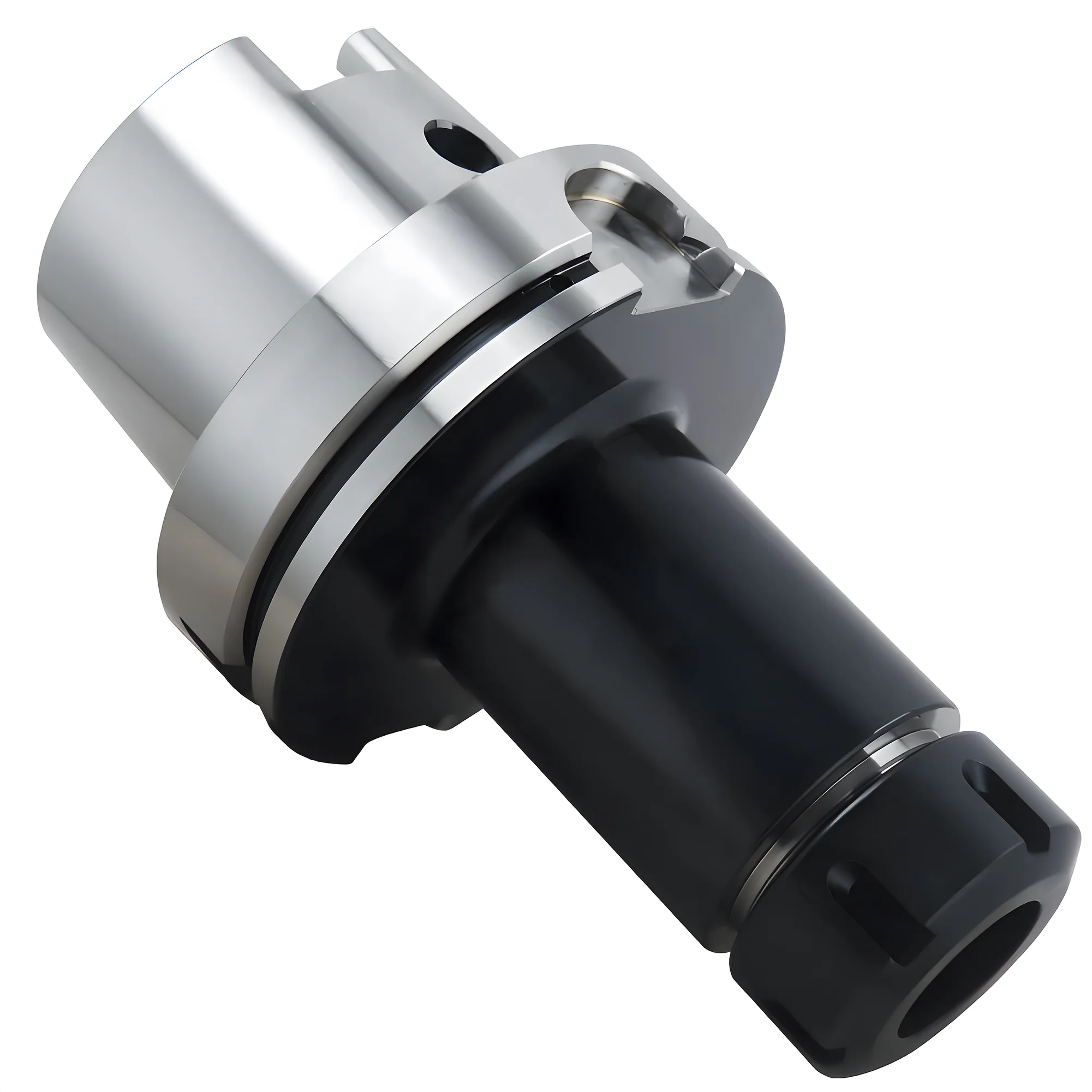
ISO 15488 (DIN 6499) standardizes six ER collet sizes — ER11, ER16, ER20, ER25, ER32 and ER40 — clamping 1 mm to 26 mm shanks; ER8 and ER50 are common manufacturer extensions below and above that range. Class 2 (normal grade) collets hold ≤0.015 mm TIR (d₁ ≤ 10 mm) or ≤0.020 mm TIR (d₁ 10–26 mm) per ISO 15488:2003 Table 4, while manufacturer UP/AA grades reach ≤0.005 mm, tighter than Class 1. Each standard (Form B) ER16–ER40 collet collapses 1 mm (ER11: 0.5 mm), so an ER32 set of 18 collets covers 2-20 mm. Typical estimates put clamping force at 3,000-25,000 N depending on collet size.
For a complete overview of tool holding systems including tapers, chucks, and workholding, see the tool holding complete guide.
ER Collet Size Chart (ER8 to ER50, mm and inch)
The number after "ER" is the holder bore diameter that receives the collet's large end in millimeters — ER32 seats in a 32 mm bore at the large end of the 8° taper, ER40 in a 40 mm bore, and so on per ISO 15488 Table 2. Each size targets a specific tool diameter range and clamping torque envelope.
| ER Size | Holder Bore | ISO 15488 Range (Forms A and B) | Largest Common Inch Collet | In ISO 15488? | Common Applications |
|---|---|---|---|---|---|
| ER8 | 8 mm | Manufacturer-defined, typically up to ~5 mm | ~3/16 in | No | Micro drills, engraving |
| ER11 | 11 mm | 1-7 mm | 1/4 in | Yes | Small end mills, engraving tools |
| ER16 | 16 mm | 1-10 mm | 13/32 in (10.3 mm, at the top of the band) | Yes | Light milling, drilling |
| ER20 | 20 mm | 1-13 mm | 1/2 in | Yes | General purpose machining |
| ER25 | 25 mm | 1-16 mm | 5/8 in | Yes | Standard milling operations |
| ER32 | 32 mm | 2-20 mm | 3/4 in | Yes | Heavy milling, large tools |
| ER40 | 40 mm | 3-26 mm | 1 in | Yes | Heavy duty applications |
| ER50 | 50 mm | Manufacturer-defined, typically up to ~36 mm | ~1-1/4 in | No | Large shanks above 26 mm |
Inch collets are typically made in about 1/32 in steps; the largest inch size is usually the biggest common fraction under each metric maximum, except ER16, where 13/32 in (10.3 mm) sits just above the 10 mm ISO maximum. Many manufacturers also make bores below the ISO minimum (for example 1 mm collets in ER32 or ER40), so check the maker's size chart rather than the nominal series.
ER60 is sometimes searched for, but it is not part of ISO 15488, which ends at ER40; sizes beyond ER40 (ER50 and larger) are manufacturer designs, so collet, nut and holder dimensions should come from one maker's chart.
Clamping Range Considerations
Per ISO 15488, each standard (Form B) ER16–ER40 collet collapses 1 mm and each ER11 collet 0.5 mm, so a full set of 18 ER32 collets covers the entire 2-20 mm shank range without gaps — collets are also commonly stocked in 0.5 mm size steps, but each ER16–ER40 collet still collapses 1 mm, so the half steps overlap rather than extend the range. A collet marked "12" clamps tools from 11-12 mm.
High Precision Option
High-precision collets achieve runout of ≤0.005 mm (5 microns), with some premium grades rated tighter still; like standard collets, they are commonly stocked in 0.5 mm size steps, and each ER16–ER40 collet still collapses 1 mm. Choose these for finishing operations where surface quality is critical.
Class 2 (normal grade) ER collets typically deliver concentricity adequate for general milling at IT8 or looser, while UP precision grades are often preferred for H7 reaming and mold-finishing operations where tool runout amplifies surface error.
ER32 vs ER40: Which Size to Choose
ER32 tops out at a 20 mm (3/4 in) shank and fits 30- and 40-taper holders; ER40 reaches 26 mm (1 in) but needs a larger nut and body, so ER40 is usually worth it only if you regularly run shanks over 20 mm. ER32 is typically the most common ER size for general CNC milling because its 2-20 mm range covers the majority of common end mill and drill shanks while staying compact. Above 26 mm, ER50 (a manufacturer size outside ISO 15488) takes over.
✦ Small Parts & Finishing
- ER8, ER11 or ER16 systems
- Lower clamping force suitable for light cuts
- Ideal for watchmaking, jewelry, micro-machining
✦ Heavy Material Removal
- ER32, ER40 or ER50 systems
- Maximum clamping force
- Required for large diameter tools
For General Machining:
- ER32 is the general-purpose default on 40-taper machines; ER20 or ER25 suit smaller machines
- Most common choice for job shops handling varied work
- Sufficient clamping force for moderate material removal
For an overview of a recent complete ER collet chuck product family, see the ER collet chuck system launch.
Collet Material, Hardness and Nuts
ISO 15488 requires ER collets to be made of steel with a tensile strength of at least 700 N/mm², with the bore and taper hardened to 44-48 HRC (44 +4/0 HRC), while the holder taper bore is hardened to 56-60 HRC (56 +4/0 HRC). Spring steels are the usual choice because the slotted body has to flex back to size after every release.
Nuts are the part of the system that is least interchangeable. ISO 15488 Table 2 fixes a standard nut thread for each size (M22 × 1.5 for ER16, M40 × 1.5 for ER32, M50 × 1.5 for ER40), but mini and other slim nut styles use different threads and outside diameters at the same ER number. A replacement nut has to match the holder's thread, not just the collet size.
Best Practices for ER Collet Use
Standard ER collets typically last 500-1,000 clamping cycles before runout drifts above the ISO 15488 limit; UP grades and clean tapers with a calibrated torque wrench can extend that service life. The five practices below preserve concentricity through long runs.
- Match collet to tool shank - Avoid using an undersized collet; this damages both the collet and tool shank
- Use sealed collets for coolant-through applications to prevent contamination
- Check concentricity with a dial indicator before production runs
- Replace worn collets - Look for marks or deformation on clamping surfaces
- Proper torque - Use a torque wrench for consistent clamping
Avoid Over-Tightening
Excessive torque can deform collets and reduce accuracy. Always follow manufacturer torque specifications and use a calibrated torque wrench.
Collet Maintenance
Clean collet tapers and nuts regularly. Debris in the taper causes runout issues that no amount of tightening can correct.
Summary
For general-purpose CNC milling shops, an ER32 system on 40-taper machines (ER20 or ER25 on smaller machines) typically delivers the best balance of clamping range, torque capacity, and holder availability — heavier ER40 setups are reserved for shanks above 20 mm (3/4 in), and ER50 for shanks above 26 mm.
Quick ER Collet Selection by Application
Use this matrix to pick an ER size, runout class, and use case from the most common machining scenarios — confirm against your spindle taper and tool inventory.
| Scenario | Size | Runout Class | Application | Why |
|---|---|---|---|---|
| Watchmaking, jewelry, micro-machining (≤4 mm tools) | ER11 | UP grade ≤0.005 mm TIR | Engraving, micro end mills, PCB drills | Small body fits compact spindles; UP class concentricity needed because tool diameters amplify runout error |
| Light milling and drilling (1-10 mm tools) | ER16 | Class 2 ≤0.015 mm TIR | Mold detail work, secondary CNC operations | 56 Nm nut torque (standard nut) covers most small-tool jobs without oversizing the holder body |
| General CNC milling, mixed tool inventory (1-13 mm) | ER20 | Class 2 ≤0.015 mm (≤10 mm) / ≤0.020 mm (>10 mm) | Job shop machining, prototype runs | Best balance of range and rigidity for BT30/HSK40 holders; covers most common end mill shanks |
| Standard production milling (1-16 mm tools) | ER25 | Class 2 ≤0.015 mm (≤10 mm) / ≤0.020 mm (>10 mm) | Steel and aluminum production, BT40 holders | 104 Nm nut torque (standard nut) handles aggressive roughing; widely stocked across tool brands |
| Heavy roughing, large end mills (2-20 mm) | ER32 | Class 2 ≤0.015 mm (≤10 mm) / ≤0.020 mm (>10 mm) | Most common CNC milling size | 136 Nm nut torque clamps 20 mm shanks securely; one full set covers the entire mid-range |
| Reaming and finishing on ER32 holders | ER32 | UP grade ≤0.005 mm TIR | H7 reaming, mold finishing | UP grade cuts runout by 3-4x versus Class 2 for tighter hole and finish tolerance |
| Heavy-duty milling, large shanks (3-26 mm) | ER40 | Class 2 ≤0.020 mm TIR (>10 mm) | Roughing in steel, large end mills and drills | 176 Nm nut torque (standard nut, all ER40 bores); large body limits use to BT40+ holders |
| Coolant-through tool feed | Sealed ER (any size) | Per chosen grade | Deep-hole drilling, MQL milling | Sealed collet closes the slots so coolant pressure goes through the tool instead of leaking out between the collet segments |
Match ER size to your heaviest regular operation.
Select an ER system based on your largest commonly-used tool diameter and material removal requirements. ER32 covers most general machining on 40-taper machines (ER20/ER25 on smaller machines), while ER40 handles shanks over 20 mm and ER50 extends past 26 mm. For precision work, invest in high-precision (UP/AA) collets.
DIN 6499 and ISO 15488 define the taper geometry, runout classes, and dimensional tolerances that make ER collets interchangeable across brands — a key reason ER systems have become the dominant tool-holding interface on 30- and 40-taper machining centers worldwide.
Properly selected and maintained ER collets typically last 500-1,000 clamping cycles or more depending on torque discipline and shank tolerance, and should be replaced once runout exceeds the ISO 15488 Class 2 limit.
What sizes do ER collets come in?
ISO 15488 standardizes six ER sizes — ER11, ER16, ER20, ER25, ER32 and ER40 — covering 1-26 mm shanks. ER8 and ER50 are widely made manufacturer extensions below and above that range. Within each size, metric collets are commonly stocked in 0.5 mm or 1 mm size steps and inch collets in about 1/32 in steps; each standard (Form B) ER16–ER40 collet collapses 1 mm (ER11: 0.5 mm).
ER32 vs ER40 — which should I buy?
Pick ER32 if your largest regular shank is 20 mm (3/4 in) or less; it is compact enough for 30-taper holders and is the most widely stocked size. Pick ER40 only for 21-26 mm (up to 1 in) shanks, accepting a larger nut and body that usually means a 40-taper or larger spindle.
Do ER collets from different brands fit the same chuck?
Yes, within the same ER number, because ISO 15488 fixes the 8° taper and the holder bore. The nut is the catch: at the same ER size, standard, mini and other nut styles can use different threads and outside diameters, so a replacement nut must match the holder rather than the collet.
What is the most common ER collet size?
ER32 is the most widely used size, covering a 2-20 mm clamping range with Class 2 (normal grade) runout of ≤0.015-0.020 mm TIR depending on bore, per ISO 15488. Its span suits the majority of common end mill and drill shank diameters in general machining, and a full set of 18 collets covers the range in 1 mm increments.
Can I use an ER20 collet in an ER32 chuck?
No — ER sizes are not interchangeable. Each size seats in a different 8° taper bore (ER20 = 20 mm, ER32 = 32 mm per ISO 15488 Table 2) and has a different clamping range (1-13 mm vs 2-20 mm). Forcing a mismatched collet damages both the collet taper and the chuck body.
How often should ER collets be replaced?
Standard ER collets typically last 500-1,000 clamping cycles before runout drifts above the ISO 15488 limit, and consistent torque wrench use with h6-tolerance shanks extends that life. Check runout with a dial indicator at each setup and replace any collet exceeding the ISO 15488 Class 2 limit on two consecutive clean setups.
What is the difference between Class 2 and high-precision ER collets?
Class 2 (normal grade) collets hold runout to ≤0.015 mm TIR (d₁ ≤ 10 mm) or ≤0.020 mm TIR (d₁ 10–26 mm), per ISO 15488:2003 Table 4. High-precision (UP/AA grade) collets achieve runout ≤0.005 mm TIR, a manufacturer grade tighter than Class 1. Grade does not change the clamping range: a standard (Form B) ER16–ER40 collet collapses 1 mm (ER11: 0.5 mm) in either grade.