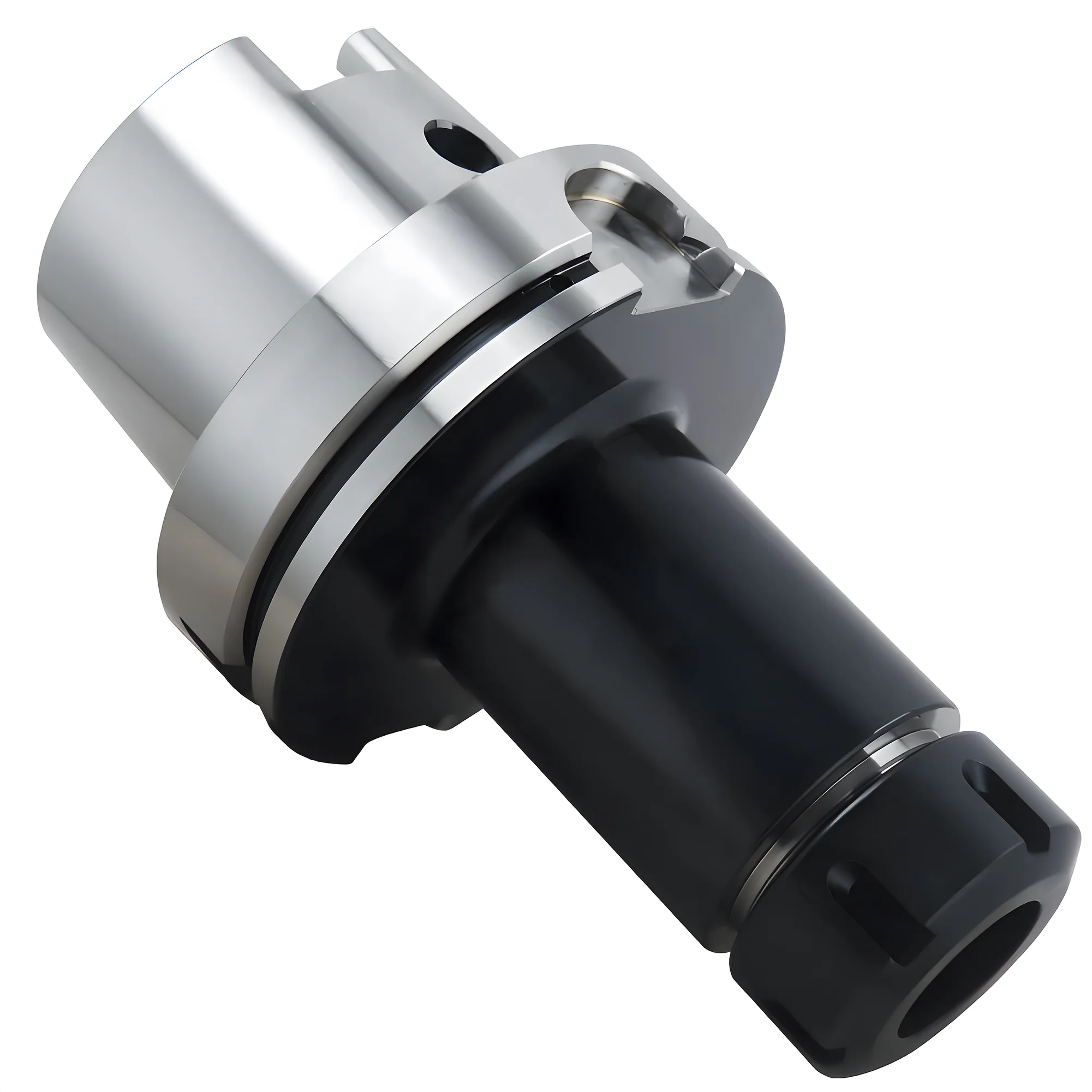
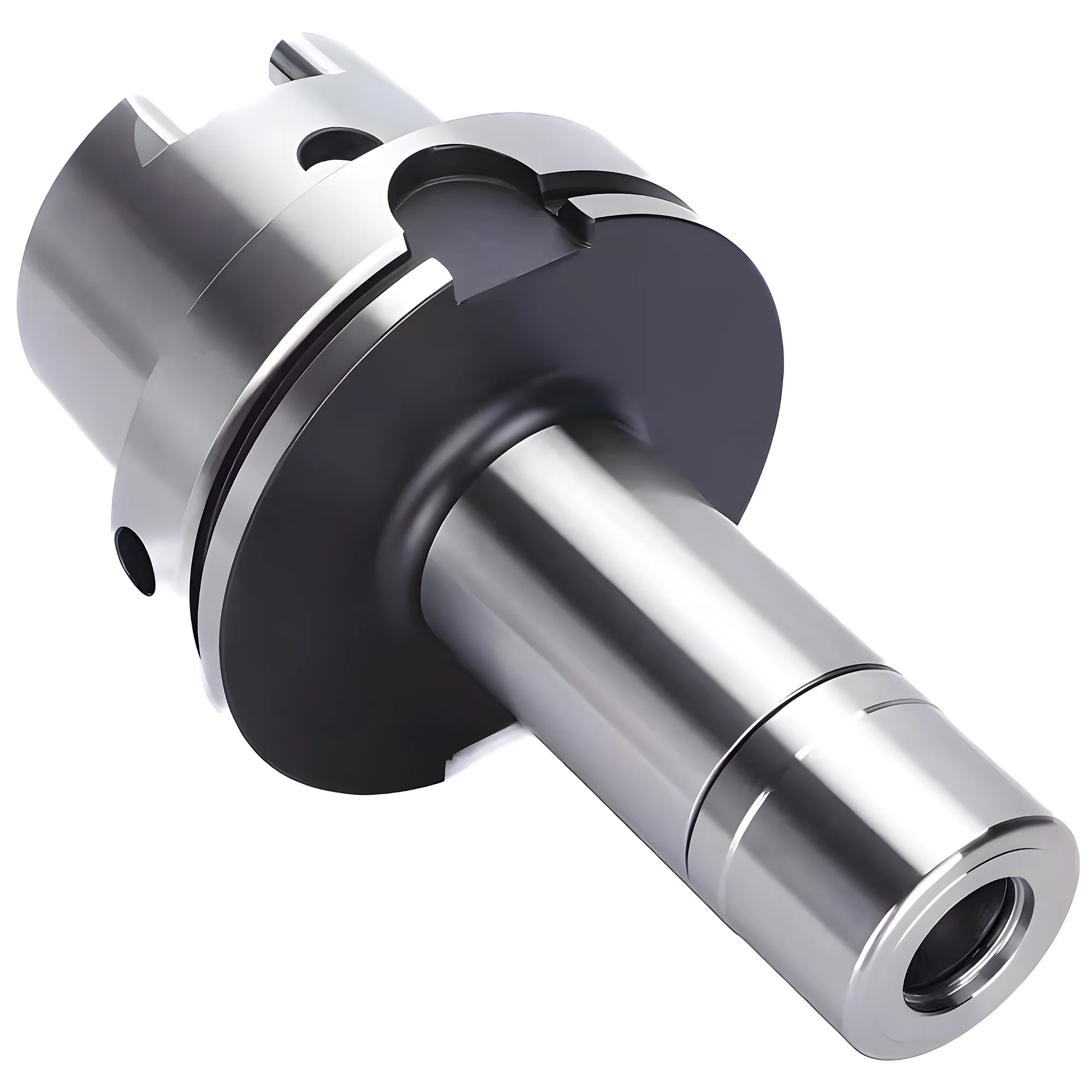
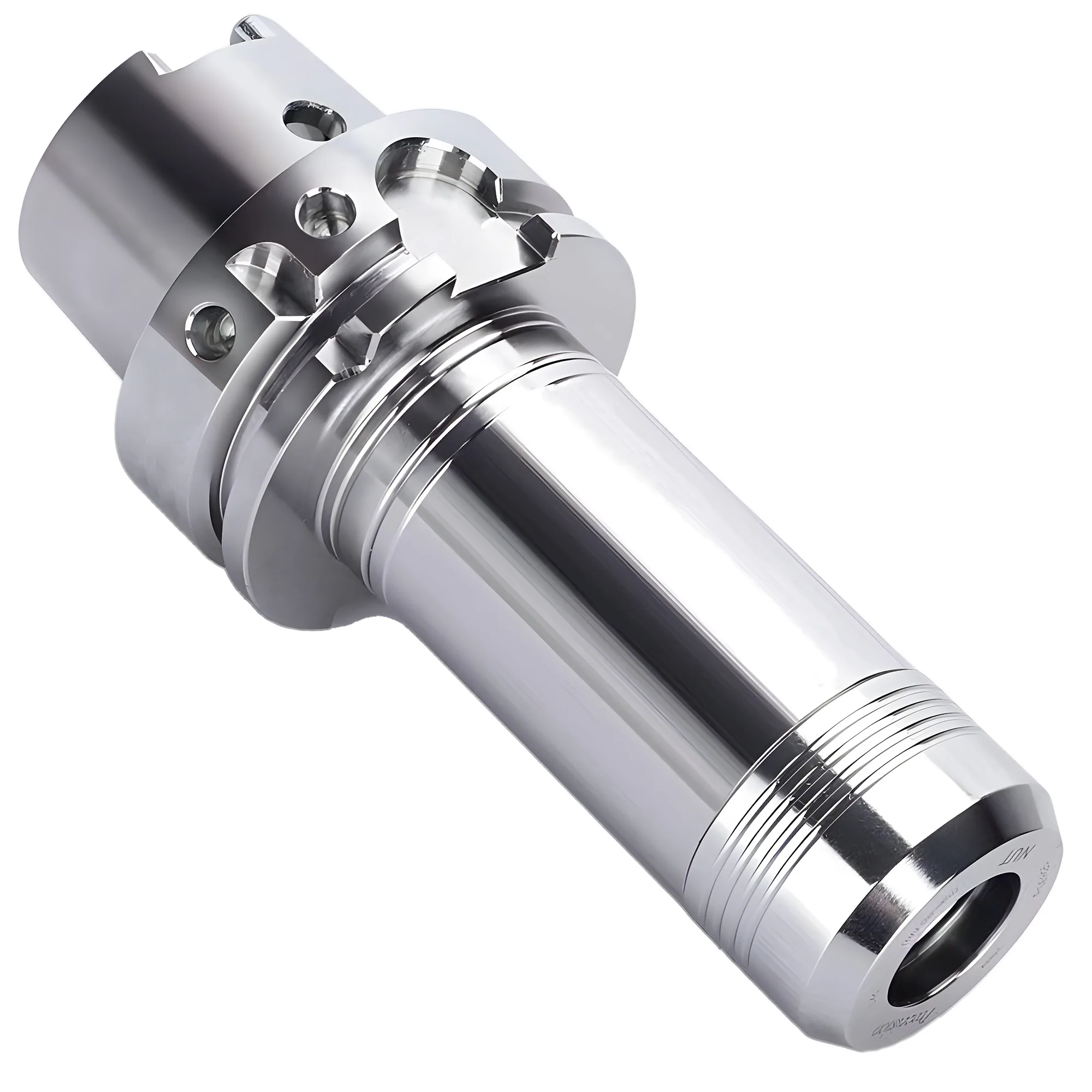
An HSK-SDC pull-back collet chuck is a slim-nose tool holder for small shanks — typically 2–12 mm across SDC04 to SDC12 collets — whose one-piece collet is drawn back toward the spindle as it clamps, so the cutter is pulled into the holder rather than pushed out of it. Choose it for small-diameter tools that must reach into deep, narrow pockets past a fixture or a part wall. Choose an ER collet chuck when you need broad shank coverage (about 1–26 mm across ER16–ER40 per ISO 15488, more with the ER50 extension) and the larger nose is not in the way.
The pull-back collet chuck answers a narrow question: how do you hold a 3 mm or 6 mm cutter on an HSK spindle when an ER nut is too fat to get where the tool has to go? This guide covers how the pull-back design works, the SDC collet sizes, which HSK shanks carry it, and how it compares with the other collet systems an HSK-63 holder can take. For ER sizing itself, see the ER collet selection guide.
What Is an HSK-SDC Pull-Back Collet Chuck?
SDC is a manufacturer collet designation, not an ISO collet standard: an SDC chuck takes a one-piece SDC collet sized to its seat, and the clamping action draws that collet back into the holder body. The shank side is a standard HSK hollow taper to DIN 69893 (the same geometry ISO 12164 covers), so the chuck fits any HSK spindle of the matching size and form.
The phrase "pull back collet chuck" is also used for lathe spindle-nose chucks that grip the workpiece. An HSK-SDC chuck is not one of those — it is a rotating tool holder that grips the cutter shank on a machining center.
The defining feature is the direction of travel: an ER nut drives the collet forward into its taper, while an SDC chuck pulls the collet rearward toward the spindle. Because the collet moves toward the gauge line as it closes, the clamping motion cannot creep the cutter out of the holder, and the nose can be built far slimmer than a body that has to carry an external ER clamping nut.
Pull-Back vs Push-Forward: Why the Nose Gets Slimmer
In an ER collet chuck, the clamping nut threads onto the outside of the holder nose and pushes the collet forward into an 8° taper bore (ISO 15488). The nut has to surround the collet, so the nose diameter is set by the nut: per ISO 15488 Table 3, a standard ER16 nut is 32 mm across, an ER20 nut 35 mm and an ER25 nut 42 mm. Mini-type ER nuts are slimmer — an ER16 mini nut is about 22 mm — but still wrap around the collet.
In an SDC pull-back chuck, there is no nut wrapped around the nose. The collet is drawn back into the body, so the nose only has to enclose the collet itself.
At the tool, an SDC06 nose of roughly 14 mm compares with 32 mm for a standard ER16 nut holding the same 6 mm shank — less than half the diameter that has to clear the fixture and the pocket wall. That clearance, multiplied over a long projection, is the reason to buy a pull-back chuck.
| Factor | ER Collet Chuck (Push-Forward) | SDC Pull-Back Collet Chuck |
|---|---|---|
| Collet movement during clamping | Forward, into the taper | Rearward, toward the spindle |
| Clamping element at the nose | External threaded nut | None — collet drawn into the body |
| Nose diameter for a 6 mm shank | 32 mm (standard ER16 nut, ISO 15488 Table 3); about 22 mm with a mini nut | Roughly 14 mm (SDC06, typical catalog) |
| Shank range per holder | About 1–10 mm (ER16) to 3–26 mm (ER40) | Typically 2–12 mm across SDC04–SDC12 |
| Collet standard | ISO 15488 / DIN 6499 — interchangeable across brands | Manufacturer-specific SDC |
| Best fit | General milling, drilling, broad tool mix | Small tools in deep, narrow features |
Collet Compatibility Note
SDC collets are not interchangeable with ER collets. Order collets by the chuck's SDC size (SDC04, SDC06, SDC08 or SDC12) and the shank diameter, and check the collet against the chuck maker's chart — SDC dimensions are not standardized across brands the way ISO 15488 ER collets are.
SDC Collet Sizes and HSK Shank Options
Each SDC size covers a band of shanks that starts at 2 or 3 mm, so the choice is driven by the largest tool you need to hold and the nose diameter you can afford. In typical catalogs, SDC04 takes 2–4 mm, SDC06 2–6 mm, SDC08 2–8 mm and SDC12 3–12 mm. Pick the smallest SDC size that covers your largest shank: it gives the slimmest nose.
On the shank side, HSK-A50, HSK-A63 and HSK-A100 bodies are common, along with the high-speed HSK-E40 and HSK-E50 forms. HSK Forms E and F omit the drive slots of Form A, which gives a symmetric body that balances better at high speed (DIN 69893). The smaller HSK-E bodies usually stop at SDC08.
Projection is the second decision. Catalog lengths run from roughly 60 mm to 250 mm. Choose the shortest projection that clears the part: tilt error and deflection both grow with distance from the gauge line, so every extra millimeter of reach costs some accuracy. The slim nose is what lets a short tool reach a deep feature without a long, flexible tool overhang — the holder carries the reach instead of the cutter.
Which Collets Fit an HSK-63 Holder?
An HSK-63 spindle does not dictate a collet system — the chuck mounted on the taper does. The same HSK-A63 shank is built into several collet chuck families, each with its own collets:
| Collet System on HSK-A63 | Typical Shank Range | Collet Standard | Best For |
|---|---|---|---|
| ER collet chuck | About 1–26 mm (ER16–ER40); to 34 mm with ER50 | ISO 15488 / DIN 6499 | General milling and drilling, broadest tool mix |
| Precision (PGER-class) ER chuck | About 3–20 mm | Standard ER collets, chuck-specific nut | Finishing where runout limits tool life |
| SK-type (GSK) collet chuck | About 1–25 mm | Manufacturer SK seats | Continuous clamping range per seat |
| SDC pull-back collet chuck | Typically 2–12 mm | Manufacturer SDC | Small tools in deep, narrow features |
| C-type power milling chuck | Up to 42 mm | Manufacturer C-type | Heavy roughing on large shanks |
When you search for an "HSK 63 collet," the answer depends on the chuck: identify the collet system printed on the holder (ER, SK, SDC or C) before ordering collets. For high-torque roughing, a pull-back chuck is the wrong tool — a power milling chuck or a side-lock holder carries that load. For ER sizing within the ER family, the ER collet selection guide covers the trade-offs.
Runout and Speed: What to Check on the Data Sheet
Runout for an SDC chuck is a manufacturer rating, not a standardized class, so compare catalog figures only when the measuring method — gauge pin, projection and indicator position — is stated. ER collets have a standardized baseline: ISO 15488 Class 2 allows ≤0.015 mm TIR for d₁ ≤ 10 mm and ≤0.020 mm for d₁ 10–26 mm, and manufacturer UP/AA collet grades reach ≤0.005 mm TIR. No equivalent standard covers SDC collets.
Runout matters most on exactly the small tools SDC chucks hold. Each 0.0001 inch (2.5 µm) of runout reduces tool life by approximately 10% (BIG DAISHOWA one-tenth rule), and on a 2–6 mm cutter the same runout is a far larger share of the chip load than on a 20 mm tool.
Speed is set by the shank form, balance and the maker's rating rather than by the collet type. HSK-A63 holders typically run in production at 15,000–25,000 RPM, while slot-free HSK-E variants reach 40,000+ RPM; DIN 69893 defines the geometry, not a speed limit. Balance grade follows ISO 1940-1, where the permissible specific unbalance is e_per ≈ 9549 × G / n (g·mm/kg, n in RPM) — doubling spindle speed halves the unbalance a holder may carry at a given grade. Check the chuck's balance rating against your spindle speed before running small tools fast. For the taper side of the decision, see the BT, CAT and HSK comparison.
When to Choose HSK-SDC vs an ER Collet Chuck
✦ HSK-SDC Pull-Back Best For
- Small cutters (typically 2–12 mm) that must reach past a fixture or into a deep, narrow pocket
- Mold and die detail work where nose clearance limits the toolpath
- Keeping cutter overhang short by letting a slim holder carry the reach
- HSK-A and HSK-E spindles already in the shop
✦ ER Collet Chuck Best For
- Broad shank coverage from about 1 mm up to 26 mm (ER40), or more with ER50
- Brand-interchangeable collets under ISO 15488 / DIN 6499
- Drilling, tapping and general milling where nose diameter is not a constraint
- BT and CAT spindles as well as HSK
Quick Selection Table
| Scenario | Recommended Holder | Why |
|---|---|---|
| 3 mm ball-nose finishing a deep rib in a mold | HSK-SDC (SDC04 or SDC06) | Slim nose clears the rib walls; short cutter overhang |
| 6 mm end mill, open part, general milling | ER collet chuck (ER16–ER25) | Nose clearance not limiting; standard collets |
| 10–12 mm tool reaching past a tall clamp | HSK-SDC (SDC12) | Pull-back nose is slimmer than a standard ER20 or ER25 nut |
| 16–20 mm roughing end mill | ER collet chuck or power milling chuck | Outside SDC range; needs grip, not slimness |
| Mixed drilling and milling, many diameters | ER collet chuck | One holder plus a collet set covers the widest range |
Choose HSK-SDC for slim reach with small tools; choose ER for range and interchangeability.
An HSK-SDC pull-back collet chuck typically holds 2–12 mm shanks in a one-piece collet drawn back toward the spindle, which removes the external nut and gives a nose less than half the diameter of a standard ER16 nut. Choose it when nose clearance, not grip or shank range, limits the job; choose an ER collet chuck for broad shank coverage, standardized collets and general milling and drilling. Compare SDC runout only against stated measuring conditions, because no ISO class covers SDC collets.
What is an HSK SDC collet chuck?
An HSK SDC chuck is a slim-nose tool holder whose one-piece SDC collet is drawn back toward the spindle as it clamps, so the cutter is pulled in rather than pushed out of the holder. Common SDC04 to SDC12 collets cover 2 to 12 mm shanks, on HSK-A and HSK-E shanks to DIN 69893.
What is a pull back collet chuck used for?
A pull back collet chuck holds small cutters where an ER nut would be too large. Because the collet is drawn into the body instead of clamped by an external nut, the nose stays slim, letting 2 to 12 mm tools reach into deep, narrow pockets and past fixtures with a short cutter overhang. It is not meant for heavy roughing.
What collets fit an HSK 63 holder?
HSK-63 holders take several collet systems. ER chucks cover about 1 to 34 mm through ER16 to ER50 collets; SK-type (GSK) seats hold 1 to 25 mm; SDC pull-back chucks hold 2 to 12 mm for slim reach; and C-type power milling chucks grip up to 42 mm for roughing. The holder, not the HSK taper, decides which collet fits.
Can I use ER collets in an SDC chuck?
No. An SDC chuck takes only one-piece SDC collets sized to its seat, such as SDC06 for 2 to 6 mm shanks. ER collets follow the ISO 15488 8° geometry and are clamped forward by a threaded nut, so they neither fit the SDC seat nor clamp correctly in it. Order collets by the chuck's SDC size.
How fast can an HSK SDC chuck run?
The speed limit comes from the HSK shank form, balance grade and the maker's rating, not from the SDC collet. HSK-A63 holders typically run at 15,000 to 25,000 RPM in production, while slot-free HSK-E shanks reach 40,000 RPM or more. Check the chuck's stated balance grade under ISO 1940-1 against your spindle speed.
Sources
- DIN 69893 / ISO 12164 — HSK Hollow-Shank Taper Specifications
- ISO 15488:2003 — Collets with 8° setting angle for tool shanks — Collets, nuts and fitting dimensions
- ISO 1940-1:2003 — Balance quality requirements for rotors in a constant (rigid) state
- BIG DAISHOWA — The One Tenth = 10% Rule and Effects of Runout