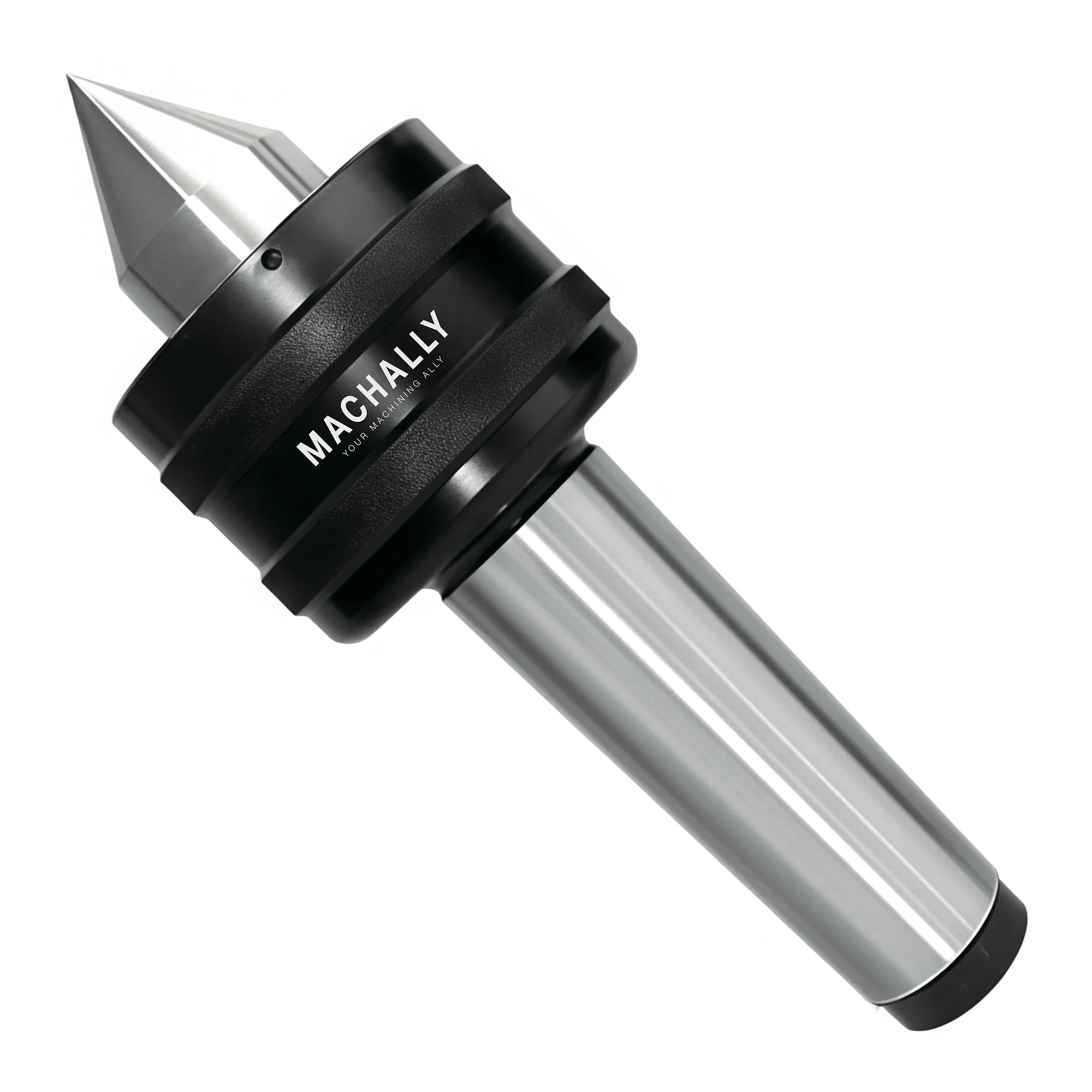
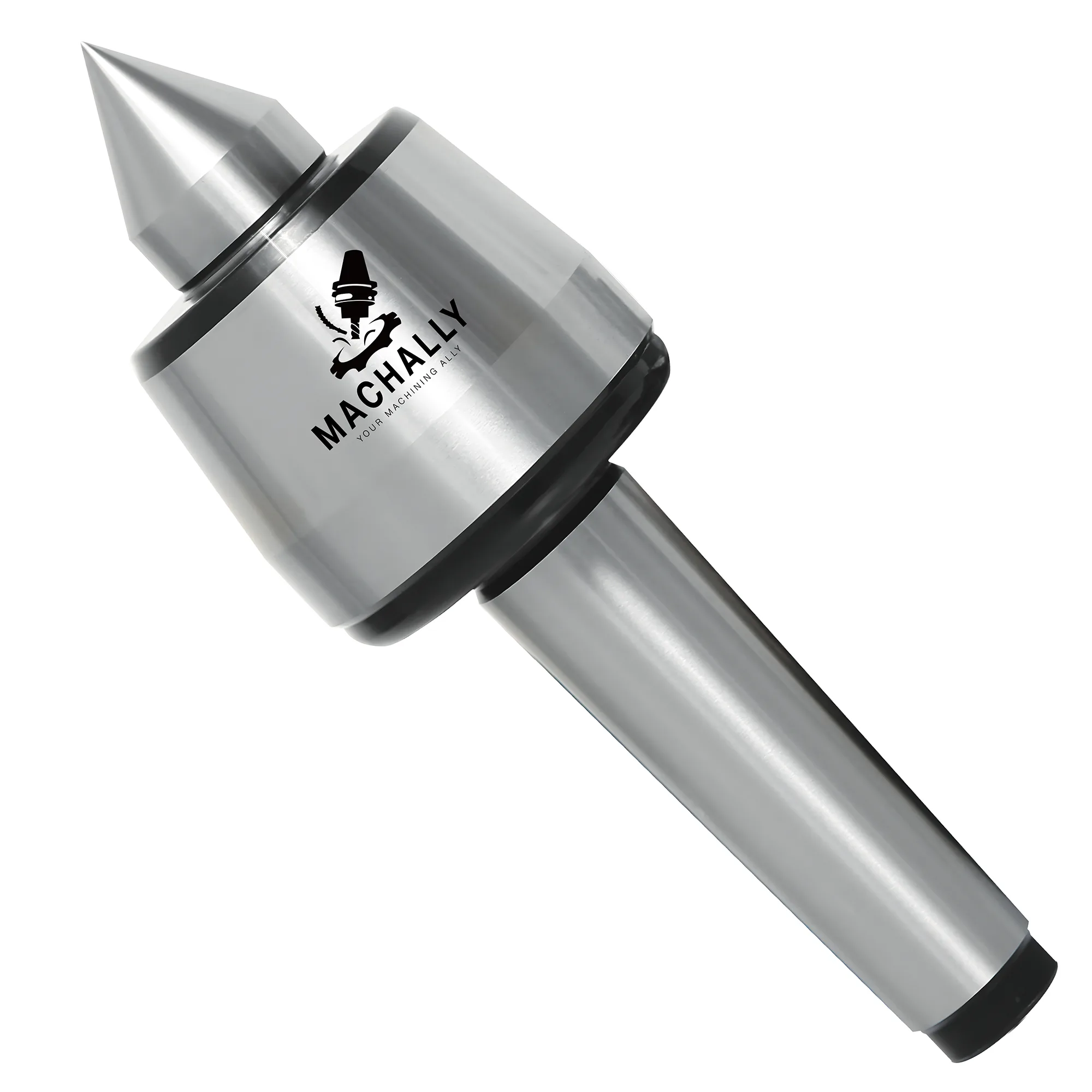
Pick a standard 60° live center for general turning under ~50 kg and 3,000 RPM. Switch to a heavy-duty taper-roller model when workpiece mass exceeds ~200 kg, and to a high-speed angular-contact ball-bearing model above ~4,000 RPM where 0.005 mm class accuracy is needed. Use a bull-nose center for hollow shaft and pipe ends where a 60° point cannot reach a usable bearing surface. Morse taper size (MT2-MT6 per DIN 228 / ISO 296) is set by the tailstock, not the application.
For the broader workholding category — vises, lathe chucks, and live center families at a glance — see the workholding selection guide. This article focuses one level deeper on matching live center type to load and RPM profile.
The Four Live Center Families and What They Solve
A live center supports the tailstock end of a between-centers workpiece on a lathe, rotating with the part on its own bearings so the contact point sees no relative sliding. Live centers are differentiated by bearing arrangement and point geometry, and the choice cascades from one variable: whether load capacity, RPM ceiling, accuracy class, or end-face geometry is the binding constraint.
The four practical families on a typical engine lathe or CNC turning center are:
| Family | Bearing System | Point Geometry | Primary Job |
|---|---|---|---|
| Standard | 1-2 ball bearings + thrust | 60° solid or carbide-tipped | General turning, light-medium loads |
| Heavy-duty | Taper roller bearings | 60° solid, often hardened | High radial load, roughing |
| High-speed | Precision angular-contact ball | 60° hardened or carbide | High RPM finishing |
| Bull-nose | Multi-bearing | Large flat or conical face | Tube ends, hollow shafts |
A pipe center (a sub-class of bull-nose with a stepped male cone) handles tube ends with a defined wall thickness and is sometimes treated as its own family.
Bearing Type Drives the Speed-vs-Load Trade-off
The bearing pack inside a live center is what fixes the working envelope. Precision angular-contact ball bearings (typically ABEC-7 / ISO 492 P4 class) carry low-to-medium thrust at high speed, while taper roller bearings carry several times the radial load but cap RPM lower because of higher friction torque and heat generation. This is the single most important specification when comparing two centers.
| Bearing Type | Typical RPM Ceiling | Typical Load Capacity (MT4) | Wear Mode |
|---|---|---|---|
| Single-row ball | 3,000-4,000 | ~250-400 kg | Brinelling under shock |
| Angular-contact ball (paired) | 5,000-6,000+ | ~400-800 kg | Cage fatigue at speed |
| Taper roller (paired) | 2,500-3,500 | ~1,500-2,500 kg | Surface fatigue (spalling) |
| Combined ball + taper roller | 3,500-4,500 | ~800-1,500 kg | Mixed |
Approximate values vary by manufacturer, internal preload, bore size, and lubrication; treat them as ranges from product literature, not single-point specs. Schaeffler/FAG and SKF catalog data backs the general scaling. The mechanism is geometric: ball bearings make point contact (low friction, lower load) while tapered rollers make line contact (higher load, higher friction). GCr15 is the standard bearing-race material in nearly all precision live centers because its through-hardened structure (HRC 60-65 per typical heat treatment) resists the rolling-contact fatigue that dominates bearing life.
Pair Speed and Load Before Anything Else
Plot the work envelope (max workpiece mass and max spindle RPM) for the next 12 months of jobs and pick a live center whose published curve covers both points with at least 30% margin. Buying for "the heaviest job we might ever do" without checking the RPM cap usually leaves the live center under-sized at the actual production point.
Accuracy Class: When Does AA Pay For Itself?
Live center runout is typically published as TIR (total indicated reading) at the point, with two grades on the market:
- Class A — runout ≤0.005 mm at the point under no-load
- Class AA — runout ≤0.003 mm at the point under no-load
Class A is sufficient for general turning, roughing, and most second-op work where the chuck end already dominates the runout chain. Class AA is justified mainly when the live-center end is the reference for a finishing pass or grinding operation, because the live center's runout adds vectorially to spindle and chuck runout at the tailstock half of the part. A class upgrade on a center that only sees roughing has no measurable yield improvement and costs roughly 1.5-2x more.
The relevant supporting standard for bearing classes is ISO 492 (rolling bearing tolerance classes): higher classes (P4, P2) tighten radial and axial runout limits, which is what most "AA" live centers actually deliver internally. ISO 492 is preferred over older ABEC numbering when reading manufacturer datasheets because ABEC technically only covers ball bearings.
Don't Buy Class AA For a Worn Tailstock
A 0.003 mm live center mounted in a tailstock whose Morse taper bore has 0.02 mm of bell-mouth wear simply transmits the larger error to the part. Verify tailstock taper integrity (DTI sweep on a clean precision arbor in the bore) before paying the AA premium — replace the sleeve or recondition the bore first if the as-installed runout exceeds 0.01 mm.
Workpiece Mass Bands and Their Recommended Center
The selection variable that maps most directly to the live-center type is workpiece mass — specifically, the mass borne at the tailstock end (typically 30-50% of total mass for a uniform shaft supported between centers, varying with the part's weight distribution).
| Mass at Tailstock End | Typical Total Workpiece | Recommended Family | Bearing Pack |
|---|---|---|---|
| <50 kg | <150 kg shafts, light bar work | Standard | Single-row ball + thrust |
| 50-200 kg | Medium shafts, typical engine-lathe production | Standard or HD | Paired ball or light taper roller |
| 200-500 kg | Heavy shafts, large bar | Heavy-duty | Paired taper roller |
| >500 kg | Large turbine shafts, heavy crankshafts | Heavy-duty (MT5/MT6) | Multi-row taper roller |
Shock loading from interrupted cuts effectively multiplies the static load 1.5-3x, so a roughing application with intermittent contact (e.g., flat-on-shaft milling between centers) should be sized one mass band higher than the static workpiece weight suggests. Hardened steel centers (Cr12MoV ground to HRC 60 typically) survive this better than annealed-steel cores; Cr12MoV is preferred for live-center spindles because its high carbon and chromium content yield wear resistance and dimensional stability after heat treatment.
RPM Ceiling and the Path to High-Speed Centers
Above approximately 4,000 RPM on an MT3 or MT4 platform, a standard live center starts to lose accuracy because of bearing dynamics — internal heat raises preload, increases friction torque, and at the limit causes thermal runaway. High-speed live centers solve this by combining angular-contact ball bearings (ISO 492 P4 class typically) with sealed-for-life synthetic grease rated to 120-150°C and tighter runout tolerance, sustaining 5,000-6,000 RPM continuously without measurable accuracy loss.
Where the mass-RPM combination is extreme — above 6,000 RPM on parts heavier than 50 kg — purpose-built live centers with carbide tip inserts and oil-mist lubrication are usually needed. These applications are uncommon in general jobshops and start to overlap with grinding-machine workhead designs rather than lathe live centers.
When Is a Bull-Nose or Pipe Center the Right Answer?
A 60° point only works when the workpiece has a usable center hole or a solid end face that can accept one. Bull-nose centers replace the point with a large conical or spherical face (typically 50-300 mm in diameter) that contacts the inside of a hollow shaft or tube end, supporting workpieces where drilling a center hole is impossible or undesirable. Pipe centers are a closely related variant with a stepped male cone sized to a specific tube ID range.
The bull-nose family typically applies to:
- Hollow shafts and tubular workpieces
- Pre-bored parts where a center hole cannot be added
- Large-OD short workpieces where face support beats point support
- Spline shafts where the male spline overlaps the end and prevents a 60° contact
Bull-nose runout is harder to control than a 60° point because the contact diameter is much larger — 0.005 mm at a 200 mm bull-nose face translates into a tighter angular tolerance on the bearing pack than the same number at a 12 mm point. As a result, bull-nose centers are normally Class A only, with Class AA reserved for special-order grinding-spec models.
Pipe Centers Need Wall-Thickness Verification
A pipe center transfers the tailstock thrust into the tube wall over a small contact band. A wall thinner than ~3 mm at the engagement diameter can deform plastically under typical roughing thrust, ovalizing the tube end and ruining downstream grinding registration. Either lighten the cut or use a bull-nose with face contact instead.
Morse Taper Size and Lubrication Strategy
Morse taper size (MT2-MT6 per DIN 228 / ISO 296) is fixed by the tailstock and only constrains live center selection by how much physical room there is for bearings inside the body. ISO 296 defines the metric self-holding taper interface dimensions; DIN 228-1 covers metric Morse tapers and DIN 228-2 covers reduced-shank adaptors. As taper size increases, the body diameter grows (MT2 ≈ 17.78 mm at the gauge line; MT5 ≈ 44.4 mm), allowing larger bearing IDs and therefore higher load capacity at the cost of weight and inertia. MT3 and MT4 cover the great majority of engine-lathe and turning-center production work; MT5 and MT6 appear on heavy industrial lathes for shafts >500 kg, while MT2 shows up on smaller toolroom lathes and second operations.
Lubrication strategy splits the market into two camps:
- Sealed-for-life — synthetic grease, no maintenance, finite service life (typically 2,000-5,000 hours of cumulative use depending on duty and temperature). Default for most modern high-speed and standard centers.
- Greaseable — a lubrication fitting (often a Zerk-style nipple) on the body. Service interval is typically 200-500 hours for heavy duty cycles. Most heavy-duty multi-row taper-roller centers are greaseable to allow re-lubrication between bearing-pack rebuilds.
Once the taper, bearings, and centers are matched, downstream rigidity becomes the next variable in the chain — for the turning side, see the boring bar selection guide for length-to-diameter and damping considerations on internal cuts. For setting up the lathe end-to-end, see the CNC tooling setup beginner guide for taper integrity and runout chain checks.
Quick Selection Table
| Scenario | Workpiece Weight | RPM Target | Bearing Type | Accuracy Class | Recommended Type |
|---|---|---|---|---|---|
| Light jobshop turning, MT3 tailstock | <50 kg | <3,000 | Single-row ball + thrust | A (0.005 mm) | Standard |
| Production turning, medium shafts | 50-200 kg | 2,000-3,500 | Paired ball or light taper roller | A (0.005 mm) | Standard or entry HD |
| Roughing heavy shafts | 200-500 kg | 1,000-2,500 | Paired taper roller | A (0.005 mm) | Heavy-duty MT4/MT5 |
| Large industrial shafts | >500 kg | 600-1,500 | Multi-row taper roller | A (0.005 mm) | Heavy-duty MT5/MT6 |
| CNC finishing at high RPM | <80 kg | 4,000-6,000 | Angular-contact ball (P4) | AA (0.003 mm) | High-speed |
| Grinding-spec setup, finish reference | <100 kg | 1,500-4,000 | Angular-contact ball (P4) | AA (0.003 mm) | High-speed Class AA |
| Hollow shaft / tube end support | Varies | 800-2,500 | Multi-bearing | A (0.005 mm) | Bull-nose |
| Pipe end with verified wall thickness | Varies | 800-2,000 | Paired ball | A (0.005 mm) | Pipe center |
Type follows load and RPM — taper size follows the tailstock.
Typically pick a standard live center for general turning under 200 kg and 3,000 RPM, switch to a heavy-duty taper-roller model when workpiece mass exceeds 200 kg, and pick a high-speed angular-contact center above 4,000 RPM. Reserve Class AA accuracy for setups where the tailstock end is the finish or grinding reference; bull-nose and pipe centers are the only correct answer for hollow ends and tube faces. The Morse taper number (MT2-MT6 per DIN 228 / ISO 296) is determined by the tailstock — match it, then optimize bearings and class for the work envelope.
How do I choose a Morse taper size for a live center?
Match the live center taper to the tailstock taper — MT3-MT4 covers most engine and CNC lathes, MT5-MT6 appears on heavy industrial lathes (typically for shafts above 500 kg), and MT2 shows up on smaller toolroom machines. Per DIN 228 / ISO 296, the taper number is fixed by the tailstock bore, not by the application.
What's the practical RPM ceiling for a standard versus high-speed live center?
Standard live centers typically run 1,500-3,500 RPM with ball-bearing packs, while high-speed models with paired angular-contact ball bearings (ISO 492 P4 class) sustain 5,000-6,000 RPM continuously. Above 4,000 RPM a standard center starts losing accuracy from internal heat and preload growth, so step up to a high-speed model.
When does a heavy-duty live center pay off?
Choose heavy-duty when workpiece mass exceeds approximately 200 kg or when interrupted cuts effectively multiply static load 1.5-3x into the medium-load band. Taper roller bearings carry roughly 3-5x the radial load of equivalent ball bearings, at the cost of an RPM ceiling around 2,500-3,500.
Is Class AA accuracy worth the price upgrade?
Class AA (≤0.003 mm runout) typically costs 1.5-2x Class A (≤0.005 mm) and is usually only justified when the tailstock end is the finishing or grinding reference. For roughing or chuck-dominated setups, Class A delivers sufficient accuracy because the live center's runout is small relative to spindle and chuck error.
When should I choose a bull-nose or pipe center over a 60° point?
Use a bull-nose when the workpiece has a hollow end or pre-bored bore that prevents a 60° point from contacting solid material — typical for tubes, hollow shafts, and large-OD short parts. Pipe centers fit specific tube ID ranges and require wall thickness above approximately 3 mm at the engagement band to avoid plastic deformation.
Sources
- DIN 228-1 - Morse and metric tapers, taper shanks
- ISO 296 - Machine tools, self-holding tapers for tool shanks
- ISO 492 - Rolling bearings, radial bearings, geometrical product specifications
- DIN 8606 - Lathe centres, dead and live centres, dimensions
- Schaeffler / FAG bearing technical handbook - Angular contact and taper roller load/speed data
- Machinery's Handbook, 32nd Edition - Lathe centres and tailstock chapters