Modular vises typically deliver 16-40 kN clamping force with 0.005 mm parallelism for CNC milling. Three-jaw self-centering chucks handle round stock at up to 3,000 RPM for lathe work. Heavy-duty live centers support loads up to 4,500 kg with 0.003 mm accuracy using 5-bearing NSK sets for between-centers turning. This guide covers vises, lathe chucks, and live centers with specifications from real product lines to match workholding to your operation.
For a complete overview of tool holding and workholding systems including tapers, collets, and chucks, see the tool holding complete guide.
Understanding the Three Workholding Categories
Workholding devices fall into three primary categories based on the type of machining operation they support. Vises clamp stationary workpieces on milling machines, surface grinders, and EDM setups. Lathe chucks grip rotating workpieces on lathes and turning centers. Live centers support the free end of long workpieces during turning operations, rotating with the workpiece to eliminate friction and heat. The category split is dictated by whether the workpiece is stationary (vise), rotating in the spindle (chuck), or supported at the tailstock end during between-centers turning (live center) — choosing across categories is rarely substitutable.
Each category has further subdivisions. Modular vises typically offer high clamping force for machining centers (16-40 kN), while toolmaker vises and sine vises prioritize precision for grinding and inspection work. Three-jaw chucks provide fast self-centering for round stock, while four-jaw chucks add gripping stability for heavier or irregular workpieces. Live centers range from high-speed models rated at 6,000 RPM to heavy-duty units supporting 4,500 kg of radial load.
Vise Selection: Modular vs Toolmaker vs Sine
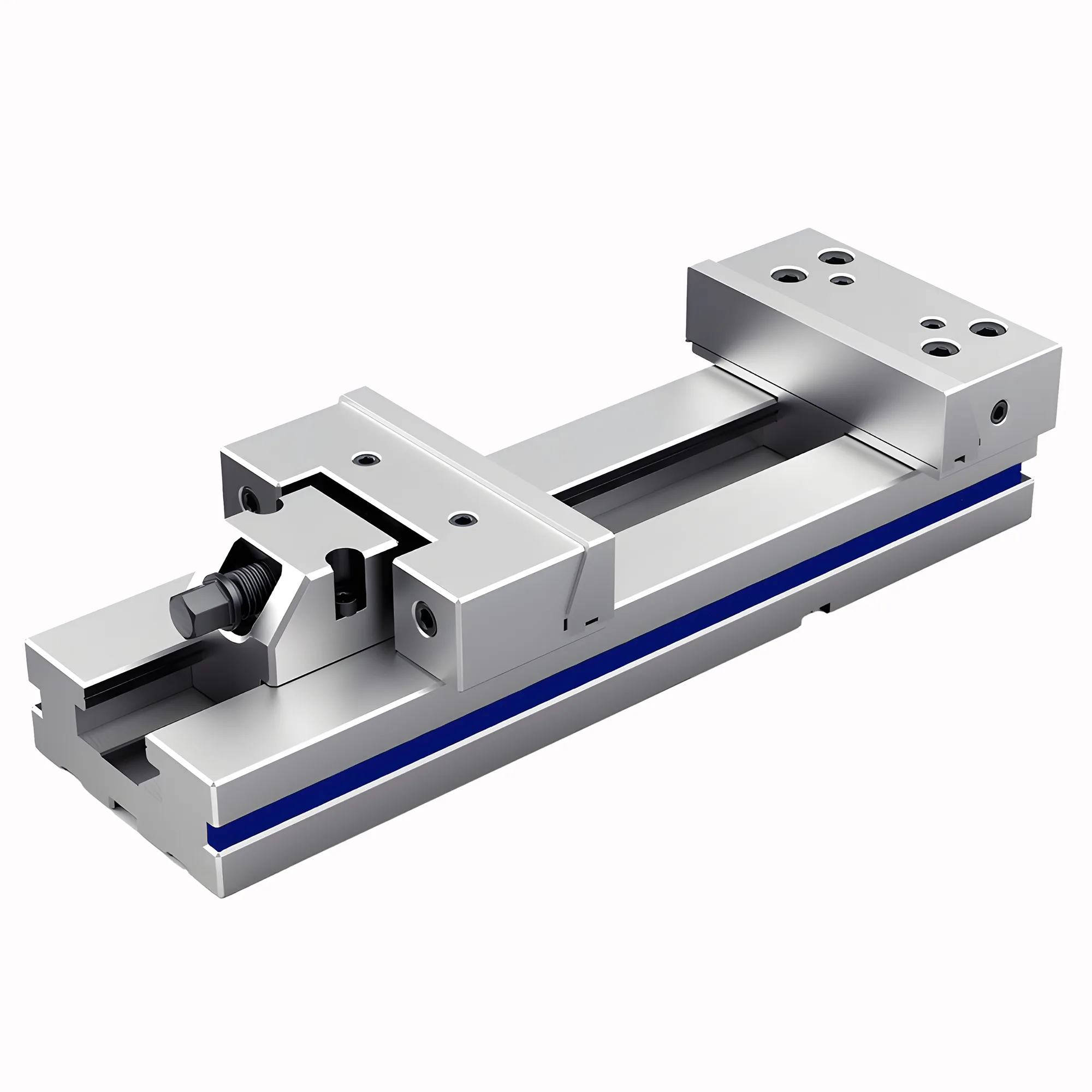
Precision vises serve different roles depending on the operation. Modular vises deliver 16-40 kN clamping force on jaw widths 100-300 mm, while toolmaker and sine vises hold 0.005 mm/100 mm parallelism — the two specs that respectively determine roughing capability and finish/grinding accuracy.
Modular vises (GT-type) use 20CrMnTi alloy steel bodies with carburizing treatment to HRC 58-62 hardness — 20CrMnTi is preferred for vise bodies because its case-hardened surface resists jaw wear while the tough core absorbs clamping shock. Their modular design allows the base, fixed jaw, and moving jaw to be separated and reconfigured. Jaw widths span 100-300 mm with clamping openings from 100-800 mm, generating 16-40 kN of clamping force. These are the primary workholding choice for machining centers and CNC mills.
Toolmaker vises (QGG-type) feature a one-piece body construction with V-grooved jaws for holding round stock. All surfaces are precision ground to 0.005 mm/100 mm parallelism and 0.005 mm verticality. Jaw widths range from 50-150 mm. The monolithic body ensures maximum rigidity for grinding and milling small parts.
Sine vises (QKG-type) share the same precision specifications as toolmaker vises but are optimized for angled setups on surface grinders and EDM machines. Jaw widths typically span 25-150 mm to cover fine detail work through medium-sized components.
| Factor | Modular Vise (GT) | Toolmaker Vise (QGG) | Sine Vise (QKG) |
|---|---|---|---|
| Jaw Width Range | 100-300 mm | 50-150 mm | 25-150 mm |
| Max Clamping Opening | 100-800 mm | 65-210 mm | 22-300 mm |
| Clamping Force | 16-40 kN | N/A (screw-type) | N/A (screw-type) |
| Surface Hardness | HRC 58-62 | HRC 58-62 | HRC 58-62 |
| Parallelism | 0.005 mm/100 mm | 0.005 mm/100 mm | 0.005 mm/100 mm |
| Primary Application | CNC milling | Grinding, milling | Grinding, EDM |
Vise Selection Rule
Choose a modular vise when clamping force and jaw opening are the primary requirements. Choose a toolmaker or sine vise when positional accuracy in multiple orientations is critical -- both types can be clamped horizontally, vertically, or flat with equal precision.
Shops moving toward 5-axis work face a separate workholding challenge — standard vises foul the rotary axes — so vise selection there usually pivots to compact 5-axis vises, dovetail fixtures, and zero-point clamping; for the cost and ROI implications, see the 5-axis machining adoption guide.
Lathe Chuck Selection: Three-Jaw vs Four-Jaw
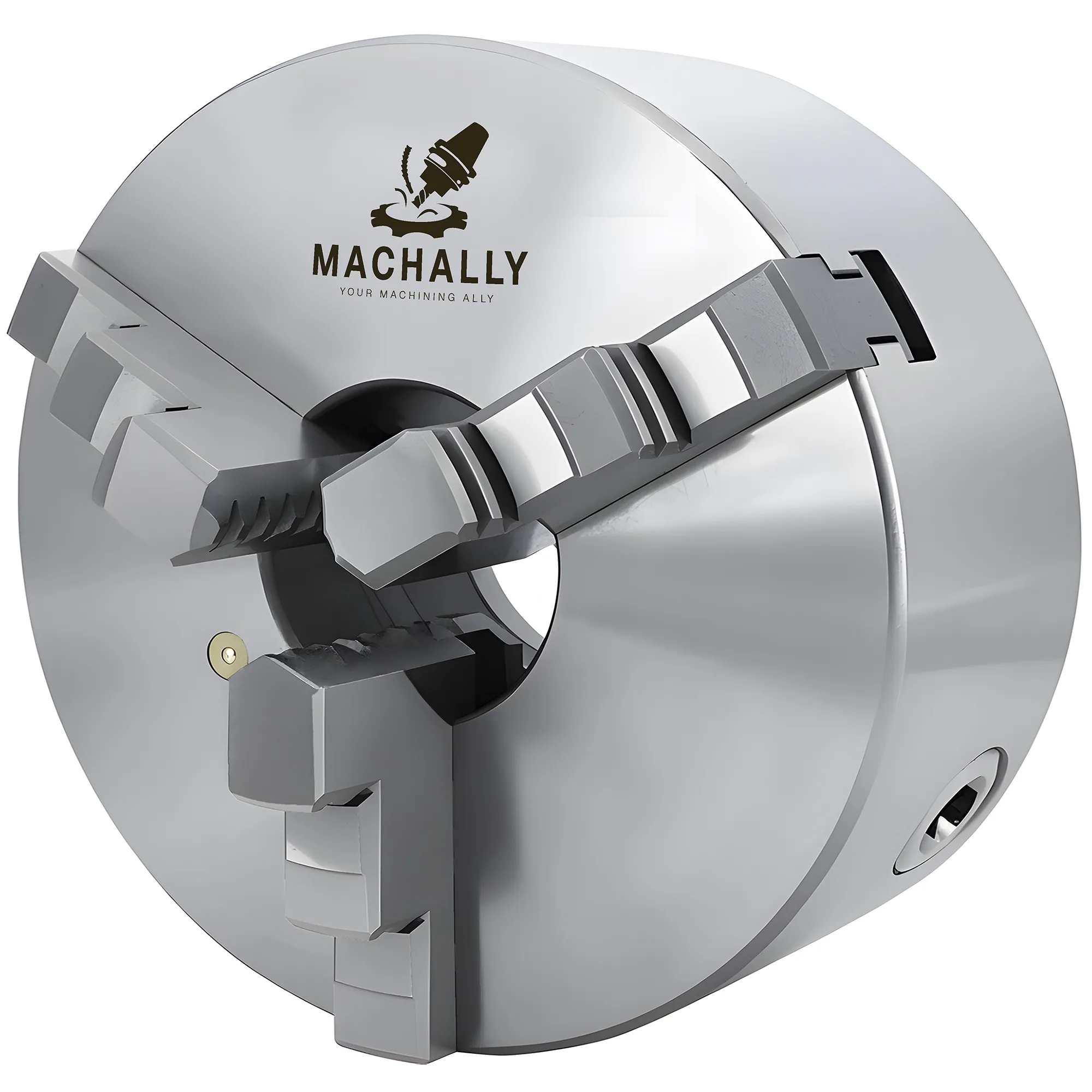
Lathe chucks are classified by jaw count and jaw construction. Three-jaw self-centering chucks (per ISO 3089 for one-piece jaws or JIS B 6151 for chuck specifications) center round/hex stock fastest, while four-jaw chucks of the same diameter typically run 33% slower (e.g., 2,000 vs 3,000 RPM at 200 mm) but distribute clamping force across four contact points for better stability under asymmetric loads.
Three-jaw self-centering chucks (K11 series, with one-piece jaws per ISO 3089) use a scroll mechanism to move all three jaws simultaneously, centering round or hexagonal stock automatically. Available from 80-630 mm diameter, they handle torques from 40 Nm (80 mm) to 800 Nm (630 mm) at speeds from 600-4,800 RPM. Standard models include two sets of one-piece jaws -- internal and external -- while ISO 3442 compliant models (K11A series) use two-piece separation jaws that can be adjusted for either gripping direction. Chuck mounting follows DIN 55029, which defines the short taper interface used to register the chuck to the lathe spindle nose without runout from a threaded mount.
Four-jaw self-centering chucks (K12/K12A series) distribute clamping force across four contact points rather than three, providing more uniform radial stress distribution that resists workpiece shift under asymmetric cutting loads. The K12 line spans 80-630 mm diameter with torques from 40-800 Nm. Maximum speeds are slightly lower than equivalent three-jaw chucks due to the additional mass -- for example, a 200 mm four-jaw runs at 2,000 RPM versus 3,000 RPM for the same size three-jaw.
| Factor | 3-Jaw Chuck (K11) | 3-Jaw ISO 3442 (K11A) | 4-Jaw Chuck (K12) | 4-Jaw ISO 3442 (K12A) |
|---|---|---|---|---|
| Size Range | 80-500 mm | 160-630 mm | 80-630 mm | 160-630 mm |
| Max Speed (200 mm) | 3,000 RPM | 3,000 RPM | 2,000 RPM | 2,000 RPM |
| Max Torque (200 mm) | 250 Nm | 320 Nm | 250 Nm | 250 Nm |
| Jaw Type | One-piece (2 sets) | Two-piece (base + top) | One-piece (2 sets) | Two-piece (base + top) |
| Soft Jaws Available | Yes | Yes | Yes | Yes |
| Through-Bolt Mount | No | No | Available on request | Available on request |
Common Chuck Selection Mistake
Do not assume a four-jaw chuck always provides better accuracy than a three-jaw. Self-centering accuracy depends on the scroll mechanism quality, not the jaw count. For maximum centering precision, request soft jaws that can be bored in-situ on the lathe -- this achieves tighter concentricity than any pre-ground jaw set regardless of three- or four-jaw configuration.
Live Center Selection: Speed vs Load Capacity
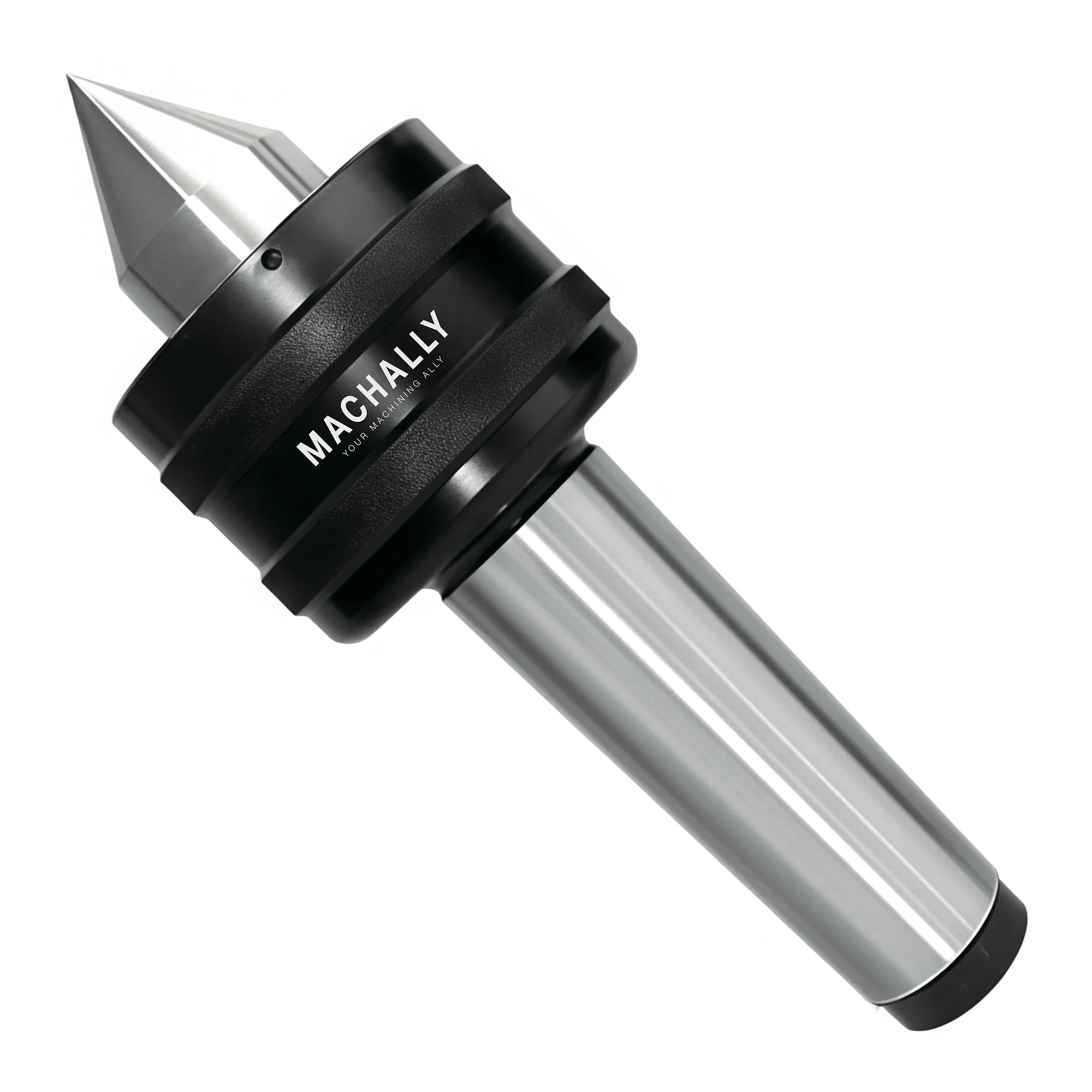
Live centers support the tailstock end of workpieces during turning. High-speed live centers using three NSK bearing sets achieve 0.003 mm runout up to 6,000 RPM (MT2) but cap at ~150-2,800 kg radial load, while heavy-duty 5-bearing models support up to 4,500 kg on MT6 at the cost of a 1,000-3,500 RPM ceiling.
High-speed live centers use three sets of NSK bearings (double-row, thrust, and IKO needle roller) with a Cr12MoV spindle heat-treated to HRC 60 plus/minus 2 degrees. They achieve 0.003 mm accuracy at speeds up to 6,000 RPM (MT2) with load capacities from 150-2,800 kg depending on Morse taper size. The double sealing system with German skeleton oil seals protects bearings from coolant intrusion.
Heavy-duty live centers use five sets of NSK bearings for maximum radial load capacity -- up to 4,500 kg on an MT6 taper. Their anti-vibration design with adjustable bearing clearance makes them ideal for roughing heavy workpieces. Maximum speeds are typically lower (1,000-3,500 RPM) due to the larger bearing assemblies.
Versa-Turn live centers feature an external rotation design with a smaller head diameter that avoids tool interference in tight turning setups. They typically support loads from 100-1,300 kg at speeds up to 4,000 RPM with 0.003 mm accuracy.
Interchangeable-point live centers allow quick point changes without removing the center from the tailstock. They achieve 0.005 mm accuracy at speeds up to 5,000 RPM. YG8 tungsten carbide tips (HRC ~90) are specified on the carbide-tipped option because the contact face wears against the workpiece center hole at high temperature — YG8's hardness and thermal stability extend point life relative to hardened tool-steel tips in abrasive or high-RPM service.
When to Choose Each Workholding Type
The first cut is always the machine type — milling/grinding selects vises, lathes select chucks plus optional live centers — and only then does jaw count, clamping force, and bearing configuration become the decisive factor.
✦ Vises Best For
- CNC milling and machining centers (modular GT vises, 16-40 kN)
- Surface grinding and EDM (sine QKG vises, 0.005 mm/100 mm)
- Toolroom work on small prismatic parts (toolmaker QGG vises)
- Multi-axis setups requiring reorientation (all-surface-ground vises)
✦ Lathe Chucks Best For
- Turning round stock with fast setup (three-jaw K11 chucks)
- Heavy roughing on large-diameter parts (four-jaw K12 chucks, 80-630 mm)
- Production runs requiring ISO 3442 jaw flexibility (K11A/K12A series)
- Workpieces needing soft jaws bored to exact diameter
✦ High-Speed Live Centers Best For
- CNC lathe finishing at high RPM (up to 6,000 RPM)
- Light-to-medium workpieces requiring 0.003 mm accuracy
- Coolant-heavy environments (double German skeleton seal)
✦ Heavy-Duty Live Centers Best For
- Large shaft turning with heavy radial loads (up to 4,500 kg)
- Roughing operations where anti-vibration matters
- MT5 and MT6 tailstock applications on large lathes
Practical Decision Framework
Start with the machine type. For lathe chucks, request soft jaws bored in-situ when concentricity must be tighter than the chuck's published self-centering accuracy, because soft jaws conform to the exact workpiece diameter and remove scroll-mechanism error from the centering chain. Milling machines and grinders need vises. Lathes and turning centers need chucks at the headstock and live centers at the tailstock.
For vises, match jaw width to your typical part size. If parts exceed 150 mm, a modular GT vise with 16-40 kN clamping force is the right choice. For precision grinding or EDM parts under 100 mm, a toolmaker or sine vise delivers the required positional accuracy without overspending.
For lathe chucks, choose three-jaw for round stock and fast setup on production work. Consider four-jaw when the part weight, overhang, or asymmetric geometry creates unbalanced loads, or when the additional gripping contact improves surface finish on heavy roughing cuts. Request ISO 3442 two-piece jaws (K11A or K12A) if you frequently switch between internal and external gripping on the same chuck.
For live centers, match the Morse taper to your tailstock and then decide between speed and load. Finishing operations at high RPM demand a high-speed center. Roughing heavy shafts demands a heavy-duty center with five bearing sets. Tight clearance between the tool and workpiece calls for a versa-turn center with its smaller head diameter.
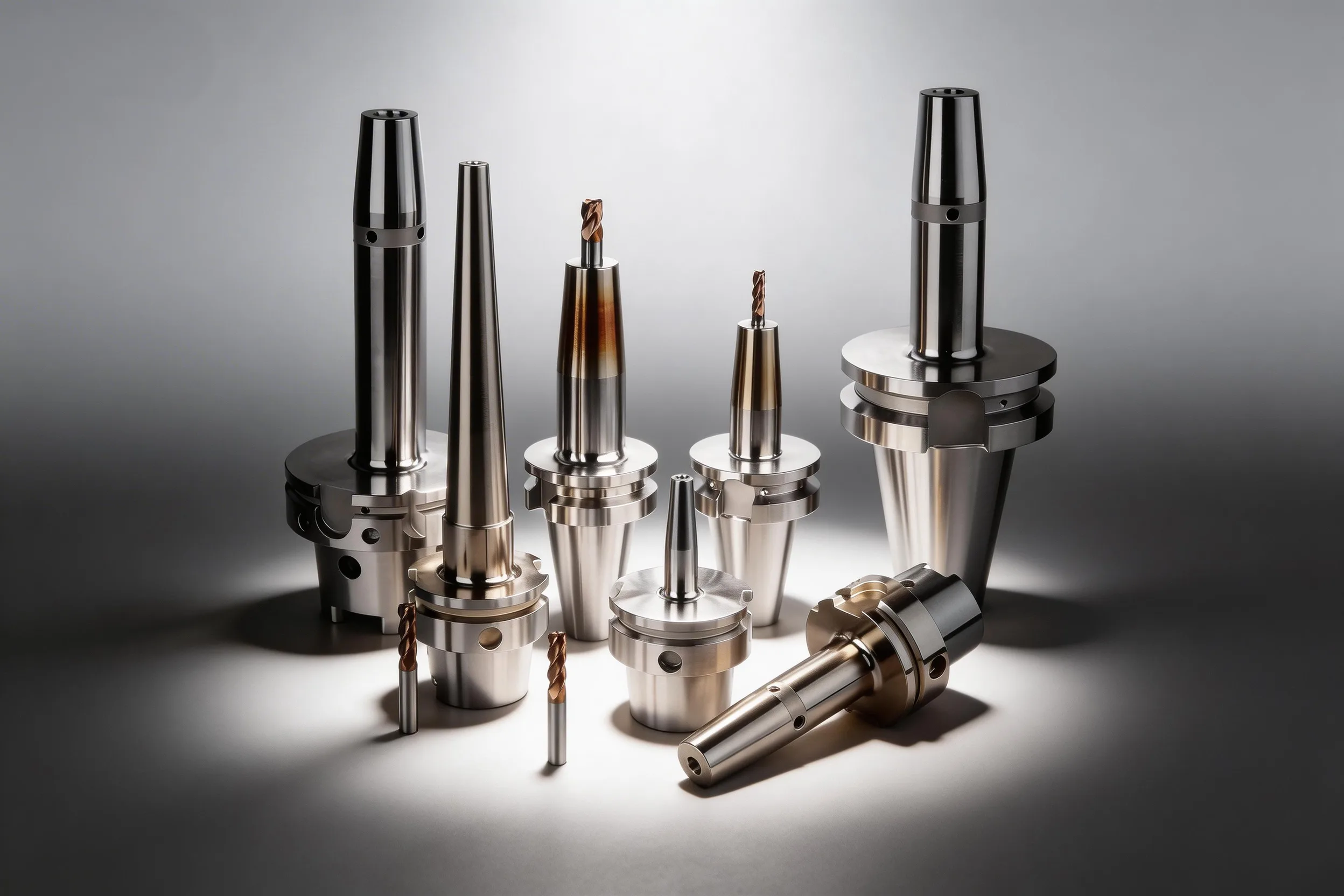
Workholding is only half of the rigidity equation — once the part is clamped, the holder gripping the cutter determines how cleanly the cut transfers — for the runout, gripping force, and damping comparison across collet, shrink-fit, and hydraulic chucks, see the tool holding solutions guide.
Quick Workholding Selection by Application
| Scenario | Fixture Type | Clamping Force | Accuracy | Why |
|---|---|---|---|---|
| CNC milling, prismatic part 100-300 mm | Modular GT vise (20CrMnTi, HRC 58-62) | 16-40 kN | 0.005 mm/100 mm parallelism | High clamping force resists cutting loads; modular jaws reconfigure for varied part shapes |
| Surface grinding, part <100 mm, multi-orientation | Toolmaker QGG vise | Screw-actuated (operator-controlled) | 0.005 mm/100 mm parallelism + 0.005 mm verticality | One-piece body holds geometry across horizontal/vertical/flat orientations |
| Sine-bar / EDM angled setup | Sine QKG vise | Screw-actuated | 0.005 mm/100 mm | All-surface ground for repeatable angular reference on sine plate |
| Lathe round/hex stock, fast setup, ≤3,000 RPM at 200 mm | 3-jaw self-centering chuck (K11, ISO 3089) | Scroll-driven, 250 Nm at 200 mm | Scroll-mechanism dependent; bored soft jaws improve concentricity | Three-jaw scroll centers fastest; standard for production turning |
| Lathe heavy/asymmetric part | 4-jaw self-centering chuck (K12) | Scroll-driven, 250 Nm at 200 mm | Improved stability vs. 3-jaw under uneven loads | Four-point clamping distributes radial stress; resists workpiece shift |
| Tailstock support, finishing at high RPM | High-speed live center (3 NSK bearings) | Tailstock-applied | 0.003 mm runout to 6,000 RPM (MT2) | Three-bearing pack minimizes inertia; sealed against coolant for finishing reliability |
| Tailstock support, heavy shaft roughing | Heavy-duty live center (5 NSK bearings, MT5/MT6) | Tailstock-applied | 0.003 mm runout (MT4); 0.005 mm at MT6 | Five-bearing assembly carries up to 4,500 kg radial load; anti-vibration for roughing chatter |
| Tight-clearance turning near tailstock | Versa-Turn live center | Tailstock-applied | 0.003 mm runout to 4,000 RPM | Smaller external head diameter avoids interference with tool/holder in tight setups |
Match workholding to the operation, not just the machine.
Typically select modular vises (16-40 kN) for CNC milling, toolmaker or sine vises (0.005 mm/100 mm accuracy) for grinding and EDM, three-jaw chucks for fast centering of round stock, four-jaw chucks for heavy-duty gripping stability, and live centers based on the speed-versus-load trade-off -- 6,000 RPM high-speed models for finishing, or 5-bearing heavy-duty models supporting up to 4,500 kg for roughing. Always verify Morse taper compatibility and consider soft jaws for maximum chuck centering accuracy.
What is the difference between a three-jaw and four-jaw self-centering chuck?
Three-jaw chucks center round or hex stock automatically via a scroll mechanism and run faster -- up to 3,000 RPM at 200 mm diameter. Four-jaw self-centering chucks cap at 2,000 RPM at the same size but distribute clamping across four contact points, resisting workpiece shift under asymmetric or heavy roughing loads where three jaws may allow slipping.
How do I choose between a high-speed and heavy-duty live center?
Choose a high-speed live center (up to 6,000 RPM, 3 NSK bearing sets) for finishing operations at high spindle speeds on light-to-medium workpieces. Choose a heavy-duty live center (5 NSK bearing sets, up to 4,500 kg load capacity) for roughing heavy shafts where anti-vibration performance and radial load capacity matter more than speed.
What accuracy can I expect from precision vises?
Quality precision vises — both toolmaker (QGG) and sine (QKG) types — achieve 0.005 mm per 100 mm parallelism and 0.005 mm verticality with HRC 58-62 surface hardness. All surfaces are precision ground, enabling use in horizontal, vertical, and flat orientations with consistent accuracy.
When should I use soft jaws on a lathe chuck?
Use soft jaws whenever concentricity requirements exceed the standard accuracy of hardened jaws. Soft jaws are bored or ground in-situ on the lathe to match the exact workpiece diameter, achieving tighter centering than any pre-ground jaw configuration. They are especially valuable for finish turning operations where runout directly affects surface quality.
What does ISO 3442 mean for lathe chuck jaws?
ISO 3442 defines two-piece chuck jaws: a fixed base jaw plus a repositionable top jaw. The top jaw can be flipped or swapped for internal or external gripping without removing the base jaw. K11A and K12A chucks with ISO 3442 jaws reduce toolroom jaw inventory compared to one-piece designs that need separate sets for each gripping direction.
Sources
- ISO 3442 - Chucks for machine tools, jaw dimensions and types
- ISO 3089 - Machine tools, self-centring chucks with one-piece jaws
- DIN 55029 - Short taper for lathe chuck mounting
- JIS B 6151 - Machine tool accessories, lathe chucks
- NSK Precision Bearing Catalog - Double-row and thrust bearings for live centers
- Machinery's Handbook, 32nd Edition - Workholding chapter