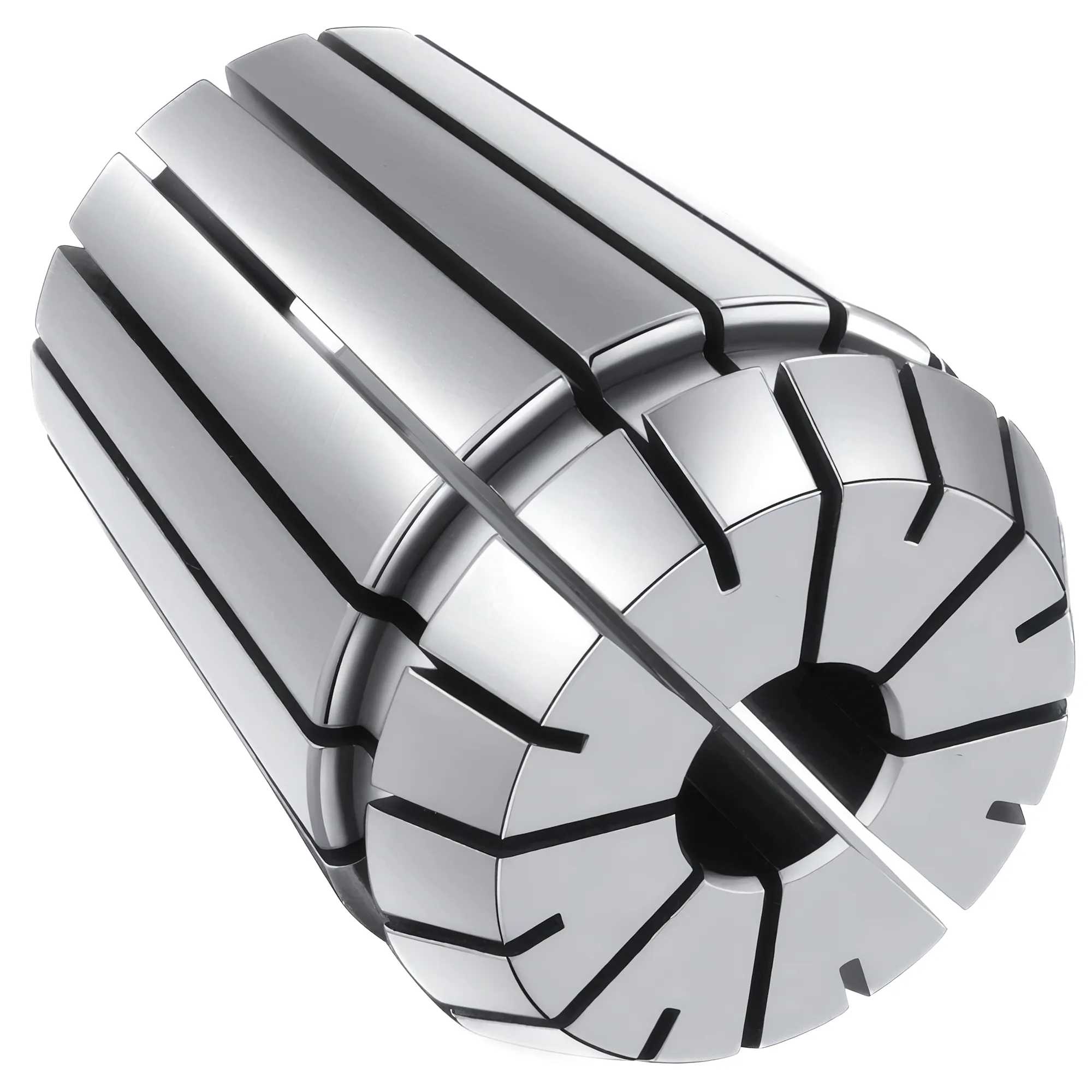
ER collet nuts come in three body types — the ISO-form standard nut (often sold as UM or RD), the slim A-type with the same thread, and the mini M-type with a finer thread — and a nut must match the holder's thread, not just the ER number — an ER32 standard nut is M40×1.5, tightened to 136 N·m (REGO-FIX). Within a type, choose a standard nut for general CNC milling and turning where runout below 0.015 mm TIR is acceptable, and a precision bearing-ring nut when runout must stay under 0.005 mm TIR or spindle speed exceeds 18,000 RPM. Correct torque is equally critical: clamping force scales roughly in proportion to nut torque, so an under-torqued ER32 nut loses a comparable share of grip and raises pull-out risk, while over-torquing can deform the collet taper and permanently raise runout.
The ER collet nut is the most mechanically stressed consumable in the ER tool-holding system. It transmits every newton of clamping force, rotates at spindle speed, and is handled dozens of times per shift. Yet it is frequently treated as a non-critical commodity — replaced only after visible failure. Understanding how nut design affects runout, what torque figures actually mean, and how to identify wear before it causes dimensional defects can reduce scrap rates and unplanned downtime in ER-dependent operations. For a complete guide to ER collet grades and size selection, see ER Collet Selection Guide.
ER Collet Nut Types: Standard (UM/RD), Slim A and Mini M
The ER number names the collet, not the nut: at one ER size, nuts are made in several body types that differ in thread, outside diameter, or both, and only a nut cut for the holder's thread will fit. ISO 15488 specifies one nut — form D in Table 3 — and leaves nut design otherwise to the manufacturer. Catalogs build three common families around it:
- Standard nut (commonly UM or RD): follows the ISO 15488 Table 3 form D dimensions — ER32 is M40×1.5 with a 50 mm outside diameter. This is the nut most ER holders are cut for.
- A-type (slim) nut: same thread as the standard nut at each size but a smaller outside diameter (ER16: 28 mm vs 32 mm), for clearance beside a fixture wall.
- M-type (mini) nut: a finer, smaller thread for slim-nose holders — ER16 is M19×1.0 instead of M22×1.5. An M-type nut does not fit a holder cut for the standard nut, and vice versa.
| ER Size | Standard UM/RD (ISO 15488 form D): Thread / OD (mm) | A-Type: Thread / OD (mm) | Mini M-Type: Thread / OD (mm) |
|---|---|---|---|
| ER8* | — | M10×0.75 / 13.5 | M10×0.75 / 12 |
| ER11 | M14×0.75 / 19 | M14×0.75 / 19 | M13×0.75 / 16 |
| ER16 | M22×1.5 / 32 | M22×1.5 / 28 | M19×1.0 / 22 |
| ER20 | M25×1.5 / 35 | M25×1.5 / 34 | M24×1.0 / 28 |
| ER25 | M32×1.5 / 42 | — | M30×1.0 / 35 |
| ER32 | M40×1.5 / 50 | — | — |
| ER40 | M50×1.5 / 63 | — | — |
| ER50* | M64×2.0 / 78 | — | — |
*ER8 and ER50 are manufacturer extensions outside ISO 15488, which covers ER11–ER40; their values are typical catalog dimensions. Other catalog nut types (for example sealed or high-speed designs) generally reuse one of these threads at a given size. Because outside diameters differ, the A, M and standard nuts of one ER size also take different spanner wrenches.
Identify a replacement nut by its thread and outside diameter, not by the ER number on the collet. The thread is set by the holder; the outside diameter decides spanner size and fixture clearance.
Standard vs Precision Collet Nut: What the Difference Actually Is
A standard ER collet nut and a precision nut of the same nut type share the thread and collet-pocket geometry but differ in internal bearing surface geometry, thread quality, and manufacturing tolerance class. A precision nut fits any holder cut for that nut type; the differences are internal.
Standard nuts bear on the collet's 30° front cone through an internal contact cone. During tightening, the collet must both compress radially and rotate slightly against this contact cone, introducing a small asymmetric load that can displace the collet axis by 0.005–0.015 mm (typical estimates) before the collet seats fully. For general production work where ISO 15488 Class 2 runout (≤0.015 mm TIR for d₁ ≤ 10 mm; ≤0.020 mm TIR for d₁ 10–26 mm per Table 4) is the target, this displacement is usually tolerable, though at the upper end it can consume most of the Class 2 band.
Precision nuts incorporate a bearing ring — either a needle-roller or ball thrust bearing — between the nut and the collet's 30° front cone. The bearing allows the nut to rotate during tightening while the collet remains rotationally stationary, eliminating the twist-and-seat friction that causes axis displacement. A bearing-ring nut can reduce the nut's runout contribution, depending on holder quality and collet grade.
ISO 15488 (and its German equivalent DIN 6499) defines ER collet dimensional and runout tolerances and a single nut form, not a precision nut type — neither standard mandates bearing-ring nuts for any runout class. The precision nut is a manufacturer design choice that improves practical system runout without changing the collet specification. Both nut types clamp securely when torqued correctly, and REGO-FIX describes its bearing nut as designed for higher clamping force than its standard nut.
Torque Requirements by ER Size
Collet nut torque is not a tightening preference — it is a clamping force specification, and deviation in either direction causes failure modes. Under-torquing reduces axial pull-out resistance; over-torquing deforms the collet and raises runout by concentrating stress asymmetrically on the taper seating surface.
ISO 15488 specifies nut dimensions but no tightening torque, so torque is manufacturer data. The values below are the REGO-FIX recommended tightening torque for the largest collet-bore band of each size, applied with a calibrated torque wrench; smaller bores within a size take less (for example 8 Nm for ER11 collets below 3 mm, 24 Nm for ER32 collets under 3 mm). Other nut makers publish different figures because nut design changes the torque-to-clamping-force relationship, so when the nut brand is known, use that maker's value.
| ER Size | Shank Diameter Range (mm) | Standard Nut Torque (N·m) | Mini M-Type Nut Torque (N·m) | Typical Clamping Force (estimate) |
|---|---|---|---|---|
| ER11 | 1–7 | 24 | 16 | 3–5 kN |
| ER16 | 1–10 | 56 | 24 | 5–8 kN |
| ER20 | 1–13 | 80 | 28 | 6–9 kN |
| ER25 | 1–16 | 104 | 32 | 8–12 kN |
| ER32 | 2–20 | 136 | — (no mini nut) | 10–15 kN |
| ER40 | 3–26 | 176 | — (no mini nut) | 15–25 kN |
The standard-nut column applies to standard-form nuts (ISO 15488 Table 3 dimensions); REGO-FIX gives its bearing-type nut the same values at these bore sizes for ER16–ER40. Mini M-type nuts on slim-nose holders take far less torque — never apply the standard-nut value to a mini nut. In imperial units, 136 Nm is about 100 ft-lb and 176 Nm about 130 ft-lb. The clamping-force column is a typical estimate: no manufacturer publishes a per-size ER clamping-force table.
Torque Tool Selection
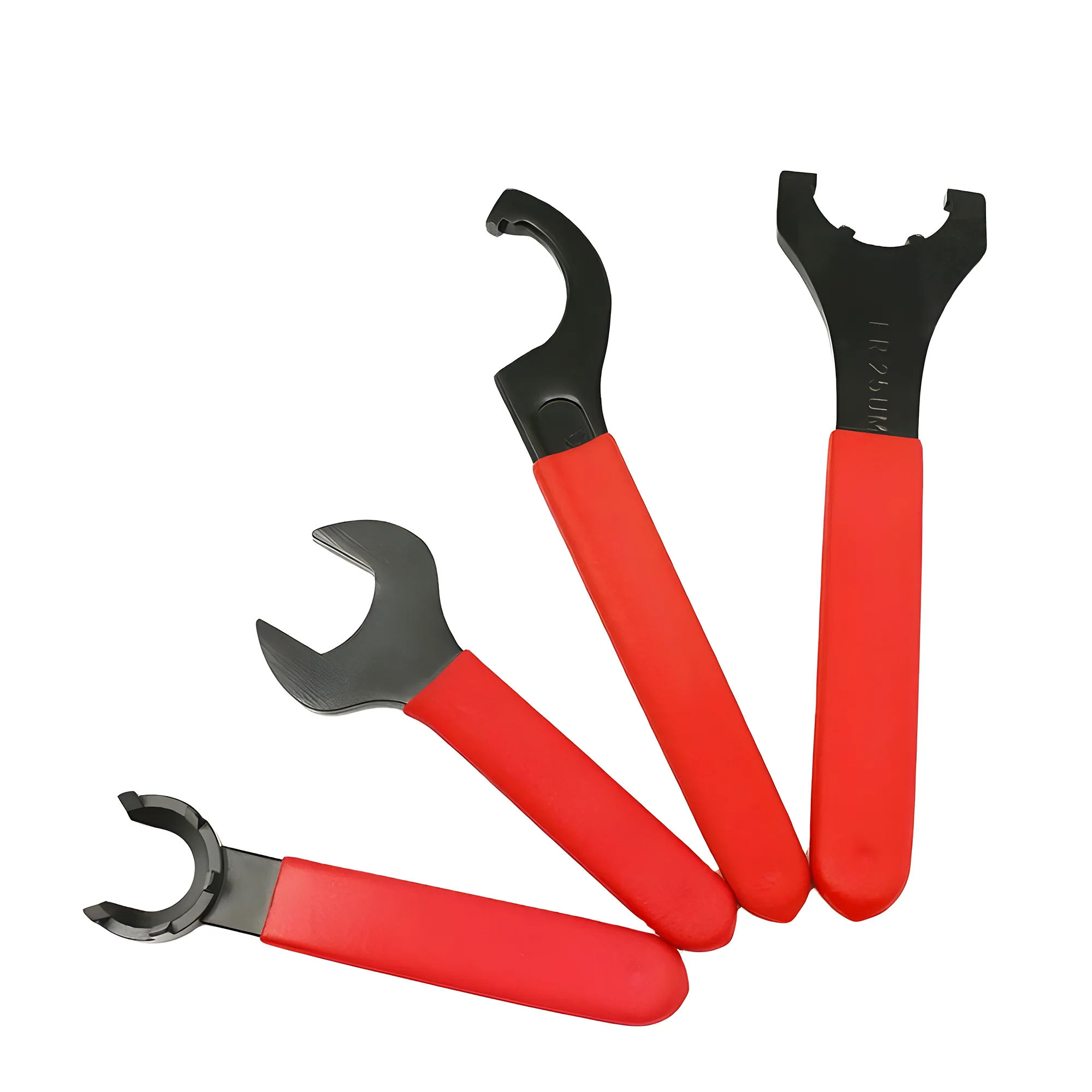
Use a dedicated ER spanner wrench rather than an adjustable wrench or open-end spanner. Adjustable tools concentrate force on two points of the nut's hex or spanner notches instead of distributing it across all engagement faces, causing local deformation that gradually widens the spanner notch opening — a reliable path to premature nut replacement.
Torque value alone does not guarantee correct clamping force if the thread or bearing surface is dry, contaminated, or worn. Lubrication state changes the torque-to-clamping-force conversion (friction coefficient at the thread flanks and the nut's contact cone). In clean, dry conditions with a new nut and collet, published torque targets apply. After repeated cycles with coolant and chip contamination, the same torque input produces measurably lower clamping force because thread friction increases. This is the primary argument for maintaining clean threads and replacing nuts before they reach visible wear.
A torque wrench reads the resistance to rotation, not the axial force on the collet. Thread condition, lubrication, and nut wear all shift the conversion factor between what the wrench measures and what the collet actually receives.
When to Upgrade from Standard to Precision Nut
Upgrade to a precision bearing-ring nut when system runout consistently exceeds 0.008 mm TIR after collet and holder inspection confirms those components are serviceable. In most cases, poor runout in an ER system is caused by a worn or out-of-spec collet, a contaminated taper bore, or an out-of-tolerance holder — not the nut. Confirm the collet and holder are within spec before purchasing precision nuts. The ER collet torque and runout guide covers collet grade thresholds in detail.
The four scenarios where a precision nut provides measurable return:
High-speed finishing above 18,000 RPM. At elevated spindle speeds, even small runout values generate vibration that degrades surface finish and accelerates both tool and collet wear. A precision nut reduces the rotational-friction-induced runout contribution.
Micro-tool operations with cutters below 3 mm diameter. For tools typically in the 1–3 mm diameter range, a 0.010 mm runout deviation represents 0.3–1.0% of the tool diameter — the threshold where individual cutting edge load imbalance causes measurable deflection and early breakage. Precision nuts in ER11 and ER16 sizes reduce this risk in the size range where standard nuts contribute the most runout as a percentage of tool diameter.
Toleranced bores and precision milling where IT6 or better is required. Achieving IT6 bore tolerance (13–16 µm for diameters over 18 up to 50 mm, per ISO 286-1) requires the total tool-holding system runout to stay well under half that band. A precision nut's 0.003 mm contribution leaves adequate budget for collet and holder runout.
High-volume production where cycle count accelerates wear. In operations running 50+ tool changes per shift, standard nuts reach the wear threshold faster than in low-frequency environments. Precision nuts typically carry higher initial cost — 2–5× the price of a standard nut — but their bearing rings are replaceable on some designs, so the nut body can stay in service when only the ring has worn.
Wear Identification: Seven Signs a Collet Nut Needs Replacement
A worn collet nut rarely fails catastrophically — it degrades quietly through dimensional drift that manifests as rising runout and inconsistent clamping. The following indicators are ranked from easiest to detect with basic shop tools to those requiring precision measurement.
Visual and tactile signs
Spanner notch deformation. Measure the notch opening width with a digital caliper and compare it with a new nut of the same type. If the opening has measurably widened, the notch wall has yielded plastically and the nut is delivering reduced wrench engagement area — replace it before the wrench starts to slip under load.
Thread galling and pick-up marks. Inspect the nut threads under a bright light after cleaning. Silver-gray smear marks crossing multiple thread flanks indicate adhesive wear (galling), typically caused by tightening without thread lubrication. A galled nut will produce inconsistent torque-to-force conversion and should be replaced; running a thread chaser through a galled nut restores thread form only if the galling is shallow.
Contact cone scoring (standard nut). On standard (non-bearing) nuts, the internal contact cone should be mirror-smooth. Circumferential scratches visible under magnification indicate that the collet's 30° front cone has been rotating against it during tightening — either because the taper bore was dirty or the nut was used without adequate clean-and-inspect practice. Scoring adds friction asymmetry that increases runout contribution.
Bearing ring looseness (precision nut). Hold the precision nut body stationary and rotate the bearing ring with finger pressure. The ring should turn with light, consistent drag and zero axial play. Axial play over 0.05 mm, or grinding sensation during rotation, indicates needle-roller cage wear — the bearing ring is replaceable on some manufacturer designs.
Dimensional measurement signs
Rising system runout trend. Measure runout at the tool tip monthly with a dial gauge graduated in 0.001 mm (ISO 463) in a dedicated test setup using a calibrated test bar. If runout has risen more than 0.005 mm from baseline on the same holder and collet combination, systematically eliminate other causes (collet wear, bore contamination) before attributing the change to the nut. If runout drops when a new nut is installed on the same collet and holder, the old nut is confirmed worn.
Thread pitch diameter out of tolerance. ER nut threads are metric fine — for the standard nut form, ER16 M22×1.5, ER32 M40×1.5 and ER40 M50×1.5 per ISO 15488:2003 Table 2; mini M-type nuts use finer threads (ER16 M19×1.0, ER25 M30×1.0), and the ER50 extension uses M64×2.0. Gauge against the thread actually on the nut. A thread gauge set or calibrated thread micrometer can verify pitch diameter. Measurable pitch-diameter wear allows collet rock during clamping and introduces position error. In high-volume shops, gauge threads on a regular schedule; in lower-volume environments, check when runout or pull-out events occur.
Contact cone witness-mark asymmetry. After tightening and releasing a collet with a light coating of engineer's blue (Prussian blue) on its 30° front cone, inspect the witness mark on the nut's internal contact cone. A uniform 360° ring confirms correct geometry. An arc covering less than 270° or a clearly eccentric ring indicates that the contact cone has worn out of concentricity with the thread axis — the nut is no longer centering the collet correctly and should be replaced.
Mixing Nut Generations
Precision bearing-ring nuts from different manufacturers are not interchangeable within the same ER size if thread engagement length or bearing ring protrusion dimensions differ. A precision nut used with a holder designed for a standard nut profile can leave the collet partially unseated, reducing clamping force while appearing fully tightened. Always confirm compatibility between holder series and nut series before substituting.
Quick Selection and Maintenance Reference
| Scenario | Nut Type | Torque Range | Replacement Trigger | Why |
|---|---|---|---|---|
| General CNC milling, runout ≤0.015 mm | Standard | Per ER size table above | Measurable notch widening, thread galling, or runout +0.005 mm from baseline | Direct cone contact adequate for Class 2 runout |
| High-speed spindle >18,000 RPM | Precision (needle-roller) | Per ER size table above | Bearing ring play >0.05 mm axial | Bearing ring prevents rotational axis shift at speed |
| Micro-tools <3 mm diameter (ER11/ER16) | Precision (bearing ring) | Per ER size table above | Any measurable runout increase | Small-diameter tools sensitive to per-unit runout |
| IT6 bore or precision reaming | Precision (needle-roller) | Per ER size table above | Monthly runout baseline trend check | System TIR budget requires <0.003 mm nut contribution |
| High-volume production >50 changes/shift | Precision (replaceable ring) | Per ER size table above | Bearing ring axial play >0.05 mm (replace ring) | Lower per-cycle cost over nut life vs standard replacement |
| Interrupted cuts, heavy side loads | Standard (heavy-duty wall) | Full rated torque for the size | Galling on thread flanks | Standard nut with full-width notch handles wrench force better |
Standard nut for production; precision nut for accuracy or high speed.
Select a standard ER collet nut for general CNC operations where Class 2 runout (≤0.015 mm TIR for d₁ ≤ 10 mm; ≤0.020 mm TIR for d₁ 10–26 mm) is sufficient. Upgrade to a bearing-ring precision nut when system runout must stay under 0.005–0.008 mm TIR, spindle speed exceeds 18,000 RPM, or tool diameter is below 3 mm. In both cases, apply correct torque per ER size with a dedicated spanner wrench, inspect spanner notch width on a regular schedule, and replace when notch wear, thread galling, or rising runout confirms degradation, matching the replacement by thread and outside diameter rather than ER number alone — the nut is the lowest-cost component in the ER system and the most cost-effective to replace proactively.
What are the different types of ER collet nuts?
ER collet nuts come in three common body types. The standard type (often called UM or RD) follows the ISO 15488 nut dimensions; the A type keeps the same thread with a slimmer outside diameter; the mini M type uses a finer, smaller thread for slim holders. Bearing-ring precision nuts exist within these families. Match type to the holder thread.
What thread is an ER32 collet nut?
In the ISO 15488 standard form, an ER32 collet nut has an M40×1.5 thread and a 50 mm outside diameter; ER16 is M22×1.5, ER20 M25×1.5, ER25 M32×1.5 and ER40 M50×1.5. Mini-type nuts at the same ER number use finer threads, such as M19×1.0 for ER16, so always check the holder thread first.
Are ER collet nuts interchangeable?
Only when the thread matches. Standard-form and A-type nuts of one ER size share a thread, so they can swap if the outside diameter clears the fixture. A mini-type nut has a different thread from the standard nut at the same ER number and will not fit that holder. Check the thread and outside diameter, not just the ER number.
What is the difference between a standard and precision collet nut?
A standard ER collet nut bears on the collet's 30° front cone through an internal contact cone, contributing a typical estimated 0.005–0.015 mm of additional runout during tightening. A precision nut adds a needle-roller or ball thrust bearing that lets the nut rotate while the collet remains stationary, limiting the nut's runout contribution to a typical estimated ≤0.003 mm TIR. Precision nuts cost 2–5× more, and some designs let you replace only the bearing ring.
What torque should I use for an ER32 collet nut?
The REGO-FIX recommended tightening torque for an ER32 standard nut is 136 N·m (about 100 ft-lb), applied with a dedicated ER spanner wrench or torque wrench; collets under 3 mm take only 24 N·m. REGO-FIX gives its bearing-type ER32 nut the same 136 N·m for collets of 8 mm and up. Apply torque in a single continuous motion rather than multiple increments to ensure even collet seating. Confirm against your holder manufacturer's specification if available, as wall thickness varies between series.
How often should I replace ER collet nuts?
Replace a standard ER collet nut when its spanner notch has measurably widened versus a new nut, thread galling is visible, or runout has risen more than 0.005 mm from baseline on the same collet and holder. On precision nuts, replace the bearing ring once it shows over 0.05 mm of axial play. In high-volume shops, log changes per nut and check on a schedule.
Can I use a precision collet nut in a standard ER chuck?
Yes, if the precision nut has the same thread as the holder. Standard-form and slim A-type nuts share the thread at each ER size, while mini M-type nuts use a finer thread (ER16: M19×1.0 vs M22×1.5) and will not fit a standard holder. Also confirm thread engagement length, or the collet may seat only partially.
How do I identify a worn collet nut without precision instruments?
Check the spanner notch width with a digital caliper against a new nut — replace the nut if the opening has measurably widened. Inspect the thread flanks under bright light for silver-gray galling marks crossing multiple threads. On standard nuts, look for scratches on the internal contact cone. These three checks need no precision instruments.