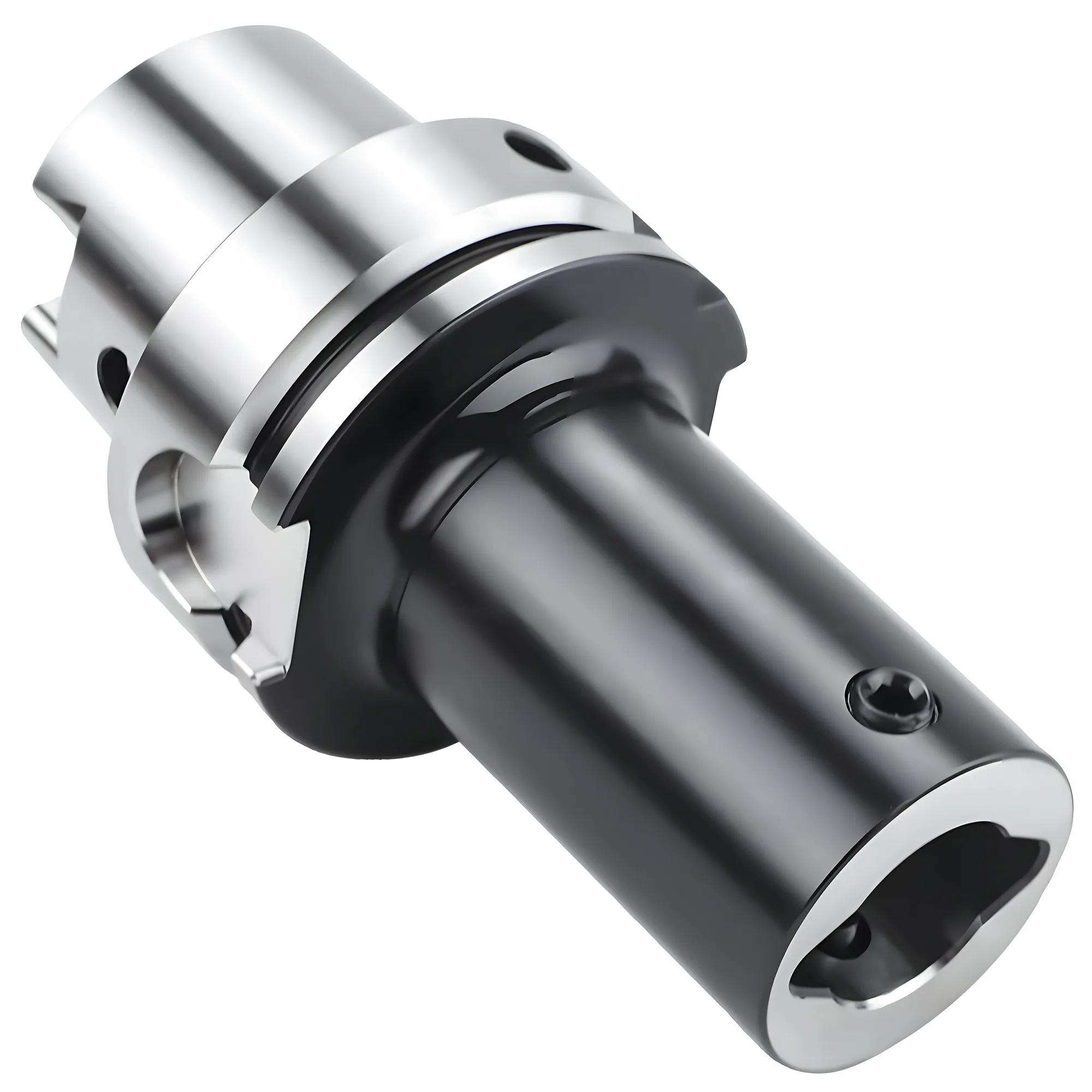
Buy an integral BT, CAT, or HSK shank boring head when one machining center does the production finishing — the one-piece body removes a joint from the runout stack, and an HSK-A63 connection delivers roughly 2-3x the radial stiffness of a taper-only BT40 (~50 N/µm vs ~20 N/µm under standard test conditions). Choose a modular CK-type taper-with-face-contact connection when one head must rotate across several machines or back to the crib: manufacturer specifications typically quote swap repeatability of 0.002-0.005 mm at the gauge line, and one head plus per-machine shanks usually costs roughly 40-45% less than duplicating complete heads. Reserve straight-shank, R8, and Morse-shank heads for manual mills and occasional work, where the extra joint or lighter drawbar grip costs rigidity the job can tolerate.
A boring head is only as accurate as the connection behind it. The head's dial may resolve 0.002 mm, but that resolution is delivered through a shank interface that adds its own deflection, runout, and — for modular systems — a joint that opens and closes every time the head changes machines. This guide compares the five interface families between boring head and spindle: straight shank, R8, Morse taper, integral BT/CAT/HSK, and modular CK-type connections. It covers rigidity, repeatability after a head swap, stack-up runout, changeover time, and the crib economics that decide when modular pays. For dialing the head itself, see the related setup guide; for the bar hanging off the front, see the boring bar guide — this article is about the joint behind the head.
What Are the Five Boring Head Interface Options?
A boring head reaches the spindle through one of five interface families — straight shank, R8, Morse taper, integral V-flange or HSK shank, and modular CK-type connections — and the choice fixes both the rigidity ceiling and the changeover workflow. The families split into two groups: heads that present a complete spindle interface themselves (integral and modular), and heads that present a generic shank for some other holder or spindle to grip (straight, R8, Morse).
Straight (cylindrical) shank heads carry a plain ground shank — commonly 20, 25, or 32 mm, or 3/4 in and 1 in — clamped in a side-lock holder, milling chuck, or large collet chuck on the machine. This is the budget path and the most universal one, because any spindle that holds a 25 mm shank holds the head. The cost is an extra joint: the shank-to-holder grip typically adds 0.010-0.030 mm TIR in a set-screw holder and stretches the cantilever by the holder's length.
R8 shank heads thread onto the 7/16-20 UNF drawbar of a Bridgeport-pattern knee mill. R8 is the de facto spindle interface on light vertical knee mills, so an R8-shank boring head is usually the only direct-mount option that class of machine accepts. Morse taper shank heads (typically MT2-MT4) fit the self-holding spindles of older mills and mill-drills; DIN 228 (and its international equivalent ISO 296) defines the Morse taper dimensions and tang form used to size these shanks, and the shallow ~1°26′-per-side angle holds by friction. Friction that resists axial drilling thrust does not resist a rotating radial boring load, so a Morse-shank boring head should be the tapped-and-drawbar-retained type, not the tang type, whenever it runs in a milling spindle.
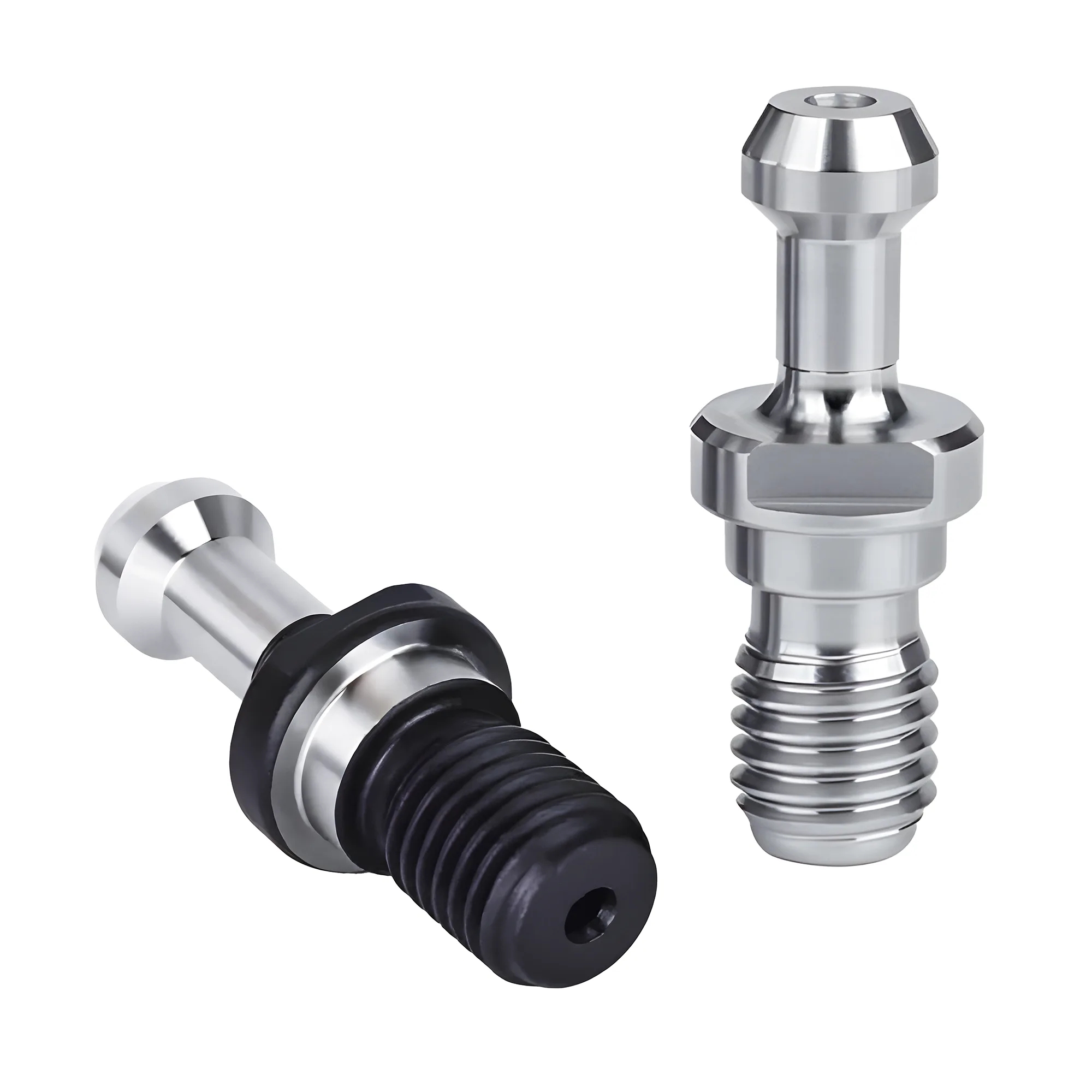
Integral BT/CAT/HSK shank heads machine the spindle taper directly into the head body. JIS B6339 governs the BT shank geometry used across Asia (MAS 403 defines the matching pull stud, so both standards are needed for a BT head to seat and retain), ANSI/ASME B5.50 defines the CAT V-flange used on North American machining centers, and DIN 69893 (with its international equivalent ISO 12164-1) defines the HSK hollow-shank taper — an integral head built to any of these drops into the matching spindle with no intermediate joint at all. The BT vs CAT vs HSK comparison covers choosing among the three taper systems themselves.
Modular CK-type connections put a short, precision-ground locating taper with simultaneous face contact between the head and an interchangeable shank. One head body accepts a BT40 shank today, an HSK-A63 shank tomorrow, and an extension in between. The CK system (originated by Kaiser, now BIG Kaiser/BIG DAISHOWA; comparable dual-contact modular connections exist from other boring tool makers) is the production-grade version of modularity; the screw-on threaded back found on entry-level import heads is the budget version, and its thread-plus-shoulder joint is the least rigid connection in this guide.
How Does the Connection Limit Rigidity and Depth of Cut?
The connection is a spring in series with the boring bar, and the softest spring dominates. HSK's simultaneous face-and-taper contact gives roughly 2-3x the radial stiffness of a taper-only BT or CAT connection (~50 N/µm for HSK-A63 vs ~20 N/µm for BT40 under standard test conditions), which is why integral HSK heads tolerate deeper finish cuts before deflection shows in the bore. Face contact matters specifically for boring because a boring head loads the interface eccentrically: the single-point cutting force acts at the swing radius, applying a bending moment that taper-only connections resist less effectively than dual-contact designs.
Length is the second lever, and it is more punishing than stiffness. Deflection scales with L³ (length cubed), so small additions to the cantilever compound fast — at 5:1 L/D a bar deflects 15.6x more than at a 2:1 baseline, and 27x at 6:1. A straight-shank boring head in a side-lock holder typically adds roughly 40-80 mm of holder body to the effective cantilever compared with an integral-shank head, which the cube law converts into a disproportionate deflection penalty at the insert. The modular CK joint sits between these extremes: it adds a short coupling length, but its ground face contact keeps the joint itself close to solid-body stiffness — manufacturer specifications generally rate modular and integral heads of the same family for equivalent cutting data in most applications.
| Interface | Joints in stack | Added cantilever length (typical) | Relative connection stiffness |
|---|---|---|---|
| Integral HSK-A63 | 1 (spindle only) | 0 mm | Highest (~50 N/µm at interface) |
| Integral BT40/CAT40 | 1 (spindle only) | 0 mm | High (~20 N/µm at interface) |
| Modular CK-type on BT/HSK shank | 2 | ~15-30 mm coupling | Near-integral (face contact) |
| Straight shank in side-lock holder | 2 | ~40-80 mm holder body | Moderate; set-screw grip |
| R8 shank (knee mill) | 1 | 0 mm | Limited by light spindle/drawbar |
| Morse taper, drawbar type | 1 | 0 mm | Limited; shallow taper, no face contact |
R8 and Morse connections are direct, so they avoid the stacked-joint penalty — their limitation is the machine class itself. An R8 spindle and its 7/16-20 drawbar suit boring forces of light knee-mill work, but the interface was never intended for the cutting forces that a 50 mm twin-cutter rough boring head generates on a machining center. Keep R8 and Morse heads on the manual machines they were designed for.
What Happens to Runout and Repeatability After a Head Swap?
Single-point boring is forgiving of pure radial runout — one edge cuts its own swing diameter regardless of where the rotation center sits. What the connection actually contributes is three different errors. For a single-point boring head, angular tilt error in the connection matters more than radial offset, because tilt tapers the bore along its depth while pure offset merely shifts the hole center. Second, for twin-cutter rough heads, radial offset unbalances the chip load between the two opposed edges, eroding the balanced-cut advantage. Third — and decisive for modular systems — non-repeatability invalidates any diameter that was preset offline: if the joint re-seats 0.01 mm differently, the preset is fiction.
The stack-up arithmetic favors fewer joints. Typical contributions, each measured at the gauge line under clean, undamaged conditions:
A modular CK-type connection typically re-seats within 0.002-0.005 mm of its previous position per manufacturer specifications, which is what allows a bore diameter preset on one machine to survive the move to another. That repeatability comes from the same feature that delivers stiffness: the ground face pulls the taper to a hard axial stop, so the joint closes to the same position each time instead of seating at a friction-dependent depth the way a plain taper does. A set-screw straight-shank grip has no such reference — each re-clamp lands the flat differently, so plan to re-touch the diameter after every transfer. The general runout-versus-grip trade-offs across holder types are covered in the tool holding solutions guide.
Verify the Joint Before Blaming the Head
When a swapped head bores oversize or tapered, indicate the head body's ground reference band before touching the dial. Typical shop experience puts a fretted or chip-contaminated modular joint at 0.01-0.03 mm of induced runout — an order of magnitude above the joint's clean rating — and cleaning both faces restores it in under a minute.
When Does a Modular CK System Pay for Itself?
Changeover time and crib economics decide the integral-versus-modular question. On changeover, typical shop experience runs: an integral head swaps via the tool changer in seconds but only on its one machine; a modular CK joint swaps head-to-shank in roughly 30-60 seconds with a single wrench; a straight-shank head re-clamped in a holder takes about 5-15 minutes once re-indicating and a test cut are counted; R8 and Morse drawbar changes on manual machines land around 1-5 minutes.
The capital math is where modular wins or loses. As an illustration using typical distributor pricing — a precision fine boring head runs roughly $800-2,500 while a CK-type machine-side shank runs roughly $200-600:
Three machines, integral approach: 3 heads ≈ $2,400-7,500. Three machines, modular approach: 1 head + 3 shanks ≈ $1,400-4,300. The dominant variable is the head count — modularity removes duplicate heads from the bill, and in this three-machine case it cuts tooling capital by roughly 40-45%.
A modular CK-type system typically pays for itself once a boring head must serve two or more machines, because each additional spindle costs one shank (roughly $200-600) instead of one complete head (roughly $800-2,500 at typical distributor pricing). The same logic extends down the head's diameter range: one modular head body accepts extensions, reductions, and larger bridge arms, so the crib stocks components instead of complete assemblies. Integral shanks remain the better buy when a single machining center runs the same bore in production, because no joint to manage means no repeatability check, no fretting risk, and the full rigidity of a one-piece body.
There is one modularity trap. Entry-level import heads offer screw-on arbors through a threaded back (commonly R8, MT, and straight arbors sharing one head). That achieves machine flexibility at low cost, but a thread with a shoulder is neither a centering fit nor a preloaded face joint — typical shop experience puts its repeatability and stiffness well below a CK-class connection, so treat screw-on modularity as a manual-mill convenience, not a production system.
Do Rough and Finish Boring Need Different Connections?
Rough and finish boring load the interface in opposite ways, and the connection should be chosen for the operation the head actually performs. The division of labor between head types is covered in the related twin-cutter versus fine boring head guide; what matters here is what each operation demands from the joint.
Rough boring is a torque and static-stiffness problem. A twin-cutter head's opposed edges balance the radial forces, but the total tangential load — and therefore the torque crossing the connection — is the highest of any boring operation, and interrupted cast surfaces add shock. Rough boring stresses the connection in torque and bending, so the interface needs positive drive (V-flange keys or HSK form-A slots) and face contact to stop the head micro-rotating under interrupted cuts. A taper-only joint that creeps a few micrometers under each shock progressively loses its preset.
Finish boring is a repeatability and dynamic-stiffness problem. The single-point radial force is modest — typically 50-150 N for a 50 mm head at finishing chip loads — but it acts eccentrically and continuously at the swing radius, and the target moves in micrometers. Here the connection's contribution to the total stack decides whether an H7 band survives: deflection scaling with L³ means the short, face-located joint of an integral or CK-type connection conserves the rigidity budget that the bar's own overhang then spends.
✦ Integral BT/CAT/HSK Shank Best For
- Production finishing on one dedicated machining center
- Maximum rigidity — no joint between head and spindle taper
- High-RPM fine boring where balance and face contact govern
- ATC-speed changeovers within a single machine
✦ Modular CK-Type Connection Best For
- One head rotated across 2+ machines or shared from the crib
- Mixed BT/CAT/HSK spindle fleets needing one boring inventory
- Preset-offline workflows relying on 0.002-0.005 mm swap repeatability
- Building extensions and reductions from stocked components
Which Boring Head Shank Should You Choose?
Match a boring head's shank interface to the machine fleet first and the bore tolerance second — the spindle decides the interface family before accuracy enters the question. If the spindle is fixed (R8 knee mill, Morse mill-drill), the interface is already decided and only the retention type is open. If the fleet is CNC, the question reduces to one machine versus many.
| Scenario | Interface | Typical Stack Runout (TIR) | Changeover (typical) | Why |
|---|---|---|---|---|
| Production finish boring on one machining center | Integral BT/CAT/HSK shank | 0.002-0.005 mm | Seconds via ATC | One-piece body removes a joint; full taper rigidity for H7 work |
| One head shared across 2+ machines or crib | Modular CK-type + per-machine shanks | 0.004-0.010 mm | 30-60 s per joint swap | Face contact repeats 0.002-0.005 mm; shanks cost less than duplicate heads |
| High-RPM fine boring in light alloys | Integral HSK-A63 | 0.002-0.005 mm | Seconds via ATC | ~50 N/µm interface stiffness; face contact resists eccentric-load micro-rotation |
| Bridgeport-pattern manual knee mill | R8 shank head | 0.013-0.025 mm | 1-3 min drawbar | Only direct mount the spindle accepts; light cuts match R8 capacity |
| Older mill or mill-drill with self-holding spindle | Morse taper shank, drawbar type | 0.015-0.040 mm | 2-5 min | DIN 228 taper fits the machine; drawbar resists radial-load walk-out |
| Occasional boring on a budget, mixed machines | Straight shank in side-lock or milling chuck | 0.015-0.040 mm | 5-15 min incl. re-indicating | Cheapest entry; any spindle via a holder, at a known rigidity cost |
Common Mistake
Buying a straight-shank head "because it fits everything" and then expecting integral-shank performance is the classic error. The set-screw joint adds typically 0.010-0.030 mm TIR and 40-80 mm of cantilever, and it re-seats differently on every clamp — acceptable for opening a clearance hole, but a constant fight for tolerance work. If the head will bore H7 fits regularly, the joint quality is not the place that should absorb the savings.
Integral shank for one machine's production; modular CK when the head travels.
An integral BT/CAT/HSK boring head gives the stiffest, shortest, most repeatable connection and is the default for dedicated production finishing — HSK-A63 where eccentric loads and speed demand its roughly 2-3x stiffness edge over BT40. A modular CK-type taper-with-face-contact system trades a small joint penalty for 0.002-0.005 mm swap repeatability and roughly 40-45% lower tooling capital once one head serves several machines. Straight-shank heads buy universality at the cost of an extra 0.010-0.030 mm joint and a longer cantilever; R8 and Morse heads belong on the manual machines whose spindles dictate them. Decide by fleet first, tolerance second — and never let a screw-on thread masquerade as a production modular connection.
Which boring head shank interface gives the best rigidity?
An integral HSK shank — HSK-A63 delivers approximately 2-3x the radial stiffness of a taper-only BT40 (~50 N/µm vs ~20 N/µm under standard test conditions), and the one-piece body adds zero joints and zero extra cantilever. Integral BT/CAT comes second; straight shanks in holders rank last because deflection grows with length cubed.
Is a modular CK-type boring head less rigid than an integral shank?
Slightly, but the taper-plus-face-contact joint keeps the penalty small — manufacturers generally rate modular and integral heads of the same family for equivalent cutting data in most applications. The joint adds roughly 15-30 mm of coupling length and re-seats within typically 0.002-0.005 mm, so the practical difference appears mainly at extreme overhangs.
Can I run a straight-shank boring head in a CNC machining center?
Yes — clamp it in a side-lock holder, milling chuck, or large collet chuck. Expect the joint to add typically 0.010-0.030 mm TIR and roughly 40-80 mm of cantilever length, and re-indicate after every re-clamp because a set-screw grip has no repeatable seating reference. It suits occasional boring, not production H7 work.
When does a modular boring system pay for itself?
Typically at two or more machines. Each additional spindle costs one CK-type shank (roughly $200-600 at typical distributor pricing) instead of one complete head (roughly $800-2,500), so a three-machine fleet saves about 40-45% in tooling capital while keeping one preset head that repeats within 0.002-0.005 mm after each swap.
Do rough boring and finish boring need different shank connections?
They stress the joint differently. Rough boring with twin-cutter heads loads the connection in torque and bending shock, demanding positive drive keys and face contact to prevent micro-rotation. Finish boring applies a modest eccentric force (typically 50-150 N) but demands micrometer repeatability, so a short face-located joint — integral or CK-type — protects the H7 tolerance budget.
Sources
- ANSI/ASME B5.50 — V-Flange Tool Shanks for Machining Centers
- JIS B6339 / MAS 403 — 7/24 Taper Tool Shanks (BT) for Automatic Tool Changers
- DIN 69893 / ISO 12164-1 — Hollow Taper Shanks (HSK) Geometry
- DIN 228 / ISO 296 — Morse and Metric Taper Definitions
- BIG DAISHOWA / BIG Kaiser — CK Modular Boring Tool Connection Documentation
- Machinery's Handbook, 31st Edition — Tapers and Machine Spindle Noses