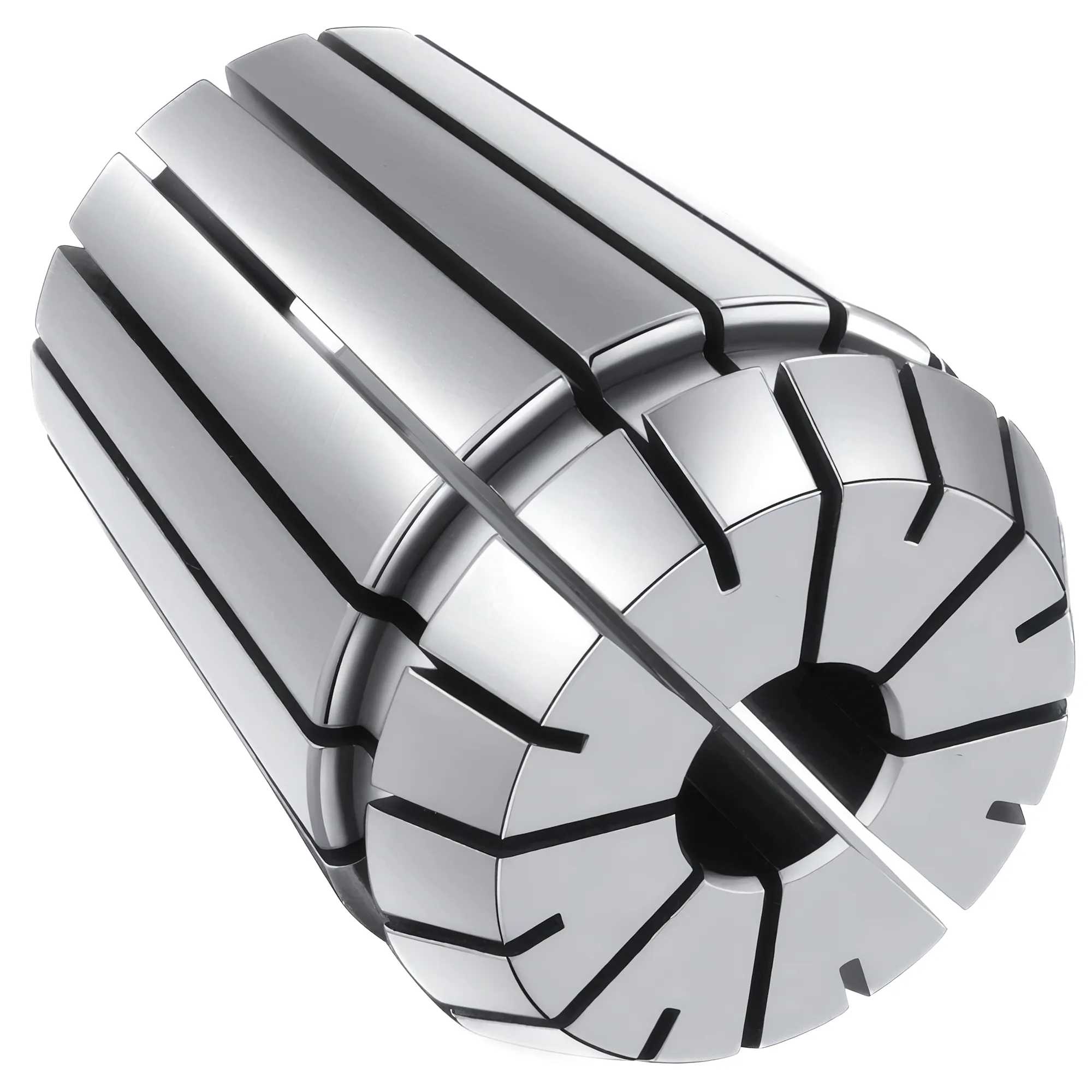
On a lathe, choose 5C collets for repeat work on standard bar sizes and ER collets for odd sizes on a budget. A 5C collet grips within a few thousandths of an inch of its marked size but takes round stock to 1-1/16 in (27 mm) plus hex and square, and standard Hardinge 5C collets run 0.001 in (0.025 mm) TIR or better. A standard (Form B) ER collet collapses 1 mm (ER16–ER40, per ISO 15488), so about 23 ER40 collets cover 3–26 mm continuously, but only for round stock.
This guide covers collets used as lathe workholding — collet closers and spindle-nose collet chucks that hold the part. For ER collets as tool holders on a mill, see the ER collet selection guide; for when jaws beat collets altogether, see 3-jaw vs 4-jaw lathe chuck selection.
How Do 5C and ER Collets Differ on a Lathe?
The two systems close in opposite directions. A 5C collet is a draw-in collet: a drawtube or the chuck's closing ring pulls it back into a 20° included (10° head-angle) seat, so the collet and the part move slightly toward the headstock as it closes. An ER collet is pushed into a 16° included (8° setting angle) taper by a threaded nut at the nose, the geometry standardized in ISO 15488 and its German predecessor DIN 6499.
That difference in closing mechanism drives almost every practical trade-off below:
- Slotting. Standard 5C collets are slit from the nose end only (three slots), so they close mainly at the front. ER collets are slit alternately from both ends, which lets the bore close parallel over its length across the full 1 mm range.
- Shapes. 5C collets are made in round, hex, square and rectangular bores. ISO 15488 covers collets for cylindrical shanks only, so ER is a round-stock system.
- Accessories. 5C has a large ecosystem built around the same collet seat: internal collet stops, dead-length collets, emergency (soft) collets and step chucks up to 6 in. ER has none of these as standard items.
Capacity, Collapse Range and Bar Through-Capacity
Collapse range is the single biggest difference: a standard (Form B) ER collet from ER16 to ER40 closes 1 mm below its nominal size, while a 5C collet is designed to grip at or very close to its marked size. Hardinge sells 5C collets in increments as fine as 0.001 in for exactly this reason, and common shop practice keeps stock within a few thousandths of an inch (roughly 0.05–0.08 mm) of nominal. Stock further undersize tends to be held only at the nose of a front-slit 5C collet, which costs both grip and concentricity.
The collapse range sets how many collets a full set needs:
| Coverage goal | 5C collets needed | ER collets needed | Basis |
|---|---|---|---|
| 1/16–1-1/16 in by 1/32 in | 33 | — | Hardinge 5C round kit |
| 1/16–1-1/16 in by 1/64 in | 65 | — | Hardinge 5C round kit |
| 2–27 mm by 0.5 mm | 51 | — | Hardinge 5C metric kit |
| 3–26 mm continuous | — | ~23 (ER40, 1 mm steps) | ISO 15488 range, 1 mm collapse |
| 2–20 mm continuous | — | ~18 (ER32, 1 mm steps) | ISO 15488 range, 1 mm collapse |
Even a 65-piece 5C set leaves gaps of 1/64 in (0.4 mm) between sizes, whereas a 1 mm-step ER set has no gaps at all because each collet's range meets the next. That count assumes the standard ISO 15488 1 mm range; the standard also permits 0.5 mm for ER16–ER40 by agreement, and collets listed with 0.5 mm bands need 0.5 mm steps to stay gap-free, so check the maker's clamping-range chart before ordering a set. For a shop that buys odd metric and imperial stock, roughly 23 ER40 collets typically cover more real-world diameters than a 33-piece 5C set. The flip side: maximum round capacity is about the same (26 mm for ER40 versus 27 mm for 5C), and an ER32 stops at 20 mm.
Bar through-capacity depends on the mount, not only the collet. A 5C drawtube closer passes bar through the collet and the drawtube into the spindle bore, and Hardinge's dead-length thru-hole 5C collets accept bar up to 3/4 in. An ER chuck on a backplate or camlock mount usually leaves the spindle bore open behind the collet; an ER chuck on a Morse taper shank with a drawbar blocks the spindle, so only stock that fits inside the chuck body can be held.
Accuracy and Runout: Collet vs Whole System
Hardinge states its standard 5C collets run 0.001 in (0.025 mm) TIR or better and its special-accuracy 5C round collets 0.0002 in (0.005 mm), the latter measured 1 in from the face in a Hardinge spindle. ISO 15488 Class 2 ER collets are allowed 0.015 mm (bore up to 10 mm) or 0.020 mm (10–26 mm) at a defined test-mandrel projection, Class 1 tightens that to 0.010–0.015 mm, and manufacturer UP/AA grades typically reach 0.005 mm or better.
On a lathe those collet numbers are only the last link in the chain. Total runout at the part is typically the sum of:
- Spindle runout at the nose
- Mount error — the D1 camlock taper, a threaded nose, a backplate register, or a Morse taper shank
- Chuck-body seat runout (the 5C seat or the ER taper bore)
- Collet runout, plus how far the stock is from nominal
An integral D1 camlock collet chuck cannot be adjusted, so any error between its taper and the chuck's collet seat appears directly at the part. A backplate-mounted chuck can have its register skimmed in place on the lathe, which is why many hobby and small-shop users prefer backplate mounting for collet chucks. ISO 702-2 defines camlock spindle-nose and chuck connecting dimensions, which is why a D1-4, D1-5 or D1-6 collet chuck from any maker fits the matching spindle nose — fit alone does not guarantee concentricity, so check the bore with a gauge pin and a dial indicator before trusting it.
Check the System, Not the Box Label
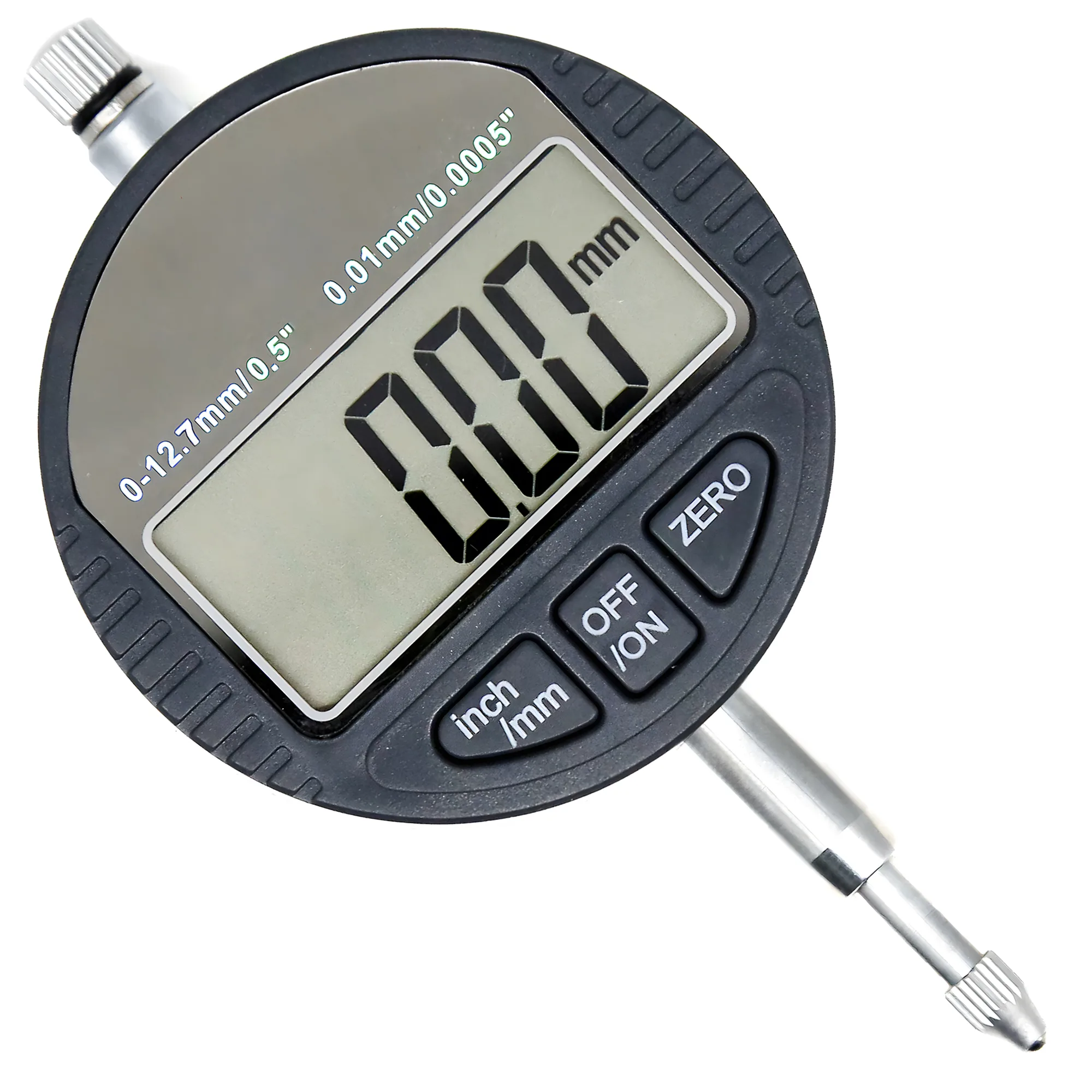
Clamp a ground gauge pin in the collet and indicate it at the nose and roughly 25 mm (1 in) out. Comparing the two readings separates offset (mount or seat error) from tilt (collet or taper contact), which tells you whether to re-skim a backplate or replace a collet.
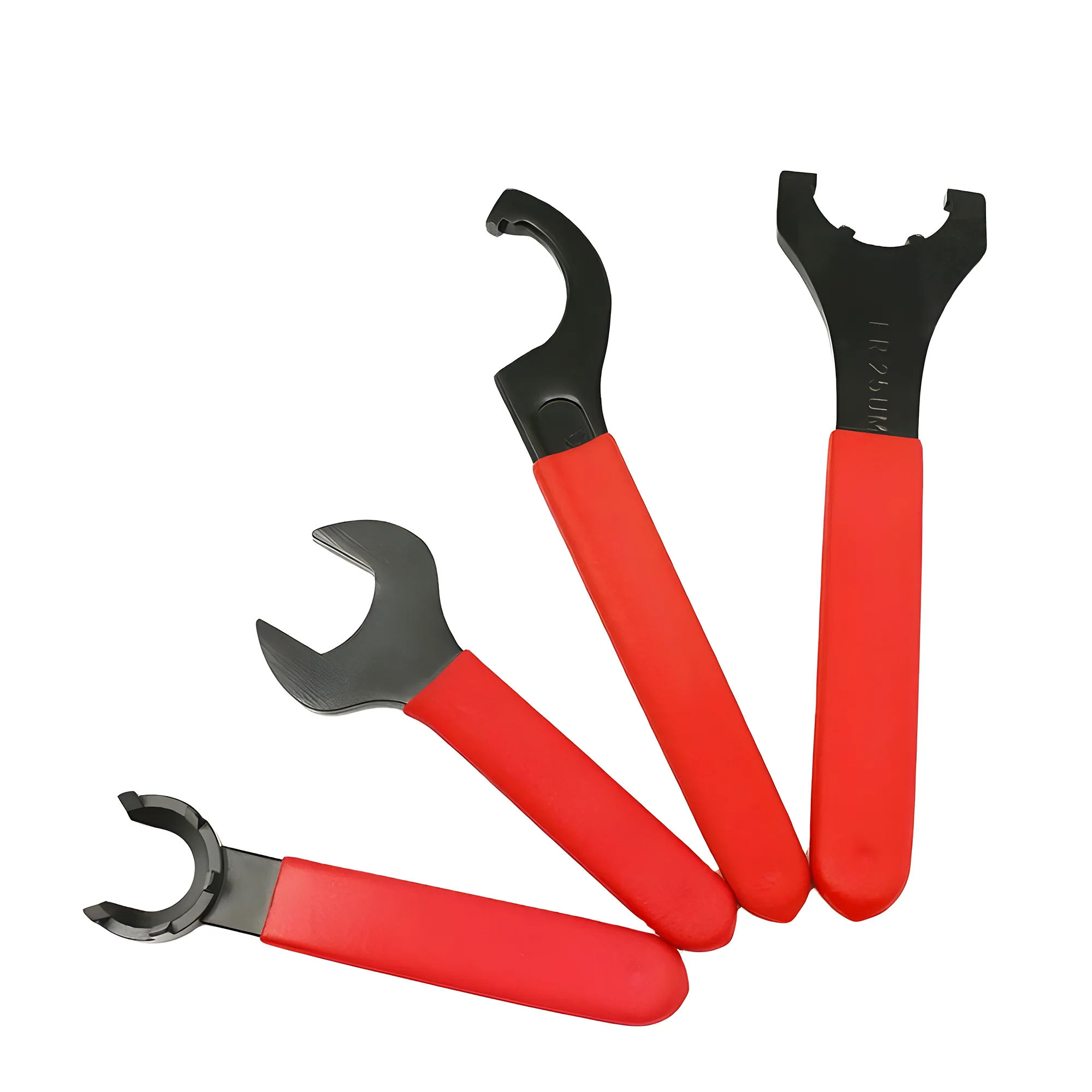
For an ER chuck, nut torque matters as much as collet grade. REGO-FIX recommends 136 Nm for an ER32 standard nut and 176 Nm for ER40 at the largest bore band; under-tightening reduces grip and over-tightening can distort the collet. The full procedure is in the ER collet runout and torque guide.
Hex, Square, Stops, Dead-Length and Step Collets
5C is typically the only practical collet choice on a lathe when the stock is hex or square, because ISO 15488 ER collets are standardized for round shanks only. Hardinge lists hex 5C collets to 7/8 in and square to 3/4 in, which covers most hex bar used for nuts, fittings and standoffs.
Length control is the second 5C-only strength. Most 5C collets carry an internal 1.041-24 thread for a threaded collet stop, but the stop moves with the collet. Hardinge gives the rule for 10° head-angle collets as 1:3 — every 0.001 in change in stock diameter makes the part pull back or stick out 0.003 in. A 0.003 in diameter spread can therefore produce up to 0.009 in of length variation. Dead-length 5C collets keep the gripping collet stationary against the spindle face, and Hardinge states finished lengths then typically vary only 0.0002–0.0005 in for the same stock spread.
ER collets close by being pushed into the taper rather than drawn back, so a fixed backstop in the spindle bore or chuck body is the usual way to repeat shoulder lengths; repeatability then depends heavily on consistent nut torque from part to part.
For parts larger than any collet:
- 5C step chucks extend a 5C closer to work up to 6 in diameter with a matching step-chuck closer. Hardinge rates its cast-iron closers at less than 5,000 rpm (2–4 in) and less than 4,000 rpm (5–6 in).
- 5C emergency collets are supplied soft and bored in place to an odd size or profile. Hardinge's rule of thumb is 300–500 pieces of life, so treat them as a stop-gap, not production tooling.
- ER has no standardized step-chuck or emergency-collet equivalent; a soft-jaw 3-jaw chuck usually fills that role.
Lathe Mounting Options and Cost of a Full Setup
Four mounting routes cover almost every manual and small CNC lathe:
| Mount | Collets | Through-bore | Typical use | Main limitation |
|---|---|---|---|---|
| Drawtube (lever or handwheel) 5C closer | 5C | Yes, via drawtube | Repeat production, toolroom lathes | Spindle bore must clear a drawtube over the 1.250 in collet body |
| Key-operated 5C collet chuck (backplate or D1) | 5C | Yes, up to 1-1/16 in | Small lathes without a large bore | Larger overhang than a drawtube closer |
| ER collet chuck (backplate or D1) | ER32 / ER40 | Usually yes, to 20 / 26 mm | Hobby and job-shop lathes | Wrench and torque on every part change |
| ER chuck on Morse taper shank + drawbar | ER25–ER40 | No | Mini lathes, occasional small work | Blocks bar feed; Morse taper seat adds runout |
A drawtube 5C closer typically needs a spindle bore of roughly 1.4–1.5 in (36–38 mm) to pass the drawtube, which rules it out on most mini and 9x20-class lathes with roughly 20 mm bores. Those machines usually take a nose-mounted collet chuck instead — a backplate ER32/ER40 chuck or a key-operated 5C chuck — so the spindle bore stays open for bar.
Cost scales mainly with collet count and grade rather than the chuck. A continuous ER40 set is about 23 collets, a 5C fractional set by 1/32 in is 33 and by 1/64 in is 65, so at a similar per-collet price a fully stocked 5C setup needs roughly 1.4–2.8× as many collets as a continuous ER40 set, before accessories such as stops and step chucks are added. Swapping from a 3-jaw to a collet chuck on a D1 camlock usually takes a few minutes; re-indicating is needed only if the mount does not repeat, which is another reason to check the chuck once and mark its best cam position.
Common Mistake
Buying an ER chuck on a Morse taper shank to save cost, then discovering it blocks the spindle bore. If you ever need to hold long bar or tube, buy a backplate or camlock-mounted collet chuck from the start.
Which to Buy for a Hobby or Small-Shop Lathe — and When to Own Both
✦ 5C Collets Best For
- Repeat batches on standard bar sizes where length control matters
- Hex and square stock up to 7/8 in hex and 3/4 in square
- Short parts and second operations with stops or dead-length collets
- Large diameters via step chucks up to 6 in
✦ ER Collets Best For
- Mixed metric and imperial stock with odd diameters
- Hobby lathes with small spindle bores and a limited budget
- Turning work that shares collets with a mill or router ER holder
- Fewer collets for continuous coverage (~23 for ER40)
Most hobby and small-shop lathes are well served first by a backplate-mounted ER40 chuck, because about 23 collets cover 3–26 mm with no gaps. Add a 5C collet chuck or closer when hex or square bar, batch length control, or step chucks start to matter. Owning both is common: ER handles one-off and odd-size round work, 5C handles repeat jobs and shaped stock, and a 3-jaw chuck stays on the shelf for anything larger.
| Scenario | Recommended System | Mount | Capacity | Why |
|---|---|---|---|---|
| First collet chuck on a hobby lathe, mixed stock | ER40 | Backplate or D1 | 3–26 mm round | 1 mm collapse covers odd sizes with ~23 collets |
| Mini or 9x20-class lathe, small parts only | ER32 or ER25 | Backplate or threaded nose | 2–20 mm (ER32) | Small chuck body fits the spindle; keeps the bore open |
| Hex or square bar (nuts, fittings, standoffs) | 5C | Collet chuck or closer | 7/8 in hex, 3/4 in square | ISO 15488 ER collets are standardized for round shanks only |
| Batches needing repeatable shoulder length | 5C dead-length | Drawtube closer | Up to 1-1/16 in | Stationary collet removes the 1:3 pull-back |
| Parts above 1-1/16 in up to 6 in diameter | 5C step chuck | Step-chuck closer | Up to 6 in | Full-circumference grip limits distortion |
| Highest concentricity on standard sizes | 5C special accuracy | Drawtube closer or trued backplate | Up to 1-1/16 in | 0.0002 in (0.005 mm) collet TIR per Hardinge |
Start with a backplate ER40 chuck for range; add 5C for hex, length control and repeat work.
ER32 and ER40 collets collapse 1 mm each under ISO 15488, so roughly 23 ER40 collets hold any round stock from 3 to 26 mm, which suits hobby and job-shop lathes with mixed stock. 5C collets grip within a few thousandths of an inch of nominal, run 0.001 in TIR or better (Hardinge standard grade), hold hex and square, and support stops, dead-length collets and step chucks to 6 in. Mount either on a backplate or camlock rather than a Morse taper shank to keep the spindle bore open, and verify system runout with a gauge pin.
What is the difference between 5C and ER collets on a lathe?
A 5C collet is drawn back into a 20° included seat and grips within a few thousandths of an inch of its size, while an ER32 or ER40 collet is pushed in by a nut and collapses 1 mm. 5C holds round, hex and square stock to 1-1/16 in; ER holds round stock only, up to 26 mm in ER40.
Are ER collets or 5C collets more accurate on a lathe?
Collet for collet, Hardinge rates standard 5C collets at 0.001 in (0.025 mm) TIR or better, while ISO 15488 Class 2 ER collets allow 0.015–0.020 mm. In practice the lathe mount often dominates: an untrued camlock or Morse taper seat can add more runout than either collet, so indicate the whole system with a gauge pin.
How many collets do I need for a full set?
Roughly 23 ER40 collets at 1 mm steps cover 3–26 mm with no gaps, because each standard ISO 15488 collet collapses 1 mm; collets listed with only a 0.5 mm range need 0.5 mm steps. A 5C fractional set needs 33 collets at 1/32 in steps or 65 at 1/64 in steps to cover 1/16–1-1/16 in, and still grips well only near each marked size.
Can I put a 5C collet closer on a small hobby lathe?
Usually not as a through-spindle drawtube closer, which typically needs a spindle bore of roughly 1.4–1.5 in (36–38 mm). Lathes with roughly 20 mm bores normally use a key-operated 5C collet chuck or an ER32/ER40 chuck on a backplate instead, which keeps the spindle bore open for bar stock.
Should I get an ER collet chuck with a Morse taper shank or a backplate mount?
Choose a backplate or camlock mount if you ever hold bar longer than the chuck, because a Morse taper shank with a drawbar blocks the spindle bore. The taper-shank version costs less and suits short parts on mini lathes, but its taper seat adds runout and it cannot pass stock through a typical 20 mm spindle bore.
Sources
- ISO 15488:2003 — Collets with 8° setting angle for tool shanks — Collets, nuts and fitting dimensions
- DIN 6499 — Clamping sleeves for collet chucks
- ISO 702-2:2007 — Machine tools — Connecting dimensions of spindle noses and work holding chucks — Part 2: Camlock type
- Hardinge — Workholding Spindle Tooling for Manual & CNC Lathes, catalogue #2348J (2023)
- Hardinge — 5C Round Collet Kit, 33 pieces 1/16 in to 1-1/16 in by 32nds
- REGO-FIX — Recommended tightening torque for ER and MR clamping nuts