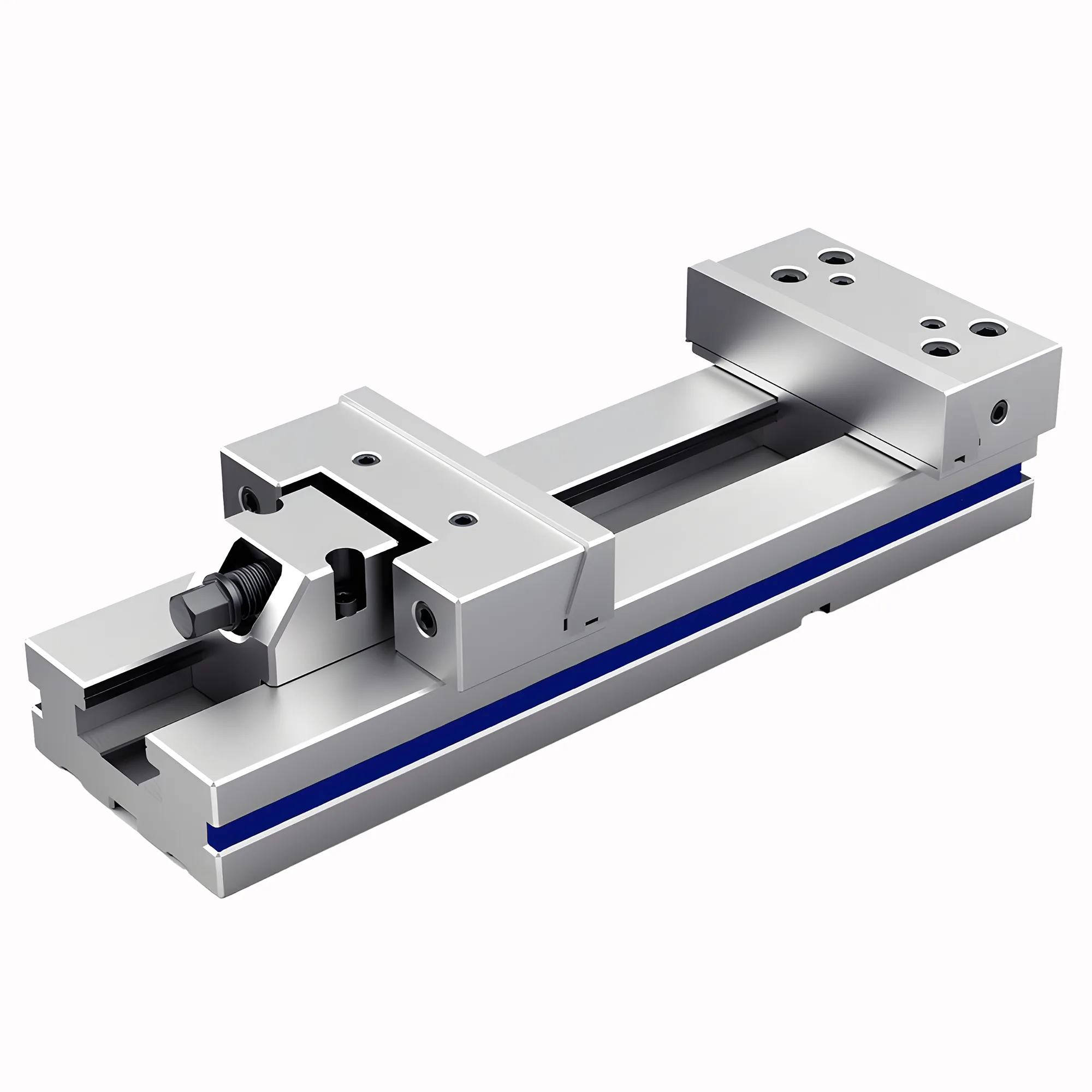
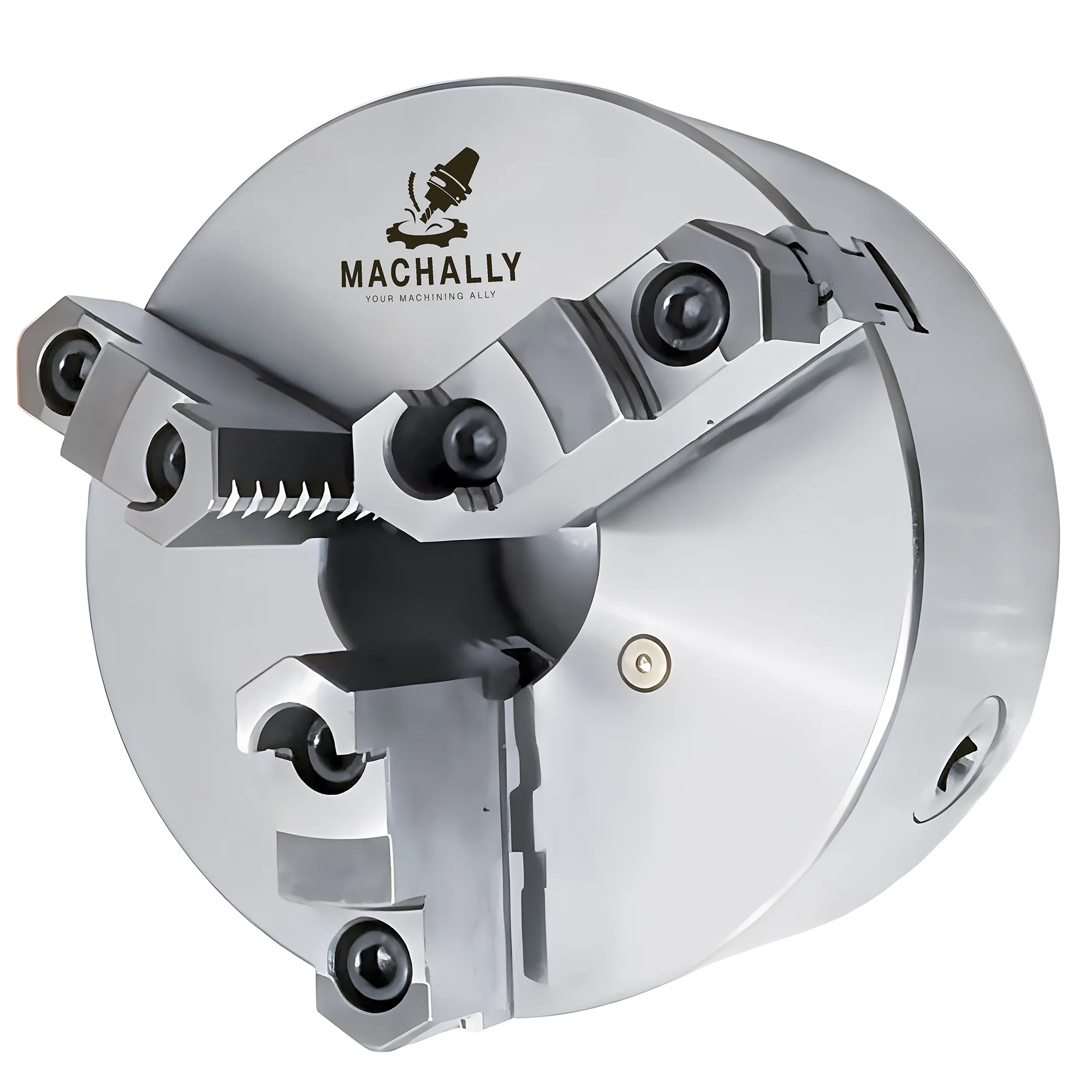
Required workholding clamping force is approximately the cutting force at the tool-workpiece interface, multiplied by a 2-5x safety factor, and divided by the jaw friction coefficient (typically 0.15-0.25 for smooth jaws on steel and 0.4-0.6 for serrated jaws). For a Ø25 mm 4-flute end mill slotting 316L stainless at ap=1 mm and fz=0.05 mm/tooth, F_cut runs around 180 N, so a smooth-jaw vise needs roughly 2-4 kN of clamping force, well within the 25-40 kN that a typical 4-inch modular vise delivers. Undersizing causes slip and chatter; oversizing crushes thin walls and prints jaw marks deeper than 0.1 mm.
Quick Clamping Force Reference
| Problem / Goal | Primary Action | Expected Impact |
|---|---|---|
| Workpiece slipping during cut | Increase clamping force or switch from smooth (μ≈0.20) to serrated jaws (μ≈0.50) | ~2.5x effective grip with same applied force, since slip force ∝ μ × F_clamp |
| Thin-wall part deforming under clamp | Spread load over larger jaw contact area or use soft jaws bored to fit | Contact pressure ↓ proportional to area; soft jaws can cut imprint depth from 0.1 mm to <0.02 mm |
| Tapping causes part to spin in vise | Apply n=2-3 safety factor on torque, not just axial force | Prevents typical rotational slip in M6-M12 taps in 6061-T6 under shop conditions |
| Interrupted milling unseats workpiece | Bump safety factor from n=2.5 to n=3-5 | Absorbs entry/exit shock loads roughly 1.5-2x steady-state F_cut |
| Cosmetic surface shows jaw marks | Reduce clamping force or use parallel-faced soft jaws on conformal contact | Imprint depth typically scales with σ_clamp / σ_yield; staying below ~30% of yield keeps marks under 0.05 mm |
| Aluminum block printing hard-jaw waffle pattern | Insert 0.5-1 mm copper or aluminum shim between jaw and workpiece | Distributes pressure across full contact face; eliminates point loading without losing significant grip |
Why Clamping Force Sizing Sits Between Two Failure Modes
Workholding has two opposing failure modes — slip from too little clamping force, and deformation from too much — and the right answer typically lies between them, not at either extreme. Sizing a vise or fixture for "as much force as it will give" is wrong about as often as it's right. On a 6061-T6 thin-wall part, full vise force can crush the wall before the cut even starts; on a Ti-6Al-4V slot, the same vise force may still be marginal because titanium's specific cutting force is roughly 3x that of aluminum.
The two boundary equations are:
- Lower bound (slip):
F_clamp ≥ (F_cut × n) / μ - Upper bound (deformation):
F_clamp ≤ A_jaw × σ_yield × k_def
Where F_cut is the cutting force at the tool-workpiece interface, n is a safety factor, μ is the friction coefficient between jaw and workpiece, A_jaw is jaw contact area, σ_yield is the workpiece material yield stress, and k_def is an allowable-deformation fraction (typically 0.2-0.4 for fixturing surfaces, lower for cosmetic surfaces). Cutting force usually drives the lower bound while material yield stress drives the upper bound — meaning soft alloys are limited by deformation, hard alloys by slip.
The required clamping force is whichever of the two boundary calculations gives the more demanding number — usually the lower bound for steel and titanium, the upper bound for aluminum and brass.
Estimating Cutting Force F_cut from Specific Cutting Energy Kc
Specific cutting force Kc converts the chip volume per unit time into a force estimate, and for production milling it is the most practical predictor of clamping demand. The basic relationship from Sandvik and Kennametal application data is:
F_cut ≈ Kc × ap × fz × z_eff
- Kc (specific cutting force, N/mm²) — from manufacturer handbooks
- ap (axial depth of cut, mm)
- fz (feed per tooth, mm)
- z_eff (number of teeth simultaneously engaged, not the total flute count)
Kc is dominant for hard alloys and z_eff is dominant for slot-and-pocket geometries — meaning the same end mill in the same setup can pull 5x more clamping demand simply by going from light side-cutting to full slotting.
| Material | Typical Kc (N/mm²) | Notes |
|---|---|---|
| 6061 / 6082 aluminum | 600-800 | Sandvik/Kennametal ranges; Kc rises ~20% in T6 temper vs O |
| 304 / 316 stainless | 1,700-2,000 | Work hardens — keep fz above 0.04 mm to avoid rubbing |
| Carbon steel C45 (1045) | 1,800-2,200 | Reference value in many handbooks |
| Ti-6Al-4V titanium | 2,000-2,400 | Roughly 3x aluminum; small ap recommended for vibration control |
| Inconel 718 | 2,800-3,500 | Highly variable; cited 4-flute carbide end mill range |
Values reflect commonly cited handbook ranges; absolute values depend on tool geometry, rake angle, and chip thickness. For typical end-mill geometries, rake angle shifts Kc by roughly 1% per degree (the correction factor built into Sandvik's Kc model), while fz and ap vary the resulting force by a factor of 4-10 — so chip-load decisions dominate clamping demand.
Worked example — Ø25 mm 4-flute end mill in 316L:
- ap = 1 mm, fz = 0.05 mm, full slot (radial engagement = 25 mm)
- For a 4-flute slotter, typically ~1.5-2 teeth are engaged at any moment in a slot
- Kc ≈ 1,800 N/mm² (mid-range for 316L)
- F_cut ≈ 1,800 × 1 × 0.05 × 2 ≈ 180 N total at the cutter (about 90 N per engaged tooth)
This 180 N is the tangential cutting force component that the workpiece must resist. The radial component is typically 30-50% of tangential for slotting and adds to the slip-direction load on the jaws.
Build a Worked Example Library
Keep a small spreadsheet of F_cut estimates for the five materials and three operations you run most often. Recomputing from first principles for every new job is fine for engineering — but in production, an estimator that takes 10 seconds beats a perfect calculation nobody runs. Compare the spreadsheet result to actual chip evacuation behavior over a few jobs to calibrate your Kc values to your specific tooling.
Friction Coefficient by Jaw Type and Surface Condition
Friction coefficient between jaw and workpiece varies by 3-4x depending on jaw style, cleaning, and oil presence — making it the single largest swing variable in clamping calculations. The slip equation F_clamp ≥ F_cut × n / μ shows that doubling μ halves the required clamping force, which correspondingly lowers the deformation risk. Switching jaw style is usually the simpler fix than buying a stronger vise: it moves μ by 2-3x, more leverage than any realistic increase in clamping capacity.
| Contact Type | Typical μ (dry) | Typical μ (oily) | Notes |
|---|---|---|---|
| Smooth hard jaw on steel | 0.15-0.25 | 0.10-0.15 | Coolant residue can drop μ ~30% |
| Smooth hard jaw on aluminum | 0.20-0.30 | 0.15-0.20 | Aluminum's softer surface yields locally, increasing real contact area |
| Serrated waffle/pyramid jaw on steel | 0.40-0.60 | 0.30-0.45 | Tooth bite into surface; mechanical interlock dominates |
| Soft jaw bored to fit (conformal) | 0.45-0.55 effective | similar | Conformal contact converts pure friction into 3-axis location |
| Diamond-coated grippy plate | 0.55-0.75 | 0.45-0.60 | Used where serrations are too aggressive; hardened-particle bite |
Values are typical industry ranges; reported μ varies with surface roughness, oxide layer, and workpiece hardness. Switching from a smooth jaw at μ=0.20 to a serrated jaw at μ=0.50 reduces required clamping force by approximately 60% for the same cutting load. That is often enough to move from "marginal grip on a thin part" to "comfortable grip without crushing."
For aluminum, smooth jaws frequently outperform their μ values because the aluminum yields locally into the jaw asperities, raising effective μ. The trade-off is visible imprint marks. On any cosmetic surface, smooth parallel-faced soft jaws are typically preferred over serrated jaws because serrations leave deep witness marks that machining cannot remove without an extra setup.
For approaches to choosing the right jaw style for a given workpiece, see the vise jaw selection guide.
Coolant on Smooth Jaws Can Halve Effective Grip
A vise that holds securely in dry setup can release the part when flood coolant pools between the jaw and workpiece. The boundary lubrication effect can drop μ from ~0.20 to ~0.10 — equivalent to halving the clamping force. For production runs with coolant, design with the wet μ value, not the dry one.
Safety Factor n by Operation Type
Safety factor n absorbs the variability that point estimates of F_cut hide — entry shock, runout, work-hardening spikes, and feed override surges — and the right n is operation-specific, not a single number. Choosing n=2 for everything underprotects interrupted milling; choosing n=5 for everything wastes capacity on continuous turning. The general rule is: the higher the variability in instantaneous force, the higher the safety factor.
| Operation | Typical n | Why |
|---|---|---|
| Continuous turning, finish | 2.0-2.5 | Force is steady; main variability is wear-driven drift |
| Continuous milling, side cut | 2.0-3.0 | Each tooth engagement is similar; some chip-thickness variation |
| Slot milling, full radial | 2.5-3.5 | Higher z_eff variation as flutes enter/exit |
| Interrupted milling (face mill across slot) | 3.0-5.0 | Entry/exit shock can spike to 1.5-2x steady-state |
| Drilling and boring | 2.0-3.0 | Axial-dominant; thrust load typically predictable |
| Tapping | 2.0 axial, 2.0-3.0 torsional | Low axial force, but torsional spike on bottom-of-hole and reverse |
| Heavy roughing in hard materials | 3.0-4.0 | Work-hardening and inclusion spikes can double instantaneous force |
These ranges follow common production practice; tighter setups with rigid spindles and well-balanced tooling can run at the lower end of each range. Interrupted milling is the most-commonly-undersized operation because operators size n from steady-state cutting force when peak entry/exit force is what actually unseats the workpiece.
The 10% rule of thumb for safety factor adjustment: for every 0.05 mm of expected runout above 0.01 mm, increase n by approximately 10%, since runout converts steady-state force into per-tooth force variability.
Deformation Limit on the Workpiece Side
Once F_clamp passes the slip threshold, the failure mode shifts to workpiece deformation — and for soft alloys this often becomes the binding constraint, not slip. The deformation upper bound is:
F_clamp_max ≈ A_contact × σ_yield × k_def
Where A_contact is the actual jaw-workpiece contact area (smaller than nominal jaw width × workpiece face on serrated jaws), σ_yield is the workpiece yield stress, and k_def is the deformation fraction you can tolerate (typically 0.2-0.4 for fixturing surfaces, 0.05-0.10 for cosmetic surfaces).
Material yield stress dominates the deformation limit because allowable contact stress scales directly with σ_yield — the same vise force that leaves no visible mark on normalized C45 steel (~350-450 MPa) can print jaw marks on 6061-T6 (~240-275 MPa) and crush thin-wall annealed 316L (~170-220 MPa).
| Material | σ_yield (MPa, typical) | Notes |
|---|---|---|
| 6061-T6 aluminum | 240-275 | T6 is the standard production temper; T0 yields near 55 MPa |
| 7075-T6 aluminum | 460-505 | Higher than T6 6061 but more notch-sensitive |
| 304 stainless | 200-250 | Annealed; cold-worked 304 can exceed 500 MPa |
| 316L stainless | 170-220 | Slightly lower than 304 in annealed form |
| C45 / 1045 carbon steel | 350-450 | Normalized condition |
| Ti-6Al-4V titanium | 800-900 | Annealed; aged grades higher |
Imprint depth follows a roughly proportional relationship to applied stress versus yield stress. For fixturing surfaces, imprint depths up to 0.05-0.1 mm are typically acceptable; for cosmetic surfaces visible to the customer, the limit drops to 0.02 mm or below, which often means smooth soft jaws or a sacrificial liner are required.
Worked example — Ø100 mm 6061-T6 block, 4-inch modular vise:
- Required F_clamp from cutting (μ=0.20, n=3, F_cut=180 N): F_clamp ≥ 2.7 kN
- Allowable F_clamp from deformation (jaw contact ~25 mm × 25 mm = 625 mm², σ_yield=270 MPa, k_def=0.3): F_clamp ≤ 50 kN
- Vise typical output: 25-40 kN
- Headroom against slip: ~9x; headroom against deformation: ~1x at full vise force
The deformation limit is the binding constraint at full vise torque. Backing off torque to 20 kN keeps imprint depth proportional and is normally fine for fixturing surfaces.
Worked example — thin-wall 316L tube, 3-jaw chuck, light cuts:
- Wall thickness 2 mm, OD 60 mm, contact area per jaw ~20 mm × 20 mm = 400 mm²
- σ_yield for 316L ≈ 200 MPa, k_def for thin walls ≈ 0.1 (deformation propagates around the bore)
- F_clamp_max per jaw ≈ 400 × 200 × 0.1 = 8 kN
- A standard 3-jaw chuck at full pedal pressure can apply 15-25 kN per jaw — ~2-3x the deformation limit
In this case the chuck does not need to be sized up for grip — it needs to be backed off to protect roundness. For thin-wall tubular parts, the 3-jaw chuck deformation limit typically governs at any usable cutting load, which is why aerospace shops often reach for soft jaws bored to fit, expanding mandrels, or shrink-grip arbors instead of standard 3-jaw chucks.
For the broader fixture-selection logic across vises, chucks, and fixture plates, see the workholding selection guide.
Putting It Together: A Sizing Checklist
A workable clamping-force calculation takes five minutes once the inputs are organized — but skipping any step typically costs an hour debugging slip or scrap parts. Use the worksheet logic below as a pre-flight check for fixture sizing.
- Estimate F_cut. Look up Kc for the material, multiply by ap × fz × z_eff. Round up to the nearest 50 N to reflect uncertainty.
- Pick μ for your jaw + workpiece + lubrication condition. Use the lower end of the dry range, or the wet range if coolant pools.
- Pick n for the operation. Lean toward the upper end if entry/exit is interrupted or if runout is unknown.
- Compute F_clamp_min = F_cut × n / μ. This is the slip-prevention floor.
- Compute F_clamp_max = A_contact × σ_yield × k_def. This is the deformation-prevention ceiling.
- Choose F_clamp inside [F_min, F_max]. If the window is empty (F_min > F_max), the operation needs different jaws, lighter cuts, or a different fixture concept (e.g., glue-down, vacuum, encapsulation) — not just more clamping force.
- Verify against vise/chuck capacity. Most modular 4-inch vises deliver 25-40 kN at rated torque; shop air-actuated fixtures vary widely with line pressure.
For machining parameter selection that keeps F_cut in a rational range to begin with, the CNC machining optimization guide covers ap, fz, and engagement choices that propagate directly into clamping demand.
Compute F_cut from Kc × ap × fz × z_eff, multiply by n / μ, and confirm the result fits inside the workpiece deformation budget.
Required clamping force is F_cut × safety_factor / friction_coefficient, with safety factor 2-3 for continuous cuts and 3-5 for interrupted milling, and friction coefficient 0.15-0.25 for smooth jaws on steel or 0.4-0.6 for serrated jaws. The deformation upper bound is jaw_contact_area × σ_yield × k_def (typically k_def ≈ 0.2-0.4 for fixturing surfaces, lower for cosmetic). For aluminum and other soft alloys the deformation limit usually binds first; for stainless and titanium the slip limit usually binds first. Run both calculations on every new fixture, and if the slip floor exceeds the deformation ceiling, change jaws or cut parameters — not just clamping torque.
How do I calculate clamping force for a CNC milling fixture?
Compute F_clamp ≥ (F_cut × n) / μ with F_cut = Kc × ap × fz × z_eff, n a safety factor of 2-3 for continuous milling and 3-5 for interrupted, and μ of 0.15-0.25 for smooth jaws or 0.4-0.6 for serrated. Then verify F_clamp stays below A_contact × σ_yield × 0.3 to avoid workpiece deformation.
What friction coefficient should I use for vise jaws on steel?
Use μ = 0.15-0.25 for smooth hardened jaws on dry steel and 0.10-0.15 if coolant pools at the contact. Serrated waffle or pyramid jaws raise μ to 0.40-0.60 dry, dropping to 0.30-0.45 with coolant. Soft jaws bored to fit deliver effective μ near 0.50 because they convert friction into conformal contact.
How much safety factor do I need for interrupted milling?
Use n = 3-5 for interrupted milling (face mill across a slot, fly-cutting an off-center boss) because entry/exit shock can spike instantaneous force to 1.5-2x the steady-state value. Continuous milling typically tolerates n = 2-3, while finish turning runs at n = 2-2.5 because cutting force is steady and predictable.
When does workpiece deformation limit clamping force before slip does?
Deformation binds first on soft alloys (6061 aluminum, brass, copper, thin-wall 316L) where σ_yield is low or contact area is small. For a Ø100 mm 6061-T6 block in a typical 4-inch vise, full vise torque (25-40 kN) approaches the deformation ceiling while sitting roughly 9x above the slip floor. For Ti-6Al-4V or hardened steel the order reverses and slip dominates.
Why does my workpiece slip even when the vise is fully tightened?
Three common causes: (1) μ is lower than assumed because of coolant or oxide on the jaws, (2) F_cut is higher than calculated because z_eff is greater than expected during full slotting, or (3) interrupted-cut shock load exceeds your steady-state safety factor. Switching from smooth to serrated jaws typically cuts required F_clamp by ~60%, often resolving slip without higher torque.