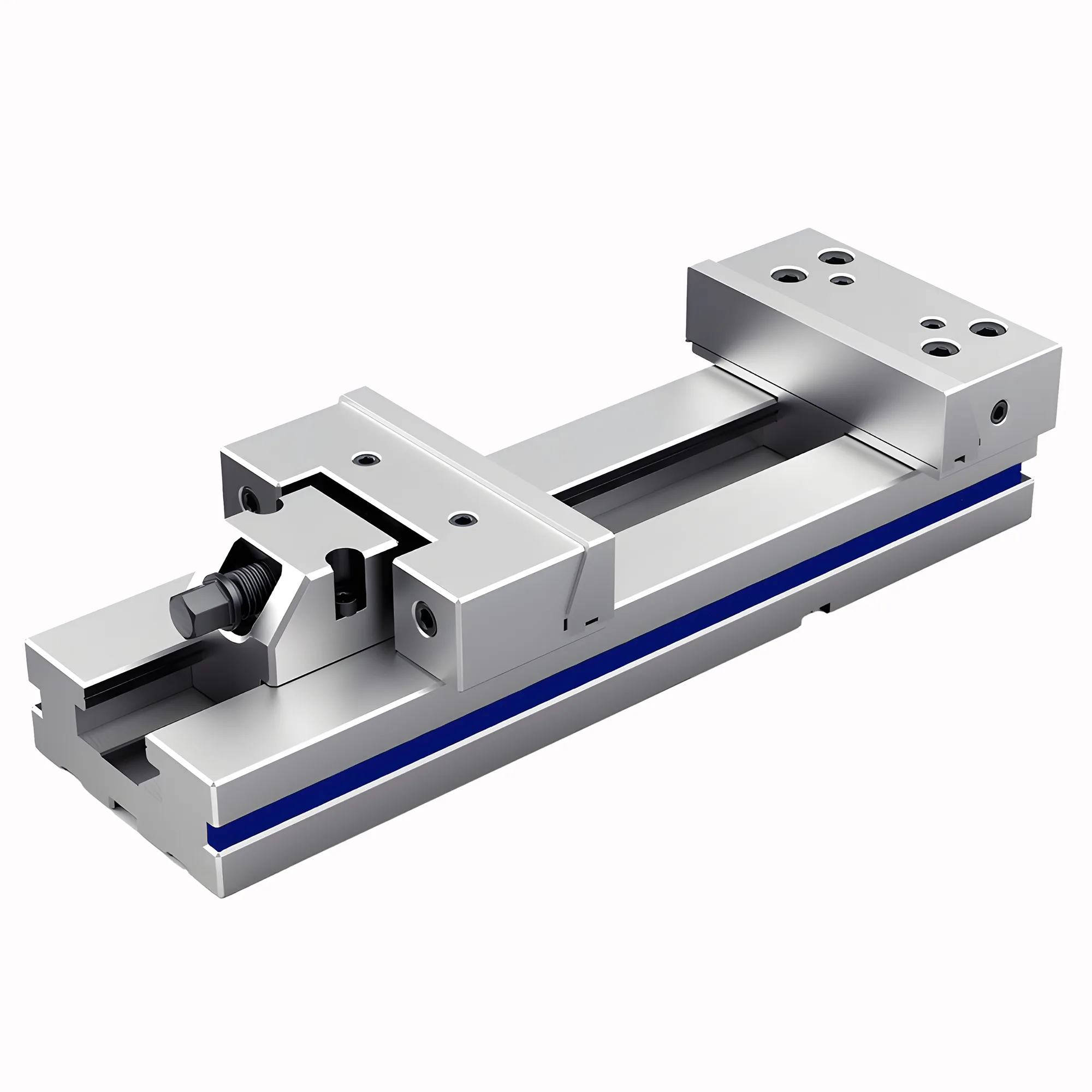
Use hardened serrated jaws (HRC 58-62) for raw stock first ops where a typical 0.05-0.15 mm of jaw bite is acceptable. Switch to bored-in-situ soft jaws (AISI 1018, HRC 15-25) for second ops where the part has a finished reference surface and concentricity below 0.025 mm is required. Step jaws extend grip on thin plate stock 6-12 mm thick; 6061-T6 aluminum jaws protect anodized or polished surfaces at the cost of 30-50% lower reliable clamping force versus equivalent steel jaws.
For the broader workholding category overview covering vises, lathe chucks, and live centers, see the workholding selection guide. This article focuses one level deeper — the jaws themselves.
The Four Jaw Families and What They Solve
A modular CNC vise body (GT-style, 100-300 mm jaw width, 16-40 kN clamping force) is only half the workholding system. The jaws bolted to the body determine grip strength, marring risk, second-op accuracy, and the smallest part the vise can safely hold — four different problems usually solved by four different jaw types.
| Jaw Family | Material (Typical) | Hardness | Primary Job |
|---|---|---|---|
| Hard serrated | AISI 4140 carburized or 20CrMnTi | HRC 58-62 | Maximum grip on raw saw-cut stock |
| Soft (bored in-situ) | AISI 1018 or 12L14 | HRC 15-25 | Concentric clamping for second ops |
| Step / shoulder | 4140 hardened | HRC 50-58 | Holding thin or shouldered parts |
| Aluminum | 6061-T6 | ~HB 95 | Marring-sensitive finished surfaces |
Most CNC shops keep three to four sets per vise: one hardened serrated set for first ops, one or two soft jaw sets matched to recurring part families, and a low-profile or step set for thin or 5-axis work. The expensive mistake is forcing a single jaw type across all operations — hard jaws marr finished aluminum, soft jaws lose grip on saw-cut bar stock, and aluminum jaws yield under heavy roughing loads.
Body materials follow the same logic at one tier up. 20CrMnTi is the standard alloy for carburized vise bodies and hard jaws because its case-hardened surface holds HRC 58-62 against jaw and stock contact while the tough core absorbs clamping shock. Per DIN 1875 (German precision machine vise specification), the working surfaces of a precision vise — including the jaw seat — must hold parallelism within 0.005 mm per 100 mm and verticality within 0.005 mm.
Hard Jaws: When Grip Beats Finish
Hard jaws are the default starting jaw for any first op on raw stock. AISI 4140 chrome-moly steel is preferred for hard vise jaws because its through-hardened HRC 58-62 condition combines wear resistance against saw-cut stock with enough toughness to survive interrupted clamping cycles. The same material specification appears as 20CrMnTi in carburized vise bodies — both deliver HRC 58-62 working surfaces.
Two surface treatments dominate:
- Carburized 20CrMnTi: case depth 0.5-1.5 mm, core retains ~HRC 30-35 toughness. Best for impact-prone roughing where the jaw face takes hammer-tap workpiece loading.
- Through-hardened 4140: full-section HRC 58-62. Higher wear life on serrations, but more brittle if the face is dropped or struck off-center.
Serration geometry sets grip force. Common patterns are 1.5 mm pitch fine serrations for stock under 50 mm, 3.0 mm pitch coarse for stock 50-150 mm, and pyramid waffle (typically 3 mm × 3 mm) for irregular castings. A serrated jaw bites 0.05-0.15 mm into a 4140 workpiece at 25-30 kN clamping force, which is acceptable on raw stock but disqualifies serrations from any finishing op.
| Pattern | Pitch | Best For | Visible Mark Depth |
|---|---|---|---|
| Fine horizontal | 1.5 mm | Bar stock, small castings | 0.03-0.06 mm |
| Coarse horizontal | 3.0 mm | Plate stock, large castings | 0.08-0.15 mm |
| Pyramid / waffle | 3 mm × 3 mm | Round and irregular stock | 0.10-0.15 mm |
| Smooth (hard) | — | Pre-machined reference faces | 0 (slip risk above 15 kN) |
Hard Jaw Practice
Lock the bottom edge of stock against the bed with a parallel before tightening — serrated jaws can lift the part 0.05-0.10 mm during clamping if the workpiece is unsupported. For most serrated-jaw setups, seat the part on parallels before final torque to prevent jaw-induced lift on serrated faces; on stock taller than ~3× jaw height, a backstop or step block is usually a better support choice.
Soft Jaws: Bored In-Situ for Concentricity
Soft jaws are the answer when the workpiece already has a finished reference surface and serration marks would scrap the part. AISI 1018 mild steel is the standard soft jaw substrate (HRC 15-25) because it can be face-milled or bored on the same machine that will run the part, transferring spindle alignment directly into the jaw geometry. 12L14 leaded steel is a faster-machining alternative when soft jaw bores are recut frequently.
The boring-in-situ workflow:
- Mount blank soft jaws (1018, 4140 annealed, or aluminum) on the vise body
- Clamp a sacrificial gauge ring or precision parallel between them at the same elevation the part will sit
- Plunge a boring bar or end mill into the jaw faces to cut the exact part profile
- Release the gauge ring; the bored cavity now matches the workpiece within the spindle's runout
Soft jaws bored in-situ can hold concentricity below 0.025 mm because the cavity is cut by the same machine and spindle that will machine the part — runout in the holding system collapses to runout in the cutting system. Pre-ground "universal" soft jaws cannot match this because they are machined off-machine and inherit error in mounting.
Common Soft Jaw Mistake
Boring soft jaws while clamped on a paper-thin gauge ring (under 5 mm tall) creates a tapered cavity — the unsupported jaw flexes outward at the top under tool pressure. Use a gauge ring at least 75% of the planned clamping height when boring soft jaws to prevent the cavity from cutting tapered.
Step Jaws and Low-Profile Jaws: Thin Parts and 5-Axis
Step jaws have a machined ledge that extends below the standard jaw face, gripping thin plate stock that would otherwise sit too low for full jaw contact. A step jaw with a typical 5-10 mm ledge can securely hold plate stock 6-12 mm thick that would slip out of a standard 30-50 mm tall jaw because the ledge restores effective contact area.
Low-profile jaws (jaw height 15-25 mm vs the standard 30-50 mm) serve a different goal: 5-axis tool clearance. On 3+2 or simultaneous 5-axis cuts, a tall jaw blocks the tool path when the spindle tilts toward the workpiece. Low-profile jaws preserve 10-30 mm of additional Z clearance under a tilted spindle, which is often the difference between a feasible 5-axis setup and a part that requires re-fixturing. This is why every 5-axis-capable shop tends to keep at least one low-profile jaw set per vise — see the 5-axis machining adoption guide for the broader rigidity and clearance trade-offs.
| Variant | Height (Above Vise Bed) | Best For | Trade-off |
|---|---|---|---|
| Standard hard jaw | 30-50 mm | First ops, general milling | May obstruct 5-axis tool paths under tilted spindle |
| Low-profile jaw | 15-25 mm | 5-axis 3+2 setups | Smaller grip surface, lower max force ~70-80% |
| Step jaw (single) | 30-50 mm + 5-10 mm ledge | Thin plate < 12 mm | Ledge wears with repeated mounting |
| Dovetail-style | Varies | Pre-clamped fixture-mounted parts | Requires dovetail prep on workpiece |
Aluminum Jaws: When Marring Is the Real Cost
Aluminum jaws solve one problem: finished, anodized, or polished workpieces where any steel-jaw mark is a scrap event. 6061-T6 aluminum jaws (HB ~95) leave no measurable serration mark on a finished aluminum or steel workpiece because their hardness is below the workpiece surface, but they reliably hold only 30-50% of the clamping force of a steel jaw of the same size before deformation.
| Factor | 6061-T6 Aluminum Jaw | AISI 4140 Hard Jaw |
|---|---|---|
| Hardness | HB ~95 | HRC 58-62 (≈ HB 600+) |
| Marring risk on aluminum part | None measurable | Visible serration impressions |
| Reliable max clamping force | 8-15 kN before yielding (typical shop experience for 100-150 mm jaw width) | 25-40 kN |
| Service life (clamping cycles) | ~500-1,500 before refacing (shop-floor practice; varies with workpiece edges) | 10,000+ |
| Refacing in-situ | Easy (face mill) | Not practical (HRC 58-62) |
Aluminum jaw users typically reface them every 500-1,500 cycles to recover flatness — a 2-3 minute facing pass on the machine that mounts the vise. 6061-T6 is the standard aluminum jaw alloy because its T6 temper combines enough yield strength (~276 MPa) to hold parts under finishing loads with the soft surface needed to spare polished aluminum, brass, and anodized work.
✦ Steel Hard Jaws Best For
- First-op clamping on saw-cut bar stock
- Heavy roughing at 25-40 kN clamping force
- Cast iron, steel, and stainless workpieces
- Long production runs with no surface marring concern
✦ Aluminum Jaws Best For
- Anodized, polished, or plated finished parts
- Second ops on thin-wall aluminum housings
- Brass and copper components
- Inspection holding where tool marks are unacceptable
Practical Decision Framework
The selection sequence is jaw-by-operation, not jaw-by-vise:
- Identify the operation type: first op on raw stock, second op on machined stock, finishing on a sensitive surface, or thin/5-axis
- Match material hardness to workpiece state: hard jaws for raw, soft jaws for machined references, aluminum jaws for finished surfaces
- Match geometry to part shape: step jaws under 12 mm thickness, low-profile for 5-axis, dovetail for pre-clamped fixture inserts
- Verify clamping force budget: expected cutting force × 2 safety factor must stay below jaw rated force (≈ 30-50% derating for aluminum, none for hard steel)
Soft jaws should be the default holding choice the moment a part has any machined reference face — they convert spindle accuracy directly into part concentricity and eliminate the marring risk that scraps finished work. Hard jaws return when the next operation introduces a fresh raw face. Aluminum jaws stay reserved for the small minority of finishing ops where any mark is a defect.
Quick Selection Table
| Scenario | Jaw Type | Material | Face / Pattern | Why |
|---|---|---|---|---|
| First op, saw-cut steel bar 40-100 mm | Hard serrated (3 mm pitch) | AISI 4140 / 20CrMnTi | Coarse horizontal serration | 0.10-0.15 mm bite gives full 25-40 kN grip on raw stock |
| First op, irregular casting | Hard serrated (waffle) | AISI 4140 hardened | 3×3 mm pyramid | Multi-direction bite resists shift on uneven faces |
| Second op, machined steel part needing concentric clamp | Bored soft jaws | AISI 1018 mild steel | Bored profile to part | Cavity cut on-machine drops concentricity below 0.025 mm |
| Thin plate 6-12 mm, second op | Step jaws | AISI 4140 hardened | Stepped ledge 5-10 mm | Ledge restores grip surface lost on thin stock |
| 5-axis 3+2 setup, cast aluminum body | Low-profile soft | AISI 1018 or 6061-T6 | Bored or smooth | Adds 10-30 mm Z clearance under tilted spindle |
| Finished aluminum housing, second op | Aluminum jaws | 6061-T6 | Smooth or lightly faced | HB 95 surface leaves no mark on anodized work |
| Anodized brass / polished components | Aluminum smooth | 6061-T6 | Smooth (no serration) | Finishing-grade hold without marring |
| Production aluminum parts repeating one geometry | Bored aluminum jaws | 6061-T6 | Bored profile | Combines marring protection with concentric grip |
Match jaw type to the operation, not to the vise.
Hard serrated jaws (AISI 4140 / 20CrMnTi at HRC 58-62) typically deliver maximum grip on raw stock first ops at the cost of 0.05-0.15 mm marring. Soft jaws (AISI 1018 at HRC 15-25) bored in-situ drop concentricity below 0.025 mm for second ops by inheriting spindle accuracy directly. Step jaws extend grip below 12 mm thickness and low-profile jaws add 10-30 mm of Z clearance for 5-axis setups. Aluminum 6061-T6 jaws sacrifice 50-70% of clamping force to protect finished surfaces. Most production CNC vises run three to four jaw sets rather than relying on a single universal type.
What is the difference between hard and soft vise jaws?
Hard vise jaws are heat-treated to HRC 58-62 (typically AISI 4140 or 20CrMnTi) and grip raw stock by biting 0.05-0.15 mm into the workpiece via serrations. Soft jaws are AISI 1018 mild steel at HRC 15-25, designed to be bored or milled in-situ on the same machine running the part — this drops concentricity below 0.025 mm by inheriting spindle accuracy.
When should I use serrated vise jaws on a CNC machine?
Use serrated jaws on first-op clamping of raw saw-cut, sheared, or cast stock where the next machining pass will remove the bite marks. The typical 0.05-0.15 mm serration depth is acceptable on raw faces but should not contact any surface that will remain visible on the finished part. Serration pitch matches stock size: 1.5 mm fine for under 50 mm, 3 mm coarse for 50-150 mm.
How much clamping force can 6061-T6 aluminum jaws hold?
6061-T6 aluminum jaws (HB ~95) reliably hold 8-15 kN of clamping force before face deformation, compared to 25-40 kN for an equivalent AISI 4140 steel jaw at HRC 58-62. The 30-50% force derating buys complete marring protection on anodized, polished, or finished workpieces where any visible mark would scrap the part.
How do I bore soft jaws to match a specific part diameter?
Mount blank 1018 soft jaws on the vise body, clamp a precision gauge ring (sized to the planned clamp diameter, height ≥75% of clamp height) between them, then plunge a boring bar or end mill on the same machine that will run the part to cut the cavity. Release the gauge; the bored profile now matches the workpiece within the spindle's own runout.
Do I need different jaws for 5-axis machining?
5-axis 3+2 and simultaneous setups typically require low-profile jaws (15-25 mm tall versus 30-50 mm standard) to keep the tool clear when the spindle tilts toward the workpiece. Low-profile jaws preserve 10-30 mm of additional Z clearance, but reduce reliable clamping force to roughly 70-80% of full-height equivalents because of the smaller grip surface.