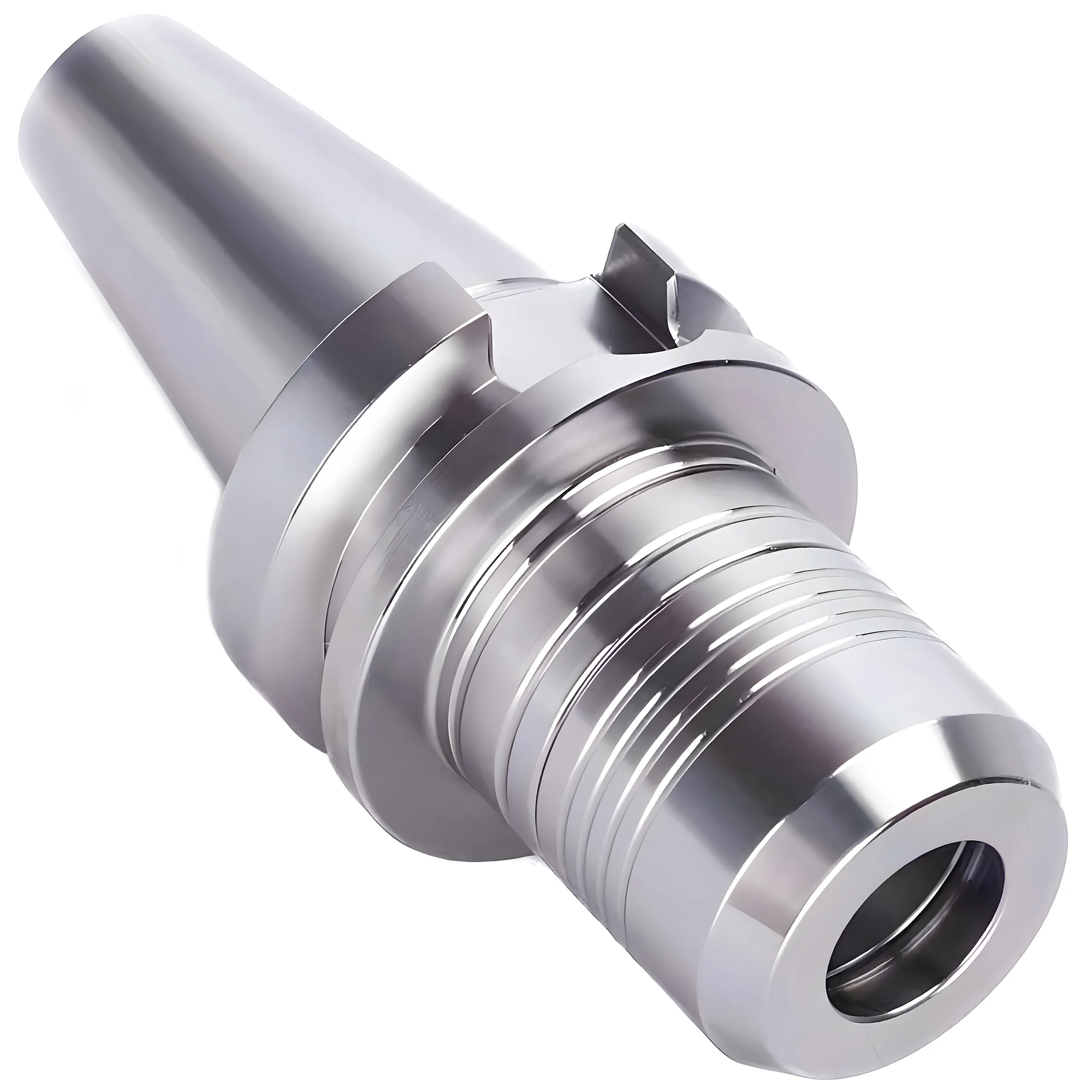
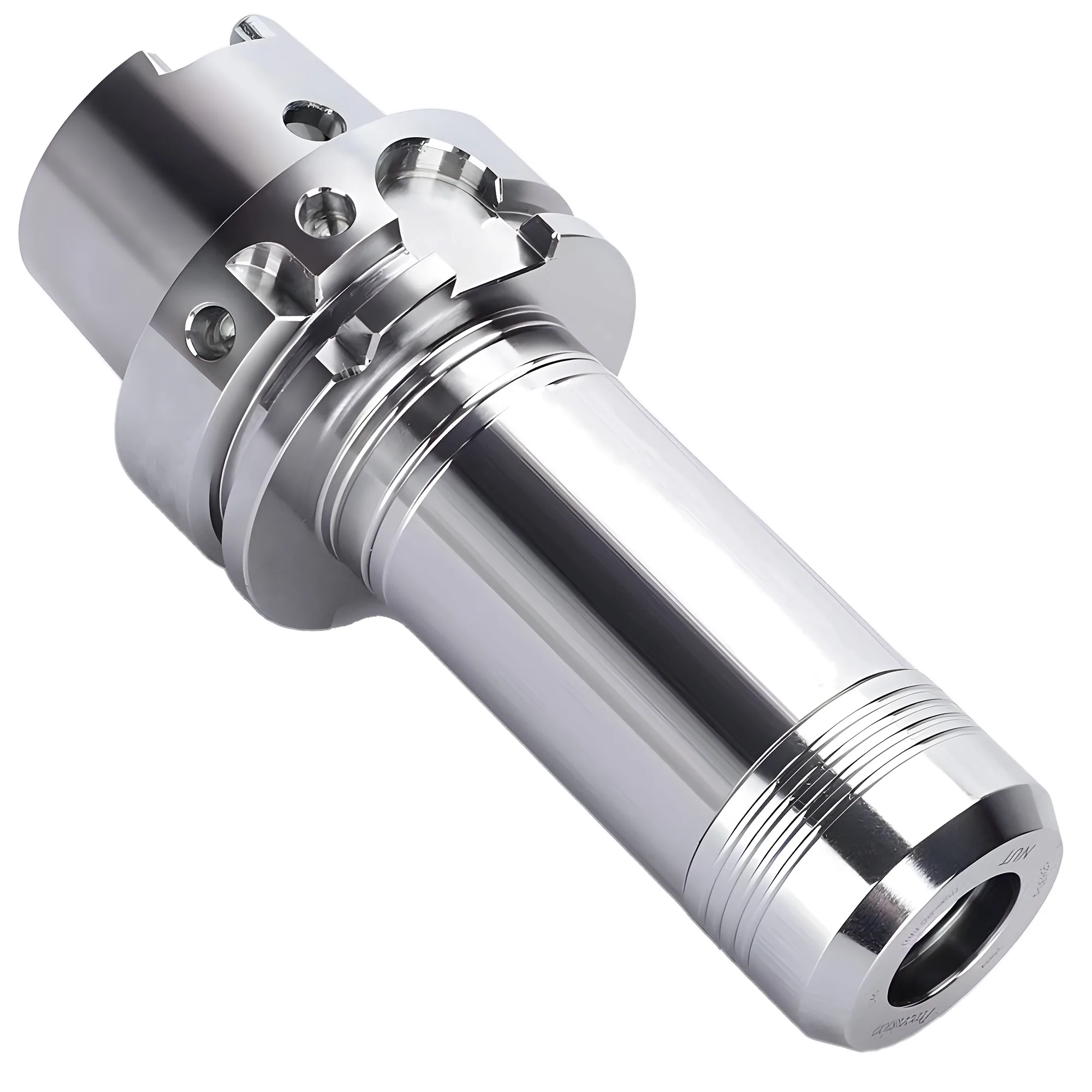
PGER-class precision ER chucks hold roughly 0.003 mm (3 µm) TIR with about twice the clamping force of a standard ER chuck, from a full-round trapezoidal-thread nut (manufacturer specification), versus ≤0.015 mm TIR (Class 2, d₁ ≤ 10 mm) or ≤0.020 mm TIR (Class 2, d₁ 10–26 mm, per ISO 15488:2003 Table 4) for standard ER chucks — a runout gap that, by the one-tenth rule, can extend finishing tool life by 25–50%. The precision chuck typically costs 1.5–3x a standard one and pays back fastest in small-diameter finishing, long-reach work, and surface-critical parts.
This guide compares what a precision-class ER chuck actually changes — nut and thread design, taper grind quality, balance grade, and runout class — and where the upgrade earns its price. It does not cover collet size selection or tightening procedure; for the broader holder landscape, see the tool holding complete guide.
What Does "PGER" Actually Mean?
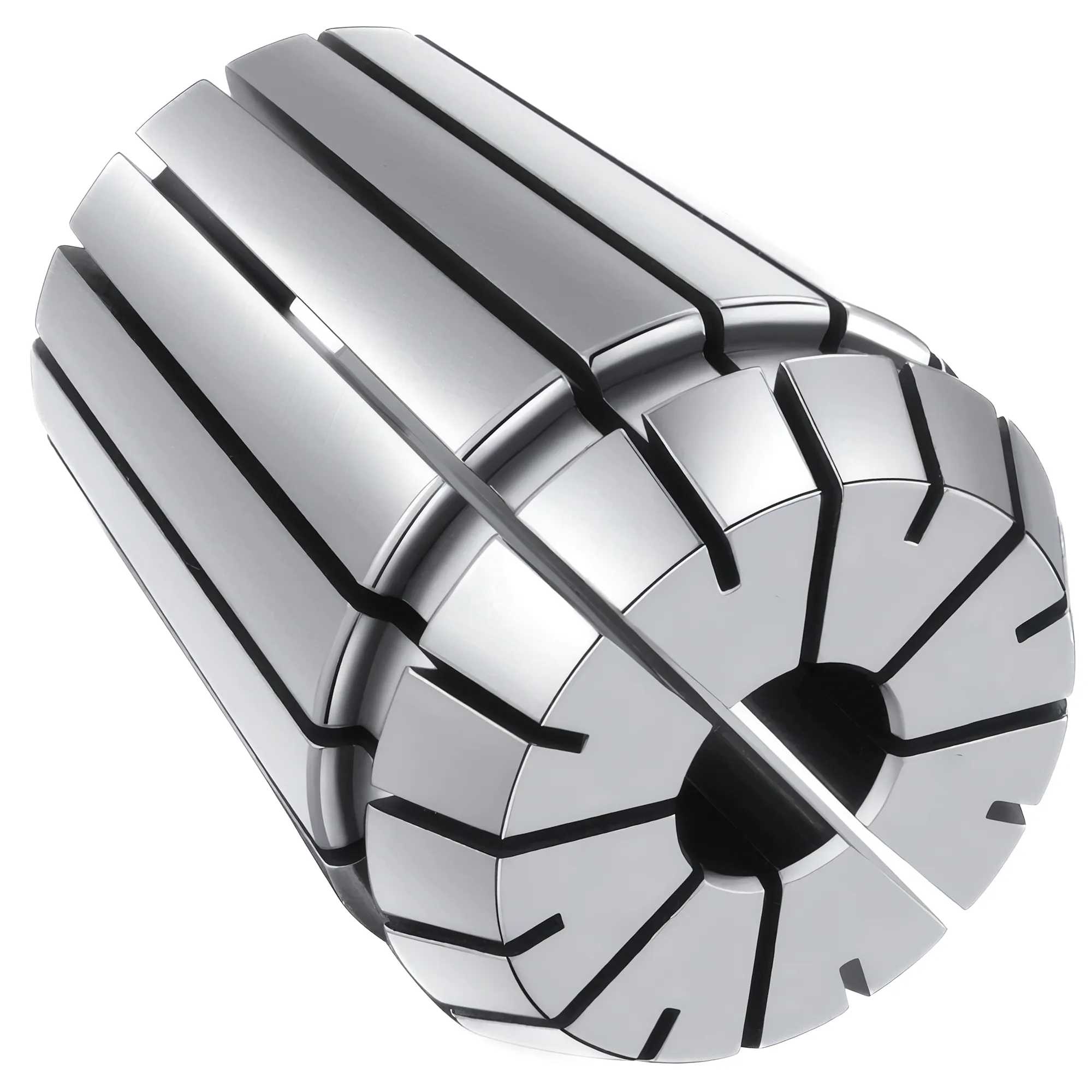
PGER is a vendor catalog designation used by several Asian tool holder manufacturers for their precision-grade ER chuck lines — it is not an ISO standard or an ISO runout class. The honest framing matters when comparing quotes: two "PGER" chucks from different brands are precision-class products by each maker's own specification, not products certified to a common "PGER standard." The interface itself remains standard ER per ISO 15488:2003 (the international equivalent of the original DIN 6499), so standard and precision chucks accept the same ER collets. The nut, however, is specific to the chuck: a PGER body's trapezoidal thread does not take a standard ER nut. Common PGER16 to PGER32 bodies grip 3 to 20 mm shanks with ER16 to ER32 collets. DIN 6499 is the original German standard that ISO 15488 internationalized, and it remains the designation many European tool holder catalogs print for the same 8° ER collet geometry.
What the standard does define is runout. ISO 15488:2003 Table 4 specifies two runout classes for ER collets: Class 1 at ≤0.010–0.015 mm TIR and Class 2 at ≤0.015–0.020 mm TIR, with the limit depending on clamping diameter. Class 2 is the normal production grade. Above Class 1, manufacturers sell "UP" or "AA" grades rated ≤0.005 mm TIR — designations that exceed the standard rather than being defined by it. PGER-class chucks sit at the top of this ladder: roughly 0.003 mm (3 µm) TIR at the nose, per manufacturer specification, when paired with a matching precision collet and an h6 tool shank. How to choose between these grades for a given job is covered in the ER collet selection guide.
ISO 15488 is the right benchmark for these claims because it defines the test method as well as the limits — runout is measured on a calibrated mandrel at specific projection lengths, so a "3 µm" catalog figure only means something when measured the same way.
What Changes Inside a Precision-Class Chuck?
Three design elements separate a PGER-class chuck from a standard ER chuck of the same nominal size.
A full-round nut with a precision 30° trapezoidal thread replaces the slotted nut and V-thread of a standard ER chuck, enlarging the clamping contact area and raising clamping force to roughly twice that of a standard ER holder (manufacturer specification). A trapezoidal thread carries the tightening load on a broad, flat flank instead of a sharp V, so it locks smoothly without galling and holds its form under repeated tightening, where a V-thread is more prone to deform and shed preload. The closed, full-round profile also lowers windage and vibration at high RPM, and — just as important for accuracy — the larger, more symmetric seating face reduces the tendency of the nut to cock the collet as it closes, which tightens runout scatter between repeat clampings.
Precision-class chucks are ground beyond the minimum cone-angle tolerances that ISO 15488 requires, improving collet-to-bore contact along the full taper. ISO 15488 Annex A requires the 8° holder bore to hold cone-angle tolerance class AT4 and the collet AT3, using the AT classes defined in ISO 1947. ISO 1947's AT classes matter here because a taper-angle mismatch concentrates contact at one end of the cone, letting the collet rock under load and degrading runout. Precision lines hold the bore grind and roundness tighter than the AT4 minimum — by how much is a manufacturer specification, not a standardized value.
Precision-class ER chucks are typically balanced for use to about 30,000 RPM — commonly quoted as G2.5 — versus G6.3 at 15,000 RPM typical for standard chucks (manufacturer specifications). The G grades come from the ISO 1940-1 framework; ISO 1940-1 is used to rate tool holder balance because it converts a residual unbalance into a speed-dependent limit rather than a single mass value. The permissible specific unbalance is e_per ≈ 9549 × G / n (g·mm/kg, n in RPM) — speed dominates this formula because n sits in the denominator: doubling spindle RPM halves the unbalance a holder is allowed to carry at a given grade. The RPM thresholds at which G2.5 becomes necessary are manufacturer recommendations built on that framework, not ISO mandates.
| Feature | Standard ER Chuck | PGER-Class Precision ER Chuck |
|---|---|---|
| Nose runout (system, with matching collet) | ≤0.015–0.020 mm TIR (ISO 15488 Class 2) | ~0.003 mm TIR (manufacturer specification) |
| Collet nut | Slotted nut, V-thread | Full-round nut, precision 30° trapezoidal thread (≈2× clamping force, mfr spec) |
| Taper bore grind | AT4 cone-angle class per ISO 15488 Annex A / ISO 1947 | Tighter than AT4 minimum (manufacturer specification) |
| Balance grade | G6.3 at 15,000 RPM | G2.5 at 30,000 RPM |
| Typical price (ER32 on BT/CAT40 shank) | $80–200 | $150–400 |
Prices are typical distributor ranges and vary by size, shank interface, and brand.
How Much Tool Life Does 3 µm Buy?
BIG DAISHOWA's one-tenth rule estimates that each 0.0001 inch (2.5 µm) of runout reduces tool life by approximately 10%. At 0.01 mm (4 tenths), the impact is roughly 40%. The rule is based on finishing tests in steel with carbide end mills, so the actual impact varies with material, radial engagement, and flute count.
Run the arithmetic on the upgrade: a standard Class 2 setup measuring 0.015 mm TIR at the tool carries roughly six "tenths" of runout; a PGER-class system at 0.003 mm carries just over one. Replacing the standard setup with a precision one can therefore extend finishing tool life by 25–50% (based on the one-tenth rule; actual results vary with material and tool diameter) — the same gain band that applies when hydraulic chucks replace standard ER collets, because the runout delta is similar.
The mechanism is chip-load asymmetry. On a two-flute cutter, runout adds to one flute's effective chip load and subtracts from the other's by an amount on the order of the TIR, so one edge does most of the work and wears at a disproportionate rate while the lightly loaded edge rubs. The tool dies when its hardest-working flute dies.
When Does 3 µm Runout Pay for Itself?
Runout hurts small tools disproportionately because the same TIR is a far larger fraction of the chip load on a 3 mm cutter than on a 12 mm cutter. At 0.02 mm/tooth on a 3 mm finishing end mill, 0.015 mm of runout is 75% of the programmed chip load — enough that one flute can end up cutting close to double its share while the other barely engages. On a 12 mm tool at 0.10 mm/tooth, the same runout is only 15% of chip load, and flank wear from the cut itself dominates. This is why precision chucks are typically specified first for tools of 6 mm diameter and below.
The tilt component of runout grows roughly in proportion to projection length, so long-reach setups amplify whatever angular error the chuck has. A holder whose runout looks acceptable at short gauge length can read 2–3x worse at 4xD stickout if tilt (rather than pure offset) dominates — a geometric relationship, since the tilt contribution scales linearly with distance from the gauge plane. Precision-ground tapers reduce exactly this tilt component.
Surface-critical work is the third payback case. In finishing, flute-to-flute height differences on the order of the TIR print directly into the surface as periodic marks, which show clearly on mold, die, and optical-finish parts targeting Ra 0.4 µm or better.
✦ Standard ER Best For
- Roughing and general milling, where chip-load-driven flank wear dominates tool life
- Job-shop flexibility at the lowest entry cost ($80–200 typical for an ER32 chuck)
- Setups already limited by machine rigidity or workholding, where 3 µm cannot be realized anyway
✦ PGER-Class Best For
- Small-diameter finishing (≤6 mm carbide), where runout is a large share of chip load
- Long-reach (4xD+) and surface-critical work such as mold and die finishing
- Spindles running above 15,000 RPM, where G2.5 balance limits bearing load
PGER-Class vs Hydraulic Chucks: Price-Performance Position
A PGER-class ER chuck typically delivers hydraulic-class runout (~0.003 mm TIR per manufacturer specification) at roughly half the hydraulic chuck's price, but without the oil-chamber vibration damping. Hydraulic chucks run $300–600 per fixed bore diameter and add passive chatter damping that no mechanical collet chuck replicates; the full trade-off is covered in the collet chuck vs hydraulic chuck comparison. The precision ER chuck's counterargument is flexibility: a PGER-class chuck still takes a range of standard ER collets — 3 to 20 mm across common PGER16 to PGER32 sizes — while each hydraulic chuck covers a single bore.
The practical positioning: if your finishing problem is runout (tool life, flute marks, small tools), a PGER-class chuck buys most of the hydraulic chuck's accuracy benefit at lower cost and keeps collet flexibility. If your problem is chatter (long reach into pockets, thin walls, borderline-stable cuts), the hydraulic chuck's damping is the feature you are actually paying for, and the precision ER chuck will not substitute.
Precision Is a System Property
Precision runout is a system property: chuck, collet, nut, and shank tolerance all need to hold grade, or the weakest link sets the TIR. Pairing a PGER-class chuck with a worn Class 2 collet, a plain nut, a shank looser than h6, or a spindle taper already running 0.005 mm wipes out the upgrade. Indicate the spindle taper before buying precision tooling — manufacturer UP/AA collet grades explicitly assume the entire system maintains accuracy.
Selection Decision Framework
The decision rule reduces to one question: is runout a measurable limiter on this operation? Specify a precision-class ER chuck where runout is demonstrably limiting the operation — one flute wearing far faster than the others, periodic flute-height marks in the surface, or finishing tools of 6 mm diameter and below; a standard Class 2 setup is typically the better spend everywhere else.
| Scenario | Chuck Class | Runout Spec (TIR) | Balance Grade | Why |
|---|---|---|---|---|
| General roughing, 6–20 mm end mills in steel | Standard ER (ISO 15488 Class 2) | ≤0.015–0.020 mm | G6.3 at 15,000 RPM | Chip-load-driven flank wear dominates; runout penalty is a minor share of tool life |
| Finishing with ≤6 mm carbide end mills | PGER-class precision ER + UP/AA collet | ~0.003 mm (manufacturer spec) | G2.5 at 30,000 RPM | At small diameters, 0.015 mm runout can reach 75% of chip load, so the one-tenth-rule penalty bites hardest |
| Long-reach finishing at 4xD+ stickout | PGER-class ER, or hydraulic if chatter present | ~0.003 mm | G2.5 at 30,000 RPM | Tilt error scales with projection; precision taper grind cuts the component that long reach amplifies |
| Mold/die surfaces targeting Ra ≤ 0.4 µm | PGER-class ER or hydraulic chuck | ≤0.003 mm | G2.5 at 30,000 RPM | Flute-height differences on the order of TIR print into the surface as periodic marks |
| Budget-limited shop wanting a first accuracy step | Standard chuck + UP/AA collets | ≤0.005 mm collet grade | G6.3 at 15,000 RPM | Captures part of the runout gain for the cost of collets ($8–25 standard; UP grades cost more) before replacing chucks |
| High-speed machining above 15,000–20,000 RPM | PGER-class ER or hydraulic on dual-contact shank | ≤0.003 mm | G2.5 at 30,000 RPM | Above ~15,000 RPM, balance grade controls bearing load; G6.3 holders add measurable forced vibration |
Buy 3 µm runout where runout is the failure mode — small tools, long reach, fine surfaces — and keep Class 2 everywhere else.
PGER-class precision ER chucks are a manufacturer designation, not an ISO class: they combine ~0.003 mm TIR (manufacturer specification), a full-round trapezoidal-thread nut, tighter taper grind, and G2.5 balance for typically 1.5–3x the price of a standard chuck. The upgrade can return 25–50% finishing tool life via the one-tenth rule, but only if collet, shank, and spindle hold the same grade. Choose hydraulic instead when chatter damping — not runout — is the real problem.
What is a PGER collet chuck?
A PGER collet chuck is a high-precision ER-type holder with a full-round nut and a ground 30° trapezoidal thread. Manufacturers rate it around 0.003 mm TIR with roughly twice the clamping force of a standard ER chuck. It takes ordinary ER collets, but its nut is chuck-specific; PGER16 to PGER32 grip 3 to 20 mm.
Does a PGER chuck use standard ER collets?
Yes. PGER16, PGER20, PGER25 and PGER32 bodies accept standard ER16 to ER32 collets, so an existing collet set carries over. The nut does not: its trapezoidal thread is not the metric V-thread of an ISO 15488 ER nut, so a standard ER nut will not fit a PGER body. Use precision UP/AA collets to realize the 3 µm rating.
Is PGER an ISO standard or runout class?
No. PGER is a manufacturer catalog designation used by several Asian tool holder makers for their precision-class ER chucks — it does not appear in ISO 15488:2003. The standard defines only Class 1 (≤0.010–0.015 mm TIR) and Class 2 (≤0.015–0.020 mm TIR) runout limits, both varying with collet diameter.
How much tool life does upgrading from a standard ER chuck to a 3 µm precision chuck add?
Per BIG DAISHOWA's one-tenth rule, each 0.0001 inch (2.5 µm) of runout reduces tool life by approximately 10%. Moving from a 0.015 mm standard setup to a 0.003 mm precision setup can extend finishing tool life by 25–50%, with the largest gains on small-diameter carbide end mills.
Do I need precision collets to get 3 µm from a PGER-class chuck?
Yes — runout stacks through the whole system. A Class 2 collet rated ≤0.015–0.020 mm TIR will typically dominate a precision chuck's ~0.003 mm bore accuracy. Pair PGER-class chucks with manufacturer UP/AA collets rated ≤0.005 mm TIR and h6-tolerance tool shanks, or most of the upgrade is wasted.
When is a hydraulic chuck a better buy than a PGER-class ER chuck?
Choose a hydraulic chuck ($300–600) when you need oil-chamber vibration damping for long-reach or chatter-prone finishing, or run one fixed shank diameter in production. A PGER-class ER chuck (typically $150–400) keeps collet flexibility across roughly 3–20 mm shanks with standard ER collets while reaching a comparable ~0.003 mm TIR class.