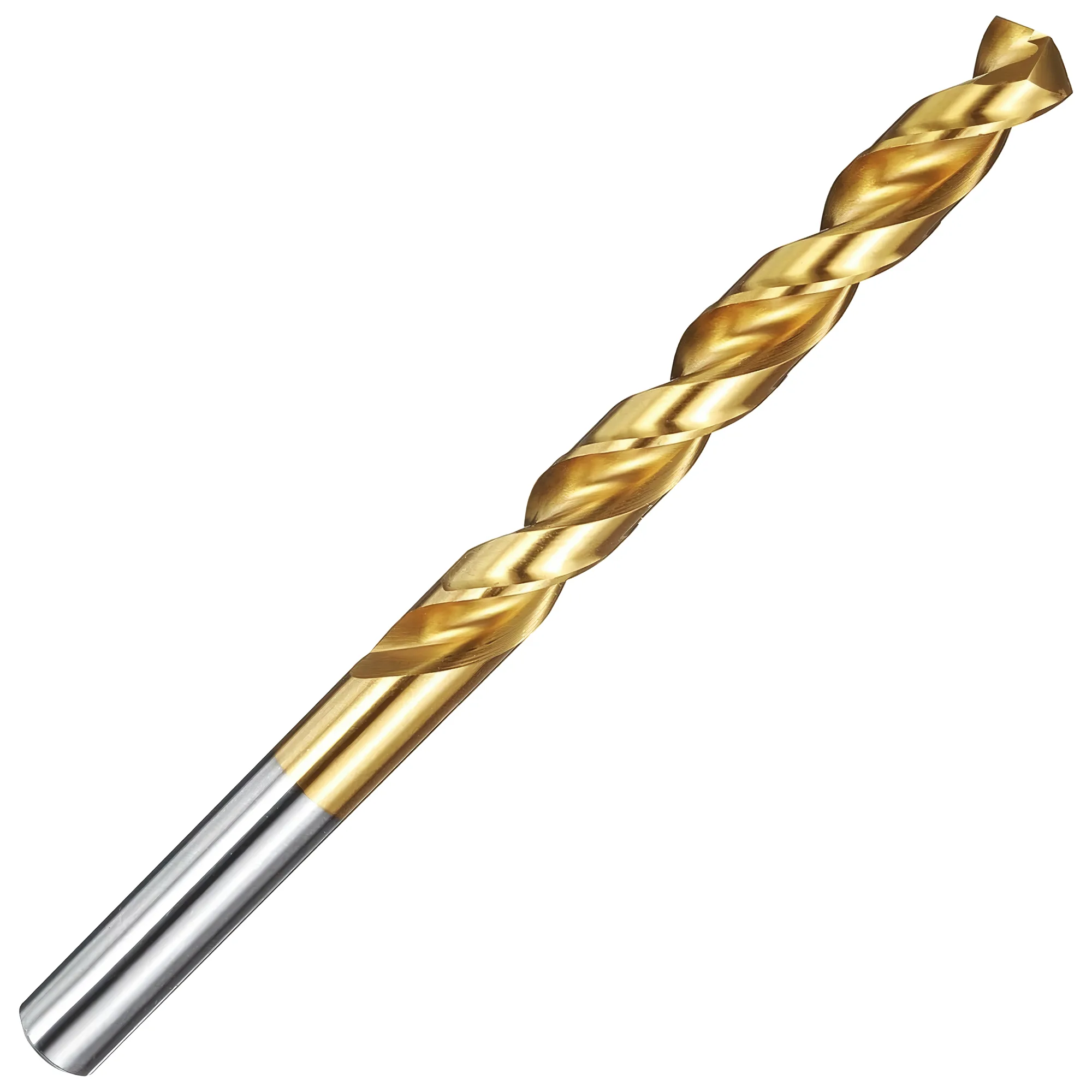
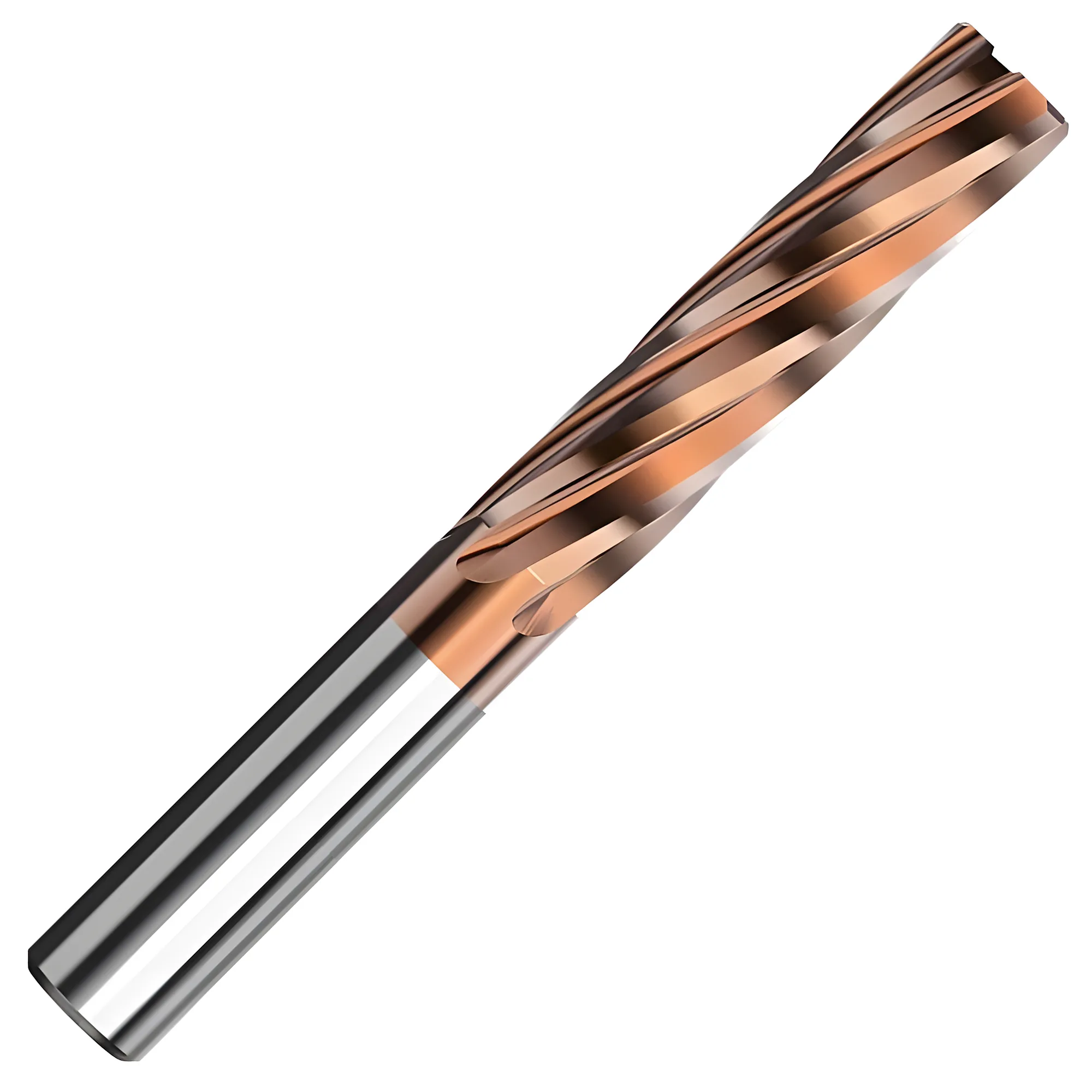
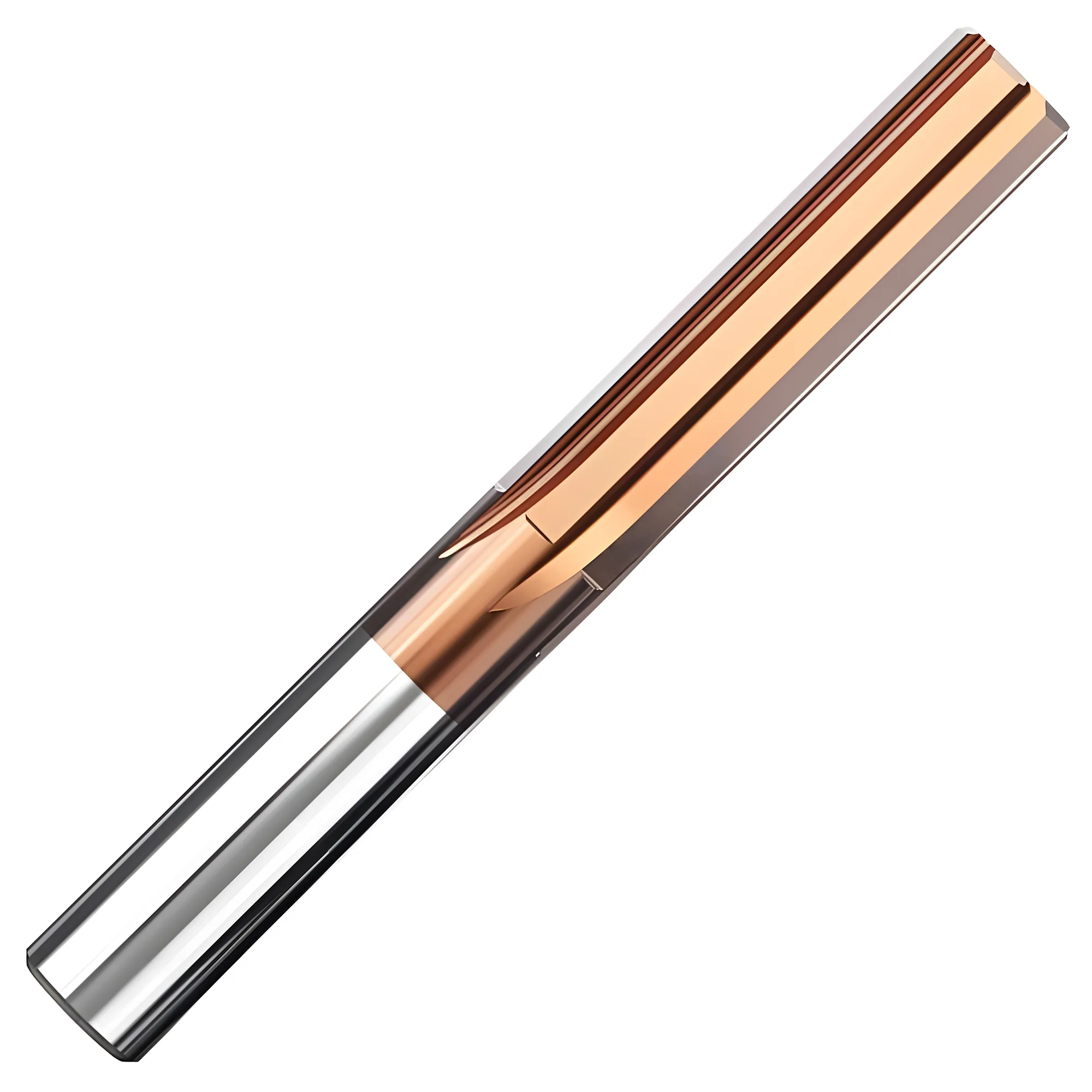
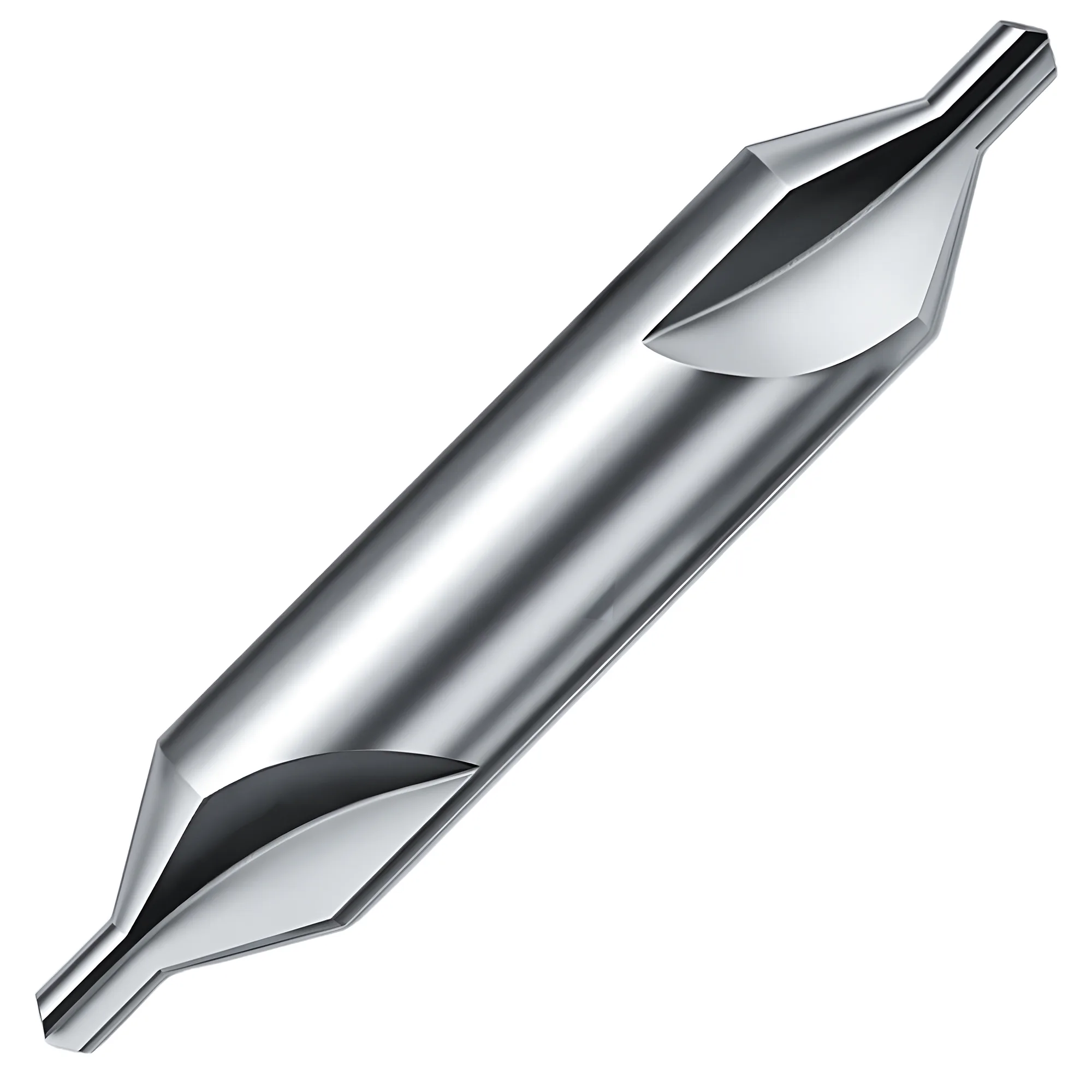
For general CNC drilling, use 135° split-point M35 HSS-Co jobber drills (DIN 338) — the self-centering geometry reduces or eliminates the need for spot drilling in most flat-surface applications and handles steel up to 30 HRC. Add a spiral-flute carbide reamer leaving a typical 0.1–0.3 mm stock for blind holes needing H7 tolerance; use straight-flute for through-holes. A wrong combination wastes tools and scrap; the right pairing can hold H7 tolerance in a single setup. This guide breaks down each tool type by geometry, material grade, coating, and application so you can match the correct drill bit and reamer to any hole-making operation.
For a complete overview of cutting tool types, grades, and coatings, see the cutting tools complete guide.
Drill Bit Types and When to Use Each
Three drill bit categories — jobber twist drills, center drills, and step drills — cover the vast majority of hole-making work in typical metalworking shops. Each has a distinct geometry optimized for a specific task.
Jobber twist drills (DIN 338 / ANSI/ASME B94.11) are the general-purpose workhorse. Standard jobber length means the flute length is approximately 7-10 times the drill diameter depending on size, providing a good balance between rigidity and depth capacity. Available from 0.3 mm to 20 mm in metric, #60 to #1 in wire gauge, A to Z in letter sizes, and 3/64" through 11/16" in fractional sizes. ISO 235 is the international counterpart used for parallel-shank jobber and stub-series drills where ISO dimensioning is required, while ANSI/ASME B94.11 governs the same tool class for North American shops.
Center drills (DIN 333) combine a short pilot drill with a 60-degree countersink in a single tool. Type A has a compact body suited for light-to-medium machining. Type B features a larger body diameter and deeper countersink for heavy-duty applications and larger drill pre-positioning. Metric sizes typically run 1-8 mm; imperial from #0 to #18.
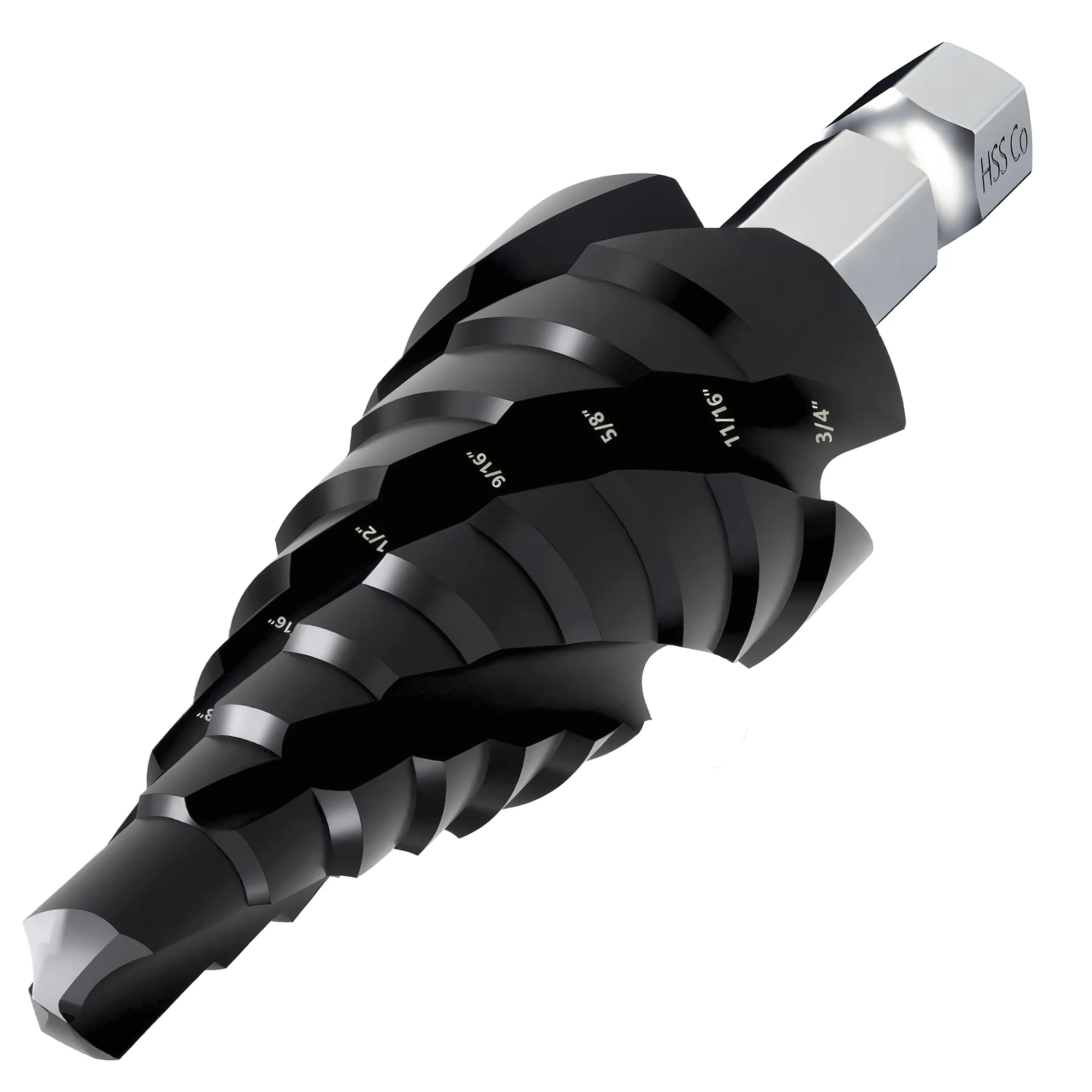
Step drills are designed for sheet metal, aluminum, and plastics where multiple hole diameters are needed from a single tool. Ranges span 4-38 mm metric and 1/8" to 1-3/8" imperial, with 5 to 14 steps per bit. Available with straight or spiral flutes and hex or 3-flat shanks.
Point Angle Selection -- 118° vs 135° vs 140°
Point angle is typically the single most consequential geometry parameter for drilling performance, controlling thrust force, centering accuracy, and chip formation.
| Factor | 118° Standard | 135° Split Point | 140° for Hard Materials |
|---|---|---|---|
| Self-centering | Poor -- walks on curved surfaces | Good -- split point prevents walking | Fair -- requires spot drilling |
| Thrust force | Higher | 15-20% lower than 118° | 20-25% lower than 118° |
| Best materials | Wood, plastic, soft metals | Steel, stainless, aluminum | Hardened steel (>35 HRC), cast iron |
| Chip formation | Thicker, wider chips | Thinner chips, better evacuation | Very thin chips, low heat per chip |
| Hole entry quality | May produce burrs | Clean entry on flat surfaces | Clean entry, minimal burr |
For CNC applications, the 135° split point is typically the default choice because its self-centering action eliminates the need for spot drilling on most flat-surface jobs, saving one tool change per hole. Reserve 118° for hand drilling and softer materials. Use 140° only when drilling hardened steels above 35 HRC or abrasive cast irons.
Point Angle Rule of Thumb
Harder workpiece material calls for a larger point angle. For general steel machining (up to 30 HRC), 135° split point handles 90% of jobs without a pilot hole.
Material Grade and Coating Selection
Drill bit substrate and coating together set the ceiling for heat resistance, wear life, and maximum cutting speed in a given material. The table below covers the three most common substrate tiers paired with their recommended coatings.
| Property | HSS (M2) | HSS-Co M35 (5% Co) | Solid Carbide |
|---|---|---|---|
| Hardness | 63-65 HRC | 66-68 HRC | 89-93 HRA (~1,600 HV) |
| Max cutting temp | 550°C | 620°C | 800°C |
| Speed in mild steel | 20-30 m/min | 30-45 m/min | 80-120 m/min |
| Speed in stainless | 8-15 m/min | 15-25 m/min | 40-70 m/min |
| Tool life vs HSS | Baseline | 1.5-2x | 5-10x |
| Cost vs HSS | 1x | 1.3-1.8x | 4-8x |
Solid carbide drills typically run 3–5× faster than HSS in steel and last 5–10× longer, but cost 4–8× more per tool — making them economical mainly for production CNC work where tool change time matters.
Coating selection adds another performance layer:
- TiN (gold) -- 2,300 HV surface hardness, friction reduction of 30-40%, max service temperature 600°C. Preferred for M35 HSS-Co drills in steel and aluminum because its lower deposition temperature preserves the HSS-Co substrate hardness while delivering meaningful friction reduction at typical HSS cutting speeds.
- TiAlN (dark grey) -- 3,300 HV surface hardness, max service temperature 800°C. Preferred for high-speed CNC drilling in stainless steel, titanium alloys, and hardened materials because its aluminum-oxide barrier layer resists oxidation at temperatures that would dissolve a TiN coating. Used on step drill spiral flute variants.
- AlTiN+TiSiN (bronze) -- Multi-layer nano-composite, preferred as the default coating for solid carbide reamers in steel because the TiSiN outer layer provides self-renewing hardness under abrasive wear, extending reamer life versus single-layer TiAlN.
- TiAlSiN (black) -- High-temperature variant preferred for interrupted cuts and demanding conditions above 900°C because the silicon content forms a dense Si₃N₄ grain-boundary network that maintains hardness under thermal cycling.
Coating Mismatch
Applying a high-temperature coating like TiAlN to a plain HSS drill is counterproductive -- the substrate softens at 550°C regardless of coating. Match coating tier to substrate tier: TiN for HSS-Co, TiAlN/AlTiN for carbide.
Center Drill vs Spot Drill -- Choosing the Right Starter
Center drills and spot drills are not interchangeable: center drills (DIN 333) make 60° lathe-center holes, while spot drills (90° or 120°) create rigid starting dimples for CNC drilling. Confusing the two is one of the most common starter-hole errors.
A center drill (DIN 333) produces a 60-degree countersink with a pilot hole. Its primary purpose is creating lathe center holes for tailstock support. Type A (compact body, typically 3.15-20 mm body diameter) suits light work. Type B (larger body, deeper countersink) provides stability for heavy-duty turning and larger pre-positioning.
A spot drill has a rigid, short body designed solely to create a starting dimple for the subsequent twist drill. Spot drills typically use 90° or 120° point angles and are stiffer than center drills at equivalent diameter.
| Criterion | Center Drill (DIN 333) | Spot Drill |
|---|---|---|
| Primary purpose | Lathe center holes | Drill starting points |
| Point angle | 60° (standard) | 90° or 120° |
| Body rigidity | Moderate -- long pilot section | High -- short, stubby design |
| CNC spot drilling | Acceptable for small holes | Preferred for positional accuracy |
| Countersink function | Yes -- built-in 60° chamfer | No |
| Depth-to-diameter | 1:1 to 2:1 pilot depth | 0.5:1 dimple only |
For CNC work where positional accuracy matters, a dedicated 90° or 120° spot drill is generally preferred over a center drill because its short, stubby body deflects less under thrust. Use center drills when you need the 60-degree countersink for between-centers turning or when a combined drill-and-countersink operation saves a tool change.
Reamer Selection -- Spiral Flute vs Straight Flute
Reaming is typically required to take a drilled hole from H9 to H7 tolerance (15 µm range on a 10 mm hole) with Ra 0.4–1.6 µm finish. The two main reamer types -- spiral flute and straight flute -- are optimized for different hole configurations.
Spiral flute reamers pull chips upward via helical cutting edges, making them the preferred choice for blind holes where chips cannot exit through the bottom. Typically available in solid carbide with 4 flutes (3-5 mm) or 6 flutes (6-16 mm), metric 3-16 mm and imperial 1/8"-1/2" sizes.
Straight flute reamers have axial cutting edges that push chips downward through the hole. They are the standard choice for through holes where chips can fall freely. Same size range and flute count progression as spiral variants.
For Morse-taper-shank machine reamers used on lathes and radial drills, ISO 521 is the relevant dimensional standard, while parallel-shank carbide reamers in this guide follow general DIN/ISO H7 tolerance practice.
| Factor | Spiral Flute | Straight Flute |
|---|---|---|
| Hole type | Blind holes | Through holes |
| Chip direction | Upward (out of hole) | Downward (through hole) |
| Surface finish | Ra 0.4-0.8 um typical | Ra 0.8-1.6 um typical |
| Chatter resistance | Higher -- helical engagement | Lower -- full-width engagement |
| Rigidity | Slightly lower | Higher |
| Cost | Same | Same |
✦ Spiral Flute Reamer Best For
- Blind holes where chips must exit upward
- Interrupted cuts (cross-holes, keyways)
- Materials that produce long, stringy chips
- Finishing operations requiring Ra below 0.8 um
✦ Straight Flute Reamer Best For
- Through holes with chip clearance below
- Short holes (depth less than 2x diameter)
- Brittle materials producing broken chips (cast iron, brass)
- Maximum rigidity when chatter is not a concern
Speed, Feed, and Practical Recommendations
Reaming requires more conservative speeds than drilling — typically 30–50% of drilling speed for HSS reamers and 50–70% for solid carbide reamers in the same material. The pre-drilled hole should be 0.1-0.3 mm (0.004-0.012") undersized relative to the reamer diameter -- too much stock causes chatter and premature wear, too little causes rubbing without cutting.
Recommended starting parameters for carbide reamers in steel (up to 30 HRC):
- Cutting speed: 60-100 m/min (roughly 50-70% of drilling speed in the same material)
- Feed per revolution: 0.1-0.3 mm/rev (higher than drilling -- reamers need consistent chip load)
- Stock allowance: 0.15-0.25 mm on diameter
- Coolant: Flood coolant strongly recommended for steel; through-tool preferred for blind holes
For aluminum and non-ferrous materials:
- Cutting speed: 100-200 m/min
- Feed per revolution: 0.15-0.4 mm/rev
- Use uncoated carbide reamers to prevent built-up edge
Decision framework: If hole tolerance is H9 or looser, a quality 135° split-point M35 drill often delivers acceptable results without reaming. For H7 and tighter, drill undersized and ream. For H6 or bore-finish requirements, consider drill-ream-bore or drill-ream-hone sequences.
For an overview of the broader drill-and-reamer catalog and matching end mills and taps, see the 2026 cutting tool line refresh.
Quick Drill and Reamer Selection by Application
This table maps the most common hole-making scenarios to a recommended tool, material, and starting cutting speed band — use it as a first-pass shortlist, then confirm against your machine and setup.
Matching drill type and reamer type to the specific application is the single most impactful decision in a hole-making sequence — wrong tool geometry or coating tier costs more in scrapped parts and regrinding than the tool itself.
| Scenario | Tool Type | Material | Speed Range | Why |
|---|---|---|---|---|
| General CNC drilling, mild steel up to 30 HRC | 135° split-point jobber drill (DIN 338) | M35 HSS-Co + TiN | 30-45 m/min | Self-centering point removes the spot-drill step; M35 cobalt holds 620°C red hardness |
| Production drilling, steel + stainless | 135° split-point jobber drill | Solid carbide + TiAlN | 80-200 m/min | Carbide allows 3-5x higher speeds; TiAlN survives 800°C dry-cutting heat |
| Drilling hardened steel above 35 HRC | 140° point drill | Solid carbide + AlTiN | 40-80 m/min | Larger point angle lowers thrust 20-25% so the harder substrate does not chip on entry |
| Sheet metal, aluminum, plastics, multi-diameter | Step drill (4-38 mm) | HSS-Co + TiAlN spiral | 20-60 m/min | Single tool replaces 5-14 separate drills; spiral flutes evacuate stringy aluminum chips |
| CNC starter holes for positional accuracy | 90° or 120° spot drill | Solid carbide | 60-100 m/min | Short stubby body deflects less than a center drill, holding ±0.025 mm position |
| H7 blind hole, steel | Spiral-flute reamer (4-6 flutes) | Solid carbide + AlTiN+TiSiN | 60-100 m/min | Helical flutes pull chips upward out of the blind cavity, preventing re-cutting |
| H7 through hole, steel | Straight-flute reamer (4-6 flutes) | Solid carbide + AlTiN+TiSiN | 60-100 m/min | Axial flutes push chips downward through the hole; full-width engagement adds rigidity |
| H7 hole, aluminum and non-ferrous | Straight or spiral flute reamer | Solid carbide, uncoated | 100-200 m/min | Uncoated edge prevents built-up edge from low-melting alloys welding to the cutting face |
Match drill type to the operation, reamer type to the hole.
Use 135° split-point M35 HSS-Co jobber drills (DIN 338) for general CNC drilling -- they self-center and handle steel up to 30 HRC. Add a spiral flute carbide reamer for blind holes or a straight flute reamer for through holes when H7 tolerance is required. Reserve center drills for lathe work and step drills for sheet metal. Match coating tier to substrate tier: TiN for HSS-Co, AlTiN+TiSiN for solid carbide.
When should I use a center drill instead of a spot drill?
Use a center drill (DIN 333) when you need a 60-degree countersink for between-centers lathe work or when combining the pilot hole and countersink in one operation. For CNC positional accuracy on flat surfaces, a dedicated 90-degree or 120-degree spot drill is preferred because of its shorter, more rigid body.
What is the difference between H7 and H9 hole tolerance?
Per ISO 286-2, H7 on a 10 mm hole (6-10 mm range) allows +0.000 to +0.015 mm (15 µm range), while H9 allows +0.000 to +0.036 mm (36 µm range). H7 typically requires reaming after drilling. H9 can often be achieved with a precision ground twist drill alone.
Should I choose a spiral flute or straight flute reamer?
Choose spiral flute for blind holes — the helical cutting action pulls chips upward and out of the hole cavity, preventing re-cutting and the surface damage it causes. Choose straight flute for through holes where chips fall freely downward; straight flutes also add rigidity in short holes under 2× diameter. Both types achieve H7 tolerance (±0.015 mm on a 10 mm hole) in solid carbide.
Why does M35 HSS-Co outperform standard HSS for drilling steel?
M35 contains 5% cobalt, raising red hardness from 550°C to 620°C and increasing overall hardness from 63-65 HRC to 66-68 HRC. This typically allows 30-50% higher cutting speeds and 1.5-2x longer tool life compared to standard M2 HSS in steel and stainless steel applications.
How much stock should I leave for reaming?
Typically leave 0.1-0.3 mm (0.004-0.012 inches) on diameter for carbide reamers in steel. Too much stock (over 0.3 mm) generates excessive heat and causes chatter. Too little stock (under 0.05 mm) causes the reamer to rub instead of cut, producing a glazed surface with poor finish and accelerated flank wear.